Search This Blog

Wednesday, April 16, 2008

Google Sky

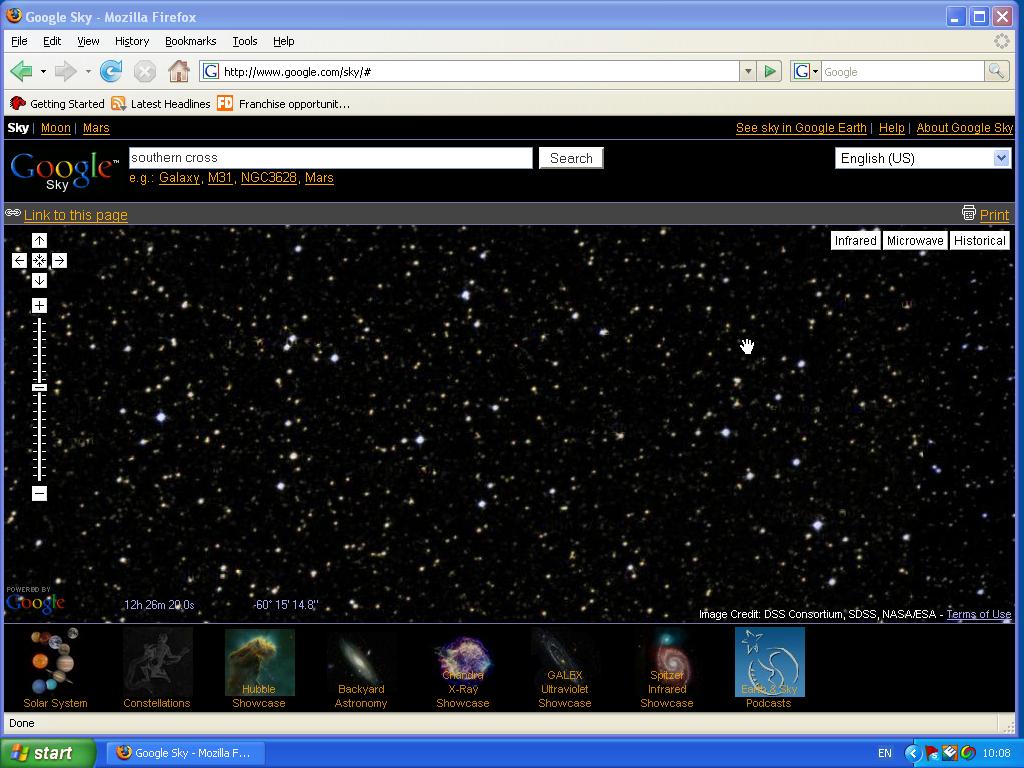
I was introduced today to Google Sky. Google Earth helps us look at the earth. Google Sky looks at the sky.

From time immemorial man has looked at the sky. The Ancients worshiped different constellations. In more recent times we believe that the Incas used the sun and the position of the planets to develop a remarkably sophisticated calendar. The Ancient Greeks also used the moon’s path around the sun to create a calendar.

I looked first for the Southern Cross – which can only be seen in the Southern Hemisphere – but points to the North South, East and West. The cross is a beautiful sight when the sky is clear.


Google Sky will transport the family to the heavens. It will stimulate speculation and wonder.

Tuesday, April 15, 2008

Eleven Plus Mentality

If your child gains entry into a grammar school then you and your child will have beaten other parents and children for a place.

In the Eleven Plus examinations some child will come first. Some children will pass and will immediately be offered a place. All the children who pass will do better than the children who do not `win a place’. Thus the Eleven Plus examinations, to a degree, are about winning and losing. The winners will gain the benefit of a grammar school education.

To come first in a county wide examination your child would have to display a multitude of attributes including ability, perseverance, desire and sheer hard work.

Matthew Webb covered himself in porpoise grease and swam from Dover to Cap Griz Nez in France – and became the first to swim the English Channel. This 21 hour swim showed great physical and mental strength.

The Soviet cosmonaut Valentina Tereshkova was the first woman in space. She orbited the earth 48 times. Valentina was the pilot of the space craft. She must have demonstrated leadership and bravery.

We also need to remember Christian Barnard who performed the first human heart transplant at Groote Schuur Hospital in Cape Town. He was dedicated and a pioneer.

William Webb Ellis also needs to be remembered because he picked up the ball and ran with it under his arm – and this is the distinctive feature of `The Rugby Game’. He must be commended for disregarding the rules.

It looks as if are going to be able to identify some characteristics that our Eleven Plus children will need to take into the examination:

Winning mentality
Good attributes of ability, perseverance, desire and hard work
Great physical and mental strength
Able to demonstrate leadership and bravery
Dedication and a pioneering spirit
A disregard for the rules

Monday, April 14, 2008

Verbal Reasoning

These Eleven Plus questions come from a 1963 book: “Essentials of Verbal Reasoning” by O.B. Gregory.

Use the letters of the word in capitals to make words which match the definitions below:

FURNITURE

The hair covering certain animals
A bird of the gull family
A melody
To move quickly on the legs
False, incorrect or unfaithful.

Each of the following pairs of definitions refers to the same word Write down what the words are:


The underneath of a part of a shoe
A flat fish

A slap
A small fishing vessel

A black substance made from tar
A piece of ground on which a game is played

A natural, flying animal
A piece of wood used for hitting a ball.

Write down the words which would complete the following analogies:


Britain is to British as Holland is to
Kilometre is to length as kilogram is to
Day is to daybreak and night is to

Arrange the following words in pairs, putting a harder word next to an easier word of a similar meaning:

Difficult, diminutive, incorrect, ancient, circular, generous, contented, intoxicated, colossal, courageous.

Old, happy, brave, round, hard, drunk, huge, small, kind, wrong.

It looks as if the thought behind verbal reasoning questions has not moved on all that much in the years between 1963 and 2008. I know that if it works don’t try to change it – but surely we have made great strides in the education and assessment over the last fifty years that there could be a case for a re-think?

Sunday, April 13, 2008

Eleven Plus Choice

I am sorry to say that at one time or another, during the course of their lives, our Eleven Plus children will need to be introduced to that very odd man called `Caesar Tiberius’. Some children may even be lucky enough to escape finding out about the horrors instigated by this strange man.

He did, however, do one good thing for our Eleven Plus children. Caesar Tiberius was told by his Doctor that he needed to eat a cucumber a day to cure an illness. He told his Head Gardner to produce a cucumber a day or else!

The gardener dug pits and then filled the pits with fermenting dung. He then covered the pits with frames or sheets of mica. Tiberius was able to survive on his `cucumber a day’

As our Eleven Plus children approach their examinations we know that they need to eat their `Five a Day’.

To help our children towards deciding that they want to `buy in to’ the concept of `Five a Day’ we need to educate them. We are lucky, however, because many of our Eleven Plus children are profoundly conscious about the need to preserve the world. Many of our children worry about the way the world works – and they like to think that one day they will be able to `Save the World’. (It is possible that some children will be a little less ambitious and simply want to be able to be a good influence.)

To give our children the ability to make reasoned choices we need to be able to give them the tools of the job. If we only offer five different types of greens and vegetables then we are restricting their choice. Some children will only want to eat locally produced `eco friendly’ food. Other children may want to be able to grow their own.

There must be some parents, however, who would want to draw the line at supplying their children with the raw material of fermenting dung. It may be easier to follow the many other Eleven Plus mothers who simply pop into a supermarket, on a daily basis, to buy a fresh daily cucumber.

Saturday, April 12, 2008

Choosing a Grammar School

If we try to look into the mind of a ten year old – and then exhort them to strive to reach a grammar school – we may need a little help. Just as children look at adults with a sense of disbelief (at times) so adults sometimes fail to understand children.

Take the choice of grammar school. Some children may enjoy the atmosphere of an old traditional building. Others will prefer the glass and solar power look. The music room in the older type school could be in the crypt of the old church. The `modern’ music room could have feeds for the school radio, recording facilities for video and the school’s podcasts.

Look now at the lunch time food. If you are lucky enough to be able to visit the school around lunch time then your child will be able to look ahead to years of school lunches. In the one canteen you could walk into the sliding smell of boiled cabbage. Your child may also comment on a pervading smell of bleach – used to try to kill the smells of cabbage and odorous mince and stale potatoes. Your much loved grammar school candidate may want to see rows of fresh green vegetables and healthy fruit smoothies. It is just a matter of choice.

Now for thoughts on after school activities. Your child may prefer the idea of the debating society and the art club. A different child would want a fifty metre swimming pool and a membership of the fencing club. Watch your child’s reactions to the different clubs on offer. After all you would prefer your child to socialise in the relative safety of the school grounds – rather than down at the local.

Finally your daughter may have her own ideas on the uniforms of the grammar school. She may like the idea of a lime green skirt and a tasty looking purple blouse. Other girls: `WOULD NOT BE SEEN DEAD IN THAT!” Quite simply the length of skirt above the knee may be enough to turn your eleven year old away from one school and into the arms of another.

Even eleven plus children are allowed to be a little irrational at times.

Friday, April 11, 2008

Eleven Plus Advice

It is always useful for your precious `Eleven Plus’ child to be given the opportunity of being able to learn from a real role model. A role model is not necessarily Uncle Bill who passed his Eleven Plus many years ago and then went on to become a successful tree surgeon. Uncle Bill may or may not tell your much loved child about how he spent a summer on the beach with the beautiful blond Summer. (A story not fit for the ears of an eleven year old.)

A more credible role model could be a Year 8 family friend. If you put your Year 5 together with a Year 8 grammar school genius you must be fully prepared for the consequences.

“What are the exams like?”

“Oh don’t worry about them. I never do any work for the exams. I didn’t do any work either for the Eleven Plus. No, just don’t think about them.”

“Do you have much homework?”

“Never – any way I do it all at school in class. I don’t have to bring homework home. None of my friends do any homework either. School is much easier than people say.”

“How you learn your French and Spanish?”


“The French teacher is never there. She is always away sick. She says that she does not like our class because we are so noisy. We don’t get any homework because she does not like marking. The Spanish teacher never talks in English. She just talks and talks we don’t know what she is talking about half the time.”

“I heard you went on a cool school trip last term.”

“Yes, but the food was terrible. It was a geography exchange. We were supposed to share with some French kids but all they did was talk to them selves. We had to eat plain croissants – and they were stale. There were no chocolate croissants, just old hard ones with horrible jam. We had no eggs and no bacon. We didn’t even have a Mac Donald the whole time because we were stuck in these little huts. They were mouldy.”

“We went on one to The Isle of Mann and had to write silly stories about the trip. Did you have to do that too?”

“Worse than that we had to write to one of the French kids – and make them a pen pal. How can you have a pen pal if you can’t even write the language? I never talked to my pen pal when I was on holiday – so I had nothing to say in my letters.”

“My dad always says that he did Latin at school – and he loved it. You do Latin don’t you?”

“The only thing I know about Latin is: “Latin is a dead language, as dead as dead can be; it killed the ancient Romans and now it’s killing me.”

“Come along dear, it is time to go. Say thank you to Trevor for telling you all about grammar school.”

Thursday, April 10, 2008

What do Eleven Plus Children Need?

It is very hard for some parents to understand the NEED some children have to be in possession of their own computers. The shared, rather elderly, family computer can not be considered as truly viable learning tool. In order to make the best possible use of the digital age, any richly deserving child has to have newest and most powerful computer possible.

It is important for parents to remember that playing games on a computer is really a sound and proven method of improving the mind. This of the skill involved in manipulating a mouse and the keyboard. Think too of the stimulation inherent in solving an adventure game. Parents need to realise that it is perfectly possible for a child to switch from an exercise involving communication with other children to getting help in solving a homework problem.

Parents only NEED to spend money to satisfy one of their child’s very real needs.

Wednesday, April 09, 2008

The Eco Friendly Eleven Plus

There must be a way to make the Eleven Plus examination a little more eco friendly.

On the day of the examination the `CANDIDATE’ has to be transported to school. This could mean a car, a bus, a tram or train. Let us keep it simple. A car needs steel, aluminium, rubber, plastics and many other chemicals. A car is going to need petrol or diesel to power it. A few parents will be able to allow their child to cycle or walk to the examination.

Even fewer parents will be able transport their child to the examination in a Toyota Prius – which is the hybrid vehicle using electricity or petrol. We have had children picked up from our lessons in cars, small buses, taxis and lorries. There has been a range of vehicles from a restored VW campervan to a brand new Bentley. I can not recall, however, ever seeing a Prius.

To obtain the petrol or diesel we need oil wells and refineries. To drive the car we need roads, land, traffic lights, pedestrian crossings and a mass of signs. When the car is old we need to crush it and then recycle as much as possible.

Bright children who have passed through good grammar schools sometimes take between eleven and thirteen GCSE examinations. A child taking eleven GCSE subjects would need to spend at least two hours on each examination. If the child did not walk to school then there would need to be eleven trips in a car to school and eleven back. It could be argued that all this driving around contributes towards ecological damage.

Thousands of children writing Eleven Plus examinations must also contribute towards any eco damage. Think of the trips in the car to ferry the candidate to extra lessons or to buy Eleven Plus books.

There is a heart warming story, however, behind all this depressing reading.

My car developed a knocking noise in the engine as we drove into today’s leisure centre to do some teaching and assessments. The AA responded with fifteen minutes. There followed a brief period of consultation and diagnosis. Thirty five minutes after my initial phone call I was delivered, by the AA, to a local car hire centre because the AA provided a three day replacement car. Within fifty minutes I was back at my car transferring `stuff’ from my car to the new car.

The new temporary car is a Ford Focus – a manual gearbox, good speakers and remarkably easy to park. This `little’ car used around half the amount of petrol that my car would have used over the homeward journey.

So thank you to the AA.
Thank you to Ford as well.

I arrived back feeling virtuous that I had helped to save the planet.

It looks as if the problem is not the children who are writing examinations but the teachers who are teaching the children who are writing the examinations. All teachers and tutors involved with the Eleven Plus may need to drive smaller cars and thus reduce their carbon foot print.

Tuesday, April 08, 2008

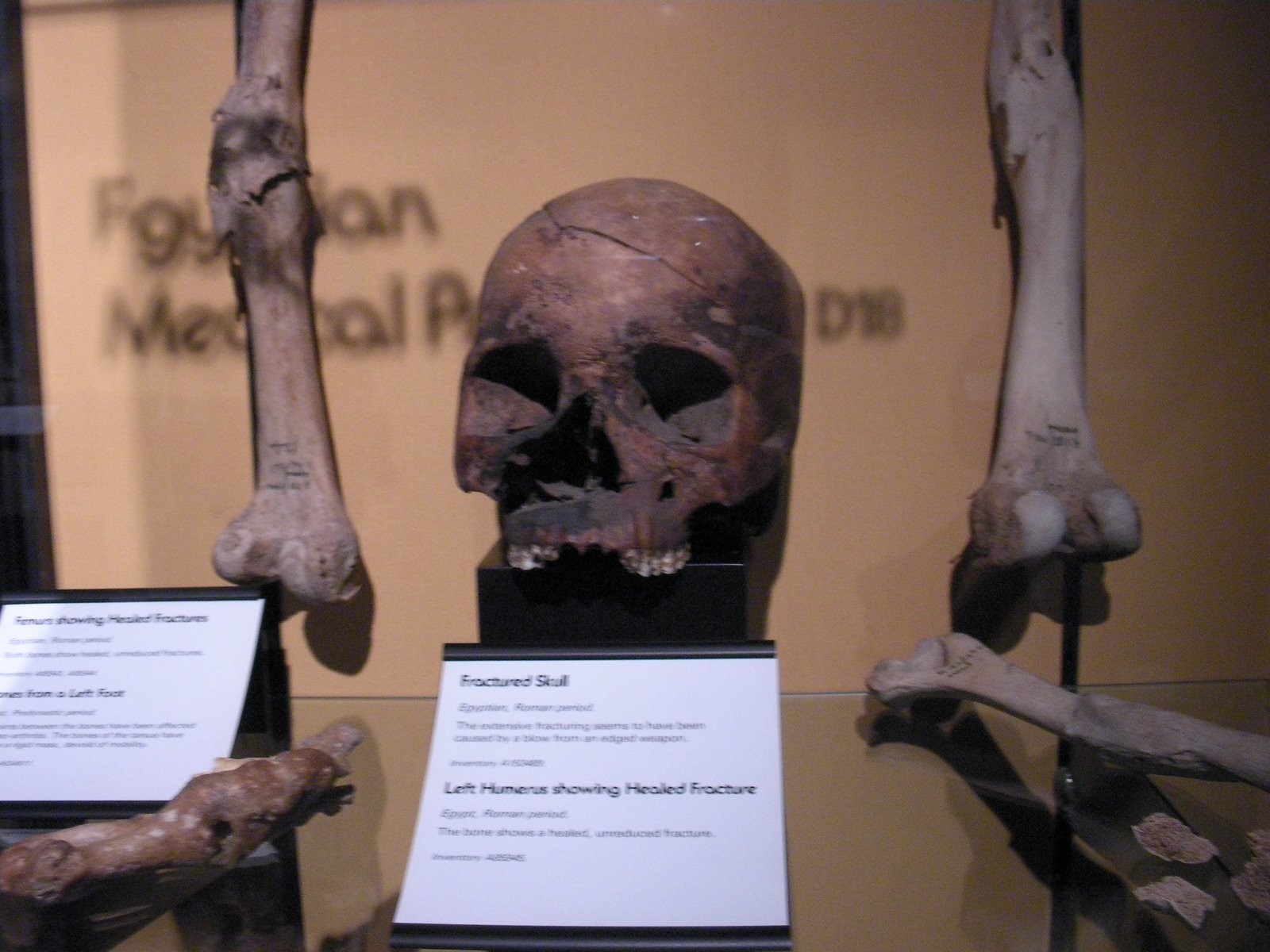
There would be no need for an outcry if a parent took his or her Eleven Plus child to the Science Museum to stand and look at this exhibit. It would be easy to initiate a discussion on how and when the skull was cracked open. The family could openly discuss if the injury to the head was caused by an accident, a crime or in battle. A full debate could take place on the type of weapon used and how hard the blow was struck.


If the same material was used in an Eleven Plus teaching aid then there could be `letters to the Editor’, complaints to the publishers and downright condemnation of the author and the Eleven Plus tutor.

The grisly image may, however, remain in the mind much longer, and make a more sustained impact, than a verbal reasoning question along the lines of:

FINGER is to H____ as T___ is to FOOT.


An Eleven Plus child should be stimulated, encouraged and enriched. Working on a boring eleven plus exercise will help your child to pass the examination. Surely your child deserves more? Perhaps as parents and teachers we need to demand that a fresh look is taken at the content of the examination.

Monday, April 07, 2008

Stimulating Eleven Plus Children

It had to happen.

It looks as if some children had some hard homework set to them over the holidays.

One question was:

In an old fashioned cuckoo clock, the bird cuckoos once at 1 o’clock, twice at 2 o’clock, 3 times at three o’clock and so on.

Jamie, who is at home sick, wakes just before 7 a.m. and goes to sleep at 8.15 p.m. How many times has the bird called during this period?

We worked out:

7 + 8 + 9 + 10 + 11 + 12 + 1 + 2 + 3 + 4 + 5 + 6 + 7 + 8.

This adds up to 93 times.

Our `bright spark’ immediately starting trying to work out how many times the cuckoo would cuckoo if it cuckooed twice during the half hour. (Apparently some cuckoos do pop out on the half hour.)

She then asked if we could add on the fact that the clock cuckooed once every quarter to and once every quarter past. The next question was: “If Jamie goes to sleep at 8.15 would she hear the clock or would she be asleep? Do we count the 8.15 cuckoo or do we leave it?”

This shows a typically divergent approach to work. Her questions were not inconsequential – she was genuinely involved. She was simply trying to take the problem to the next level.

Perhaps one day there will be more genuinely stimulating questions in the Eleven Plus examinations. Well done to the teacher at school for setting the work. We had a few minutes of pleasure in the lesson. We also were able to try to keep up with an able mind working at the speed of light!

Sunday, April 06, 2008

Eleven Plus Story

We know just how important it is to keep our Eleven Plus children fit and healthy as the examinations approach.

I took this photograph on a main road – just a few miles from the proposed Olympic Stadium.


There is an Eleven Plus story about a father who offered everything to his son if he passed the Eleven Plus. The father was a demolition contractor who specialised in pulling down old buildings. A few weeks before his firm was to blow up the old building he took his family, friends and key employees into the pool. Naturally all the family were wearing safety helmets.

The assembled guests saw dozens of alligators swimming in the pool. The guests surmised that some alligators must have escaped some years ago and made their home in the old pool.

The dad turned opened his arms and told the gathering that if anyone jumped into the water they could have anything they wanted. Everyone laughed and moved on.

Suddenly they heard a loud splash and looked around. There was the much loved son swimming for his life through the water. He swam round some alligators and dived under others. It was a magnificent feat of bravery. Some would even call it foolish.

The boy’s dad ran round to the other side of the pool and hauled his son out of the water. He threw his arms around his son, and said, with tears of relief running down his face: “Why? Why did you do that?”

His boy, with water steaming off his face, said: “Dad, please now can you give me the verbal reasoning answer book? I would do anything to work out the answer to Number 32 of Test 2 in Verbal Reasoning Book 1.”

Saturday, April 05, 2008

Eleven Plus Stars - The Week Ahead

Aries Mar 21-April 20

A good week to consider Eleven Plus Work.

Romantic Venus is in the sign and unexpected changes are due.

(Your child may fall in love with the idea of doing Eleven Plus papers.)

Taurus April 21-May21

A good week to consider Eleven Plus Work.

A new friendship may enhance your life.

Work together on Eleven Plus papers.

Verbal Reasoning will be in the ascendancy.

Gemini May 22-June21

A good week to consider Eleven Plus Work.

The new moon brings exciting changes in your social life.

Join the newly formed `Mothers for the Eleven Plus’ group.

Cancer June22-July23

A good week to consider Eleven Plus Work.

Mars is travelling through Cancer.

Use the energy to encourage your child to work as hard as possible. Concentrate on timing and reading over completed work.

Leo July24-Aug23

A good week to consider Eleven Plus Work.

You must be confident and stand your ground.

There is some possibility that the answer book is wrong – and that you are right.

If all else fails stamp your foot and say: “I suppose you are right.”

Virgo Aug24-Sept23

A good week to consider Eleven Plus Work.

Put your personal plans on hold and concentrate on the Eleven Plus.

This is a particularly good month for Non Verbal Reasoning exercises.

Libra Sept24-Oct23

A good week to consider Eleven Plus Work.

Use your Libran charm to convince your child of the need to work hard.

Use words like: “You could be right, well done.”

“You are so able. I am enjoying this work with you.”

“I can see that you have a point. I am listening to you.”


Scorpio Oct24-Nov22

A good week to consider Eleven Plus Work.

Once again don’t listen to advice from friends, colleagues or other parents,

Select the answer that you think is right and stick to it.

Take the heat out of discussion with ice cream - and start again another day.

Sagittarius Nov23-Dec21

A good week to consider Eleven Plus Work.

It is all to do with the New Moon and being creative.

A very good week to work on creative problem solving.

Capricorn Dec22-Jan20

A good week to consider Eleven Plus Work.

You should meet a new friend who will grow into an Eleven Plus partner.

Try to have lots of communication, listening and talking about feelings.

Aquarius Jan21-Feb19

A good week to consider Eleven Plus Work.

Forget about worries with money and the mortgage. Don’t worry if your credit cards are `maxed’. Just go for it!

Keep buying Eleven Plus papers.

Failing that down load as many free Eleven Plus papers as you can.


Pisces Feb20-Mar20

A good week to consider Eleven Plus Work.

This is YOUR month for a career move.

Help your children to understand their positions in life – and you go out to enjoy yourself. The New Moon will help.
Friday, April 04, 2008

Bullying and the Eleven Plus

I was buying a pint of milk today.

There was a boy and his grandmother ahead of me in the queue. The boy was between thirteen and fourteen years old. The boy wanted a particular brand of cigarettes and the grandmother was not being quick enough. His three friends were standing a few feet away mocking him for taking so long. At one stage one of the `friends’ shouted: “Hurry up grandma!”

The shop keeper was patient. She understood that the boy could not make a direct purchase. She listened to the grandmother. She took the cigarettes off the shelf at the boy’s behest. Grandmother paid – but the boy pocketed the cigarettes. His friends left with him laughing and joking. The group went off in a different direction to the grandmother.

My grandparents had a tobacco farm in Zimbabwe. They grew a tobacco called `Virginia’ because it had a light colour. The leaves were picked in the fields and taken to the barns for curing. The tobacco was `flue cured’ – meaning that it was stored in a barn and heat was gradually added. The temperature in the barn had to be kept constant for days on end as the leaf slowly turned from green to gold.

The barn was allowed to cool and the tobacco was then taken to a grading shed where the leaves were sorted into different sizes and quality.

As the tobacco leaves rubbed against each other tiny flecks of tobacco fell to the floor.

Children dived under the table sweeping up and collecting. Naturally small bits of leaf also fell to the floor at times. These were hurriedly crushed and added to the dust.

Some tobacco was passed onto the adults – but some children kept little bags of crushed leaf. I suppose that only a person who has smoked a cigarette without a filter can imagine what a cigarette rolled in newspaper could possibly taste like.

I simply can not imagine any grammar school boy or girl bullying their grandparents in such a blatant manner. For this reason alone I hope your children do pass the Eleven Plus. At least you know that they won’t want to treat their grandparents badly.

Thursday, April 03, 2008

Eleven Plus Tests

It is very difficult to be able to measure just how much a child has learnt. What a test can do is provide information in the form of a snap shot. “This is what this child ha been able to do at this moment in time.”

We can set a child objectives – and then we can try to measure to see if the child has reached the objective.

We can work out what has not been achieved – and then try to give the necessary help.

If we are teaching a child towards an Eleven Plus examination we can see just how effective our teaching is.

When parents are working from commercially available Eleven Plus papers they are pleased when their child reaches a predetermined level.

"Yes, my son, we did want you to reach 55% on this paper. Well done."

"Oh, no! You have only obtained 93%. Last time you reached 96%. You have to keep concentrating. I have told you about this before."

"If you don't reach 75% on this paper I will take your ipod, computer and your drums away. You need to try much harder this time."

Parents are setting objectives all the time. There could, however, be material in the papers that have not been covered in lessons or at school.

Thankfully very few parents set unrealistic goals for their children.


Wednesday, April 02, 2008

Eleven Plus Problem Solving

Parents working on Eleven Plus papers are often faced with the problem of how to help their child to decide on the right answer – and hence to solve problems.

At one level it is easy to explain the problem in a form of continuous prose and then encourage your child to find the right solution. In other words you talk and talk – and hope your child is listening.

Using words will not always give the easy way of helping your child to solve a problem – for example:

Steven had new pair of football boots. He did not like the colour of the laces so he exchanged his new boots with William for a game boy. William and Henry had exchanged the game boy for Henry’s new trainers. Henry had obtained the new trainers from Arthur.

A different method of helping our Eleven Plus child to solve problems is to encourage trial and error or discovery. This is where you set your child an Eleven Plus problem and expect (or hope) that your child will work out the answer by `discovering’ the correct answer.

Here your Eleven Plus child may have to come up with a vast number of solutions before finding one to suit the problem. Boredom, frustration and an `unhelpful attitude’ may creep in.

There is also the risk that at incorrect solution may be presented as the correct answer simply to be able to move on. Children need to be aware of this when tying to look at the alternatives in multiple choice answers.

A third way is to set present a series of recipe type solutions. If your child follows certain steps then you a reasonably confident that he or she will solve the problem.

The great advantage here is that your child may not need to work through every single step of the recipe to be able to emerge with the correct answer.

What is the best ending?

A party always has (ice cream, paper hats, jelly, fancy dress, and people)

Does every party have ice cream? Yes / No.

Does every party have paper hats? Yes / No.

A fourth way is set up a decision table – where you ask a series of questions and then guide your child towards a solution.

Which two letters occur least often in the word DISINTERESTED?

Look at the first letter of the word. Is it in the word again?

Now look at the second letter – the letter `I’. Is there another `I’ in the word?

We move now to the letter `S’. Are there any more `S’s in the word?

Neither you nor your child can hope to solve all Eleven Plus problems by following rules. The easier the problem the more likely that words alone will help. More complex problems may have to use a combination of methods.

Tuesday, April 01, 2008

Questions in the Eleven Plus

We have a copy of Modern Cookery Illustrated by Lydia Chatterton. There is no date on the book but it was probably produced in the 1950s. The book is a hardback – but bound in cloth. We think that the book belonged to my wife, Susan’s mother. The book traveled out to Zimbabwe, and was then brought back when our family entered England some years ago.

There is a section on electricity. Page 15: “Today the majority of housewives obtain current for cooking and other domestic tasks for three farthings and in many cases a halfpenny a unit. Under such conditions electricity ceases to be an expensive method of cooking.”

It was in these long ago days that the Eleven Plus was introduced. Today’s children would struggle to understand a halfpenny much less three farthings. Today’s families would not be able to buy electricity at such a unit price.

Electricity has moved on. So have our families. We have access to a wide selection of kitchen gadgets. Page 18: goes on to talk about refrigerators. “Refrigerators, once only heard of in mansions and hotels – are now installed as a fitment in many of the new flats and housewives who have purchased their own on the hire purchase system declare that they save more the weekly sum they cost to buy. (1s. 8d. per week, or 2s. 6d. for the larger size is more than paid for by the serving in food.)”

If we feel the need to smile at the two sections taken from the 1950s cookery book I wonder why we still allow some Eleven Plus questions that date from that era.

Today’s Eleven Plus children are computer literate. They are internet literate. They will have seen more films by the time they are eleven than some eleven year olds from the fifties will have seen in their lifetime. Some of the Eleven year olds writing this year will have traveled to Europe, America and Asia. They will have eaten meals under the mantle of an African night time. Today’s child will have more tunes on their ipods than the eleven year olds from the 50s will have been able to collect as 78 singles.

If today’s children have had so many opportunities to learn in new and exciting ways, I wonder why Eleven Plus papers still have questions like:

Beatrice was born in 1998. She has sister exactly three years older. In what year was she born?

I think we need to ask the children what they think they should be tested on. After all today’s child will have a wide variety of experiences to draw on. So we need to `turn the light out’ on the team of `experts’ who are fashioning Eleven Plus examination papers and look for `flashes of insight’ from our able ten and eleven year olds.

Monday, March 31, 2008

Eleven Plus Sensitivity

Parents spend a lot of time thinking about how to get the best out of their children.

One of the easiest ways to tackle a problem is to offer a lecture. This is where you stand and deliver. You offer your thoughts in a forthright manner. You assemble your thinking into a beginning, middle and end and then give vent to your feelings. At the end of the experience you will feel much better. Your child would, however, feel very different emotions.

A different way is to indulge in a group discussion. This could be no more than the family sitting around the table talking about an Eleven Plus problem. All concerned would be expected to participate and offer their opinion. You hope at the end of the discussion that your family would have made a joint decision for the good of the `Eleven Plus’ child. This may or may not have a lasting effect.

A third option could be brainstorming. All participants throw many different ideas around. There could be some repetition and some undue excitement. After the whole idea of brainstorming is to throw lots of balls into the air and hope that the correct answer evolves.

Some families may find that sensitivity training gets results. This is where the child is sensitive of the mother’s feelings. The child and the father learn to be sensitive of the mother’s feelings. Mother and child learn to sensitive about the father’s feelings. Both parents learn to be sensitive about their child. The whole family learn to be sensitive and caring about each other.

The problem is that a `touchy feely’ approach may not be quite a satisfying as letting out a blast of anger. Under the bravado and backchat of your ten to eleven year old could be a sweet gentle child just waiting for an opportunity to show his or her best side.

Sunday, March 30, 2008

Driving and the Eleven Plus

When you drive your child to school for the Eleven Plus examination you will want to arrive safely and on time.

If you walk your child to school for the Eleven Plus examinations you will want to arrive safely and on time.

If you cycle with your child to school …..

If you go by bus or train to your child’s school …….

At one time it was thought that walking to school was the most dangerous and the most stressful. Imagine, however, the pleasure of being able to walk with your child along a quiet path in the middle of the countryside. Let your imagination fly as you visualise a safe `school walking bus’ organised and executed by some one else’s mother!

If you have to drive the journey may offer a mass of sensory and motor pressures. It is not only the position of your seat, and the noise in the car you may have to cope with, but also the other less able drivers. Even if you have found a worthy `rat run’, so can you travel on a trouble free and traffic free journey, you will still be subjected to pressures and strains.

Your driving performance on the day of the examination will be affected by your passengers. You will worry that your `candidate’ is feeling as relaxed as possible. You will worry that you are not offering even more last minutes advice. You will think about the contents of the school bag. You will suddenly remember to remind your child that to find ten percent you have to divide by ten. Your muscles will tense up. Your back ache will increase. Your headache will force its way forward. You will show all the symptoms of car sickness. Ringing through your head will be the sorry statistic that hypertension is seven times more likely to lead to a stroke.

You still have to talk pleasantly to your child. You have to wave thanks to the crossing person. You have to ignore the ringing of your mobile phone. You can’t take your eyes off the road to see who has texted you so early in the morning.

Before you slip into the driving seat on that all important morning take a few moments to do some `Pre Eleven Plus’ exercises.

Stand beside the car, hold onto the door, and work your way through some deep knee bends.

Breathe slowly through your nose to a slow count of five.

Run on the spot for fifteen seconds.

Stretch your neck in a controlled and relaxed manner.

What you are trying to achieve is for you to be relaxed and `loose’. When you have achieved this state of `karma’, call your child to the car. Take one last deep breath. Go forth to your child’s destiny.

By the way, I am slipping this in early so you can practice before the examination.

Saturday, March 29, 2008

Eleven Plus Dreams

I had a myth shattered today. The Sea Life Aquarium at Brighton had a tank of piranhas. The modestly lit notice explained, in rather too much detail, that the piranha had had a bad press and only occasionally ate humans.

I had grown up on Boys Own stories of intrepid explorers falling out of canoes into the Amazon. I can still picture today piranhas, in a feeding frenzy, tearing the flesh off the still living body.

We enjoyed the tunnel with a glass roof – and it was possible to watch sharks swimming over head. The other plaque that caught my eye was an explanation that sharks are really gentle fish – and very seldom eat humans. Bang goes another myth.

It becomes rather easy then to destroy a myth by the simple task of exhibiting a little notice.

On the entrance to `the bed room of the candidate’ you need a series of little notices.

  • Eleven plus examinations really are quite hard.

  • When we say, `Do your best’ what we really mean is that we really do WANT you to pass.

  • We don’t really mind which school you go to, so long as you are happy.

  • If you don’t do a reasoning paper every day a shark or a piranha will get you in your dreams.

Friday, March 28, 2008

Listening to the Eleven Plus Child

Parents working with their children towards the Eleven Plus will be aware that there is sometimes a great difference between the way a child learns a new topic and that taken by an adult.

A young child is willing to learn by imitation and memorising. An older child will be more willing to question. An adult will be more inclined to try to learn by synthesising and evaluating information – and may be more inclined to accept independent study.

A child learning a new Eleven Plus topic may want to be taught by a different teaching method that used by his mother or father. (In my day we did it like this.)

Where some bright children are able to accept a rule or definition, the adult (or parent) may want to pitch in with far too much explanation and detail.

Grand parents, however, will tend to work their way through the same problem in yet another manner. The grand parent will possibly be most concerned with selecting the correct teaching strategy.

Thus three generations may have different approached to an Eleven Plus problem.

A number of Eleven Plus children will accept being told how to work on a new topic.

Parents (some) may be inclined to go on and on just a bit too much for their child to stomach.

Grand mother or grand father could spend a bit too long working out how to tackle and then explain the problem.

The Eleven Plus child should listen to the parents, the parents should listen to their parents. The parent of the parent will need to listen to the Eleven Plus child – because in their day there was no such thing as an Eleven Plus examination.

Thursday, March 27, 2008

Eleven Plus Motivation

When we are trying to motivate a child to do well in the Eleven Plus examinations we may, at times, need to encourage our child to participate fully in the learning environment.

It may be easier, in the long run, to simply ignore any great motivational speeches and pleas for co-operation and simply try help your child engage in the Eleven Plus activity.

The young men and women engaged in the Apprentice last night were all trying to win. A major motivation must have been the idea of being able to hold down a job with a six figure salary.

A very different motivation must be the idea of winning. “I am the winner. I beat everyone. I am the chosen one. Anything you can do I can do better.”

In the very first episode of this new series the women were pitted again the men. A new kind of motivation came into effect. The men, I am sure, were thinking: “They are only girls. We can beat them.”

The girls clearly were not prepared to be beaten by mere men. Many of the young women would have been little `Spice Girls’ – and so had had strong role models driving them forward.

Then we need to look at the task. The task was selling fish. The women focused on finding the best site – and then getting on with the task. The men argued and beat their chests. The women wanted to win. The men wanted to sort out a `top dog’ hierarchy.

Our Eleven Plus children will be motivated to the task of passing the Eleven Plus. Some will find the motivation within themselves. Others will need to be led and managed.

It would make fantastic gladiatorial television if a number of eleven year old had to fight off competition to win a place in a grammar school. I am not sure, however, that I would really want to watch eleven year olds adopting such a winner take all mentality.

Wednesday, March 26, 2008

Eleven Plus Inheritance

It takes a special kind of intelligence to be able to work out relationships.

Brothers and sisters have I none,
but this man's father is my father's son.

The answer, of course, is that `this man’ is the son.

Some types of Eleven Plus papers still contain gems like:

What relation is Mrs. Wilson to her daughter’s brother?

What relation is Uncle Jack to his father’s father?

What relation is Wendy Lomax to her father’s sister?

The answers are easy to some types of brain:

Mrs. Wilson is the mother.

Uncle Jack is the brother

Wendy is the niece.

Gegor Mendel would have been able to work out the answers to the questions very quickly.

Fist of all he was a monk – and later on he become the abbot.

Secondly he researched inheritance laws in peas. He was involved the laws of genetics. He used peas to work out a law of alternate generations.

This means that if Granddad or Grand mum are very bright it is likely that grandson or granddaughter are also going to be bright and able.

We know that children are made up of genes from mother and father – and so the genes of the grandparents are passed on too. If your child is likely to pass the Eleven Plus it is likely that either grand mum or granddad – or both – could also have passed the Eleven Plus if they had had the opportunity.

So as you turn to your parents to pay the Eleven Plus fees you could also turn to them with some of the `more complex’ Eleven Plus questions that simply require a little common sense.

After all:

Brothers and sisters have I none,
but this man's mother is my daughter.

"This Man’s mother" must be her granddaughter.

Tuesday, March 25, 2008

Eleven Plus Chains

Every now and then we encourage our Eleven Plus children to learn in chains. Picture the scene rows and rows of poor children all chained together learning and studying. (Little slaves to the Eleven Plus!)

It is relatively easy to learn to ride a bicycle with the stabilisers on – but it is more complex for the child when there are just two wheels. (As easy as learning to ride a bike.)

A chain is carrying out a set of instructions in a particular order. Before your child can carry out the steps of the chain you have to make sure that he or she is confident of each of the links. You could run into difficulty if one of the links was loose or poorly taught.

One type of training is called `Progressive Training’. This is where you teach a series of steps. You start with the first step and then the next and then the next.

A more familiar type of learning to most parents and adults is `Rote Learning’. This is where tables are learnt `by heart’. The child works though a number of examples and commits the method of approaching the problem to memory.

The third type is `Retrogressive Training’. This is where the chain is acquired working backwards. Anyone treading this who has worked through some Eleven Plus problems will have suggested the need to start at the end of the problem and work backwards.

Four times a number is four less than a number which is ten more than thirty. What is the number?

The advantage of solving a problem by the retrogressive method is that you can keep motivation high. It will remain a novel and interesting method of solving problems.

So when you were teaching your Eleven Plus hope to ride a bike – you may have reduced the out riggers very gradually until he or she was cycling on his or her own. The other method was simply to remove the outriggers and provide lots and lots of verbal and physical support.

If you are expecting your child to do well in the Eleven Plus examinations, and you are relying on Progressive Training, then you are setting your child up for a fall. After all if you remove one link, then you may have provided a recipe for disaster.

The problem with learning chains by rote is that chains can easily be forgotten.

In fact you are probably going to be teaching your child using a combination of all three methods.

Monday, March 24, 2008

Eleven Plus Questions

Bright children enjoy solving problems.

Some bright children enjoy solving some problems.

Do you know of any bright children who enjoy solving problems?

If at least one of the above statements is true we can set a little Eleven Plus question.

The Great Pyramid is supposed consist of 6 000 000 tons of stone. Each block weighed 2.5 tons and was cut to shape with very careful exactitude of angle and surface. Herodotus thought that it took 100 000 men around twenty years to build.

This was a tremendous feat as the blocks had to be brought down the River Nile by boat. Building the Great Pyramid must have taken a lot organisation.

The Eleven Plus questions are:

If there had been 200 000 men working on the pyramid would the task have been finished in 10 years?

If all the 100 000 men were going to work on an egg, how many eggs would be eaten each week?

Some Eleven Plus questions are a little far fetched aren’t they?

Eleven Plus Reading

Reading an Eleven Plus question requires a number of different skills. After all, reading is more simply interpreting a series of letters into sounds to make a word. We use the alphabet to write words down – and to read words – but reading is more than simply manipulating letters. To be able read effectively a child needs to be able to think and reason.

The visual analysis of patterns of letters can be done very rapidly and accurately. Some children will be able to look at the words in a sentence very quickly. Other children will read a verbal reasoning question using a word by word method.

Once the letters making up the words have been mastered and assimilated then the reader will need to be able to associate sounds with the words. This in turn will lead to comprehension of the word or words. So we look at a word, hear the sounds in the word and then understand the meaning.

A child could be faced with a question like: Which two words in the brackets make the same kind of pair as the two words at the beginning of the group?

ONE, FIRST (seven, seventeenth, seventieth, seventh)

Here the child had to read the words, understand the individual words and then work out what the question was asking. Last of all the words had to be analysed and sorted. Finally the correct solution to the question needs to be selected. After all it is no good knowing the right answer if the correct response is not selected.

A parent will ask their child to read the sentence aloud.

The words: “Slow down and read it again,” will be used by many parents.

Slowing down and reading the question aloud will be important – if the child is also reading for meaning and mastery of the question.

We can make a test more difficult by using harder and less familiar words. Parts of a test can be made demanding by choosing words from topics where the child can not be expected to have specialist knowledge.

So if Eleven Plus tests are trying to select children who are able and well read, then you really do need to try to encourage your child to read and read and read.

Saturday, March 22, 2008

Eleven Plus Food

As the Eleven Plus examinations grow nearer thoughts of parents must naturally turn towards food and immunity from any last minute problems. An attempt to change a child’s diet a few days before an examination will probably erupt into a mini battle of wills.

Very occasionally a mother or father may wake up feeling tired and irritable. If their child wakes up the same way the concerned parent would possibly first of all look at food. We know that an eleven plus child needs good food to provide energy. Parents, however, have the privilege of being able to add alcohol, sugary drinks and chocolate to the diet. It would, however, be a very sad day if parents had to give up late nights, snacks and all junk food for the duration of the Eleven Plus run in to the examination.

If a child is looking run down, a concerned parent will immediately deliver a lecture on ‘blood sugar management’. They will tell their child to eat a good blend of food – with carbohydrates being the key as they are most easily converted into glucose. A parent will then go on to confirm the need for their child to eat a balanced diet that includes proteins and fats - as these have the necessary vital nutrients. If a child is feeling stressed then he or she will need extra energy – but sweets, chocolates and canned goods will only give a temporary sugar surge. In theory nibbling on raw vegetables and fruit is an equally quick method of boosting energy – but try telling that to your stressed and hungry child.

Children attending lessons straight after school often bring food to their lessons with us. It is fascinating to see the range of foods that some children prefer. Some children will arrive with a plastic bag or bowl full of healthy `nibbles’. Other children arrive munching on chocolate bars, crisps and fizzy drinks.

When we run holiday courses that last from nine to one, we do ban chocolates and fizzy drinks. Some children appear to have problems coping with the dreaded sugar surge.

Some children may become conditioned to studying and doing Eleven Plus papers with the aid of the dreaded `junk’ food. I wonder if they do as well in the examination?

Friday, March 21, 2008

An Eleven Plus Tribute


The National Cycle Pathway Route 1 runs beside the canal that flows between Gravesend and Higham in Kent. As the crow flies this is a distance of around six miles. By bicycle, along the cycle route, the journey is possibly nearer to eight miles.

In mid summer hundreds of people cycle and walk along the path. Today I met just one intrepid cyclist. The wind was very cold.

Some volunteers have obviously been working on the route. There was no rubbish lying beside the path. (Thank you to them for their hard work.) Reeds, branches and trees had been cleared in key places.

An obelisk stood proudly in a clearing. I have been down the path many times and have never seen it before - so it was an exciting find.

I was too far away to read any inscriptions. I did wonder whose names were recorded.

Many parents would probably think it very fitting to erect a monument to the person who first thought of the Eleven Plus.

We could then applaud the opportunities that have been offered to so many children.

Thursday, March 20, 2008

Eleven Plus Boredom

The only way to stop your bright and able child telling you that he or she is bored is to try to offer an activity that will not be boring.

This is not so easy.

"I have already read a book about that."

"I have seen it on T.V."

"We have got it on DVD."

"I went there with my friend."

"I am really too old for that now, It was all right when I was six but I am eleven now. No thank you."

"Remember? We researched that on the internet last holiday."

So if you are going to survive without offering the alternative of extra Eleven Plus work then you will need to negotiate. Try to find something that will interest him or her. After all it is your Easter holiday too. All you want to do is avoid any emotional problems. Don't you?

Wednesday, March 19, 2008

Eleven Plus Help

My name is William.

My mother and father want me to pass the Eleven Plus examinations.

They keep talking about how important it is to go to Grammar School. They tell me that if I go to grammar I will probably be able to win a place at a good university. They have said that if I choose the right degree I will probably earn a lot more money. I would like to earn lots of money.

One of my friends does not want to go to grammar. He is better than me at mathematics. We are both in the top mathematics group. He says that if he goes to grammar he will have to work hard for years and years. He says that it would be much better to go to our local comprehensive, grow our hair long and make lots of money playing music.

I have another friend. His brother does go to grammar and he says that grammar is really good. He says that there are lots of sports and hundreds of different after school activities. He says that the work is all right as long as you organise your homework time.

I don’t really know what I want to do. We have an Eleven Plus group at our school – but I don’t want to go because it is on the same afternoon as football. I am a member of the academy where I am a goal keeper. I play for the district and for the county. A talent scout told my dad that he wanted to sign me last year. My mum says that going to the school’s Eleven Plus classes is very important. She likes me to play football but she wants me to go to grammar. She says that they will be more opportunities later in life.

My older sister goes to grammar and she comes home and does her homework. She never talks to us about what she does – she just goes to her bedroom and comes down for her meals. She does not have a TV in her room so I don’t know what she does. I know I don’t want to have to work as hard as that.

The trouble is that I like doing verbal and non verbal papers when I do settle down to do them. I can do the codes exercises very quickly. I find the Eleven Plus mathematics questions on paper very easy. I get stuck sometimes but I can usually work them out myself. My mother asks my sister to help me but she says: “I passed without any help, so why should I help you.” She does help sometimes but only when she is in a good mood with me.

I know that I should go but I just don’t like to work every single moment of my life.

Please help.

William

Tuesday, March 18, 2008

Eleven Plus Appeal

I heard a story yesterday. I am not quite sure where it will end – but it looks as if it could turn out to be an on going saga.

A young mother had a kidney transplant in early January of this year. She had been ill for some years. Luckily she was offered a new kidney from a suitable donor. You will have guessed it by now – the donor was her sixty year old mother.

Both women are not very well at the moment. The new kidney has worked but not quite as well as could be hoped.

There are two children in the family. The boy is aged four and the girl has just turned ten. The girl has been doing very well at school. She is not doing any extra work towards the Eleven Plus examinations, at the moment, because of all the turmoil in the family. It can not be easy for the children to have their mother so ill.

The dad walked out on his family towards the end of January. He explained, I understand, that he could not take the pressure any more and needed some space.

He has the children one day a week – and had them as usual on Wednesday of last week. Last Friday the mother telephoned him to say that she was not feeling well and would have to go back into hospital for some checks over the weekend. She told him that her mother was also `not too good’ at the moment and simply could not manage to look after the children. He was asked if he could help.

Dad explained that he was off to Ireland for the weekend with his mates and could not change his arrangements. He would be letting his friends down.

So when is the ten year old girl going to find time to do her Eleven Plus preparation? How will an appeal panel react to the mother if the little girl does not pass her Eleven Plus examination? Will the appeal panel take any of the `circumstances’ into account?

How will the little boy ever learn to read with all the upset in his family?

Is it really fair to ask both children to be `brave and understanding’?

Monday, March 17, 2008

Eleven Plus Discussions

I had a chat with a mother over the weekend. One of the topics that came up was about relationships between eleven year old boys and girls.

The mother had an eleven year old daughter who wanted to date an eleven year old boy. Simple things like visits to the cinema, going to a swimming pool and going shopping. (It is clear who the `strong’ figure was in this budding relationship. I can’t imagine many eleven plus boys actually choosing to go shopping without some considerable inducement.)

It is obviously impossible to generalise about a particular set of circumstances because we know so little about the personalities and relative maturity of the two youngsters. One thing for certain is we can not underestimate the emotions that had been unleashed once they recognised the mutual attraction.

They only thing I could think of was to suggest some form of a plan that could serve for the moment – and for the years ahead.

1. Acknowledge the depth of feeling. It will be no good trying to say: “You are just too young.” After all you just need to remember back to when you were in your teens or approaching your teens.

2. Work out a method of explaining that boys and girls can be friends before they `go steady’.

3. Welcome the other child into your home – and include both children in family outings.

4. Talk to the other set of parents – communication is the key here.


The very last thing you want to do is to fight with your children before an Eleven Plus examination.

Sunday, March 16, 2008

Eleven Plus and Languages


Children learn about the Egyptians at home.

Children also learn about the Egyptians at school.

Some children travel to Egypt and learn all about the Ancient Egyptians through seeing the real pyramids and artefacts.

Other children read about the Egyptians in books.

Some have the opportunity of being able to visit the British Museum.


We went there today. It was a wet and cold day. It was crowded. I have been through the Egypt sections on days when there were many fewer people.

On every exhibit families from all over the world were discussing the Egyptians. I have no idea of how many tongues were spoken. Naturally some parents were reading and translating for their children – but many children seemed to be able to read English. They held animated discussions with their parents in a mixture of their home languages and English. I was struck again and again by the rapt attention and the laughter.

What a tremendous fillip it would offer to language teaching if children writing Eleven Plus examinations had to offer a language. Think of the effort and attention that parents would put into ensuring that their children could read and speak another language.

We have heard that there are fewer children choosing to `do languages’ at school. Think of the impact on the language department of a grammar school if each intake had children reading and writing a second language.

Saturday, March 15, 2008

Managing the Eleven Plus

I was asked today the perennial question: “What can I do to help my child?”

Now mothers are traditionally the real managers of the family. It is mum who makes the decisions about children, food, dogs, walks, school, drinks and the Eleven Plus. Mothers have to work in a dual function. They have to be able to manage – but they also have to be able to do the actual work as well.

Mangers perform the functions of planning, organising, leading and controlling.

Planning

When a mother plans an attack on the `Eleven Plus’ she brings into play the ability to call on a vast sisterhood. Planning includes the key tasks of communication and collecting information. When all the facts have been gathered `mother’ sets out the objectives.

Organising

This is where the mother organises and `sorts out’ all the family’s resources. She has to take into account such diverse functions as transport, food, relationships and control.

Leading

This is the work a mother does to motivate, encourage and inspire not only her Eleven Plus child – but also the rest of the family. After all it is `mother’ who has to have full confidence in her child.

Controlling

This is where a mother sets out to make key decisions about the course of the Eleven Plus saga. She alters, adjusts and plots the events leading up to the examination. On an hour by hour basis she reassesses and alters her plans.

When the results are out she will be able to take quiet pride in the fact that a grammar school place has been secured.

Friday, March 14, 2008

Eleven Plus Assumptions

We need to make some assumptions about children writing Eleven Plus examinations.

Assumption One

A true Eleven Plus child probably does not really need to be taught how to work through much of a verbal reasoning paper. The good Eleven Plus child can probably work out the answer given enough time. As teachers and parents we tend to jump in and supply the answer instead of drawing the answer out.

Assumption Two

That children will be motivated to learn in their own way and in their own time. Exhorting your child to work hard may be counter productive.

Assumption Three

Your child will always believe that he or she is behaving logically and sensibly. He or she will think that YOU are away with the fairies.

So remember the words of the famous proverb:

When the child tackles the verbal reasoning paper, reason flies out of the window.

Thursday, March 13, 2008

Eleven Plus Speeches

You are out with family and friends celebrating your son or daughter passing the Eleven Plus. At some stage of the evening you decide that you would like to make a little speech.

Your brother, however, reminds you of the little speech you made when you were his best man. As you are rising to your feel he reminds everyone how you nearly pulled off a speech to the bride and groom – and how you landed up a little mixed up.

This is a family occasion. You need the speech to say good things about your son or daughter. You need to be able to make a few jokes – that take into account the children that are present. You need to be able to speak up and sit down.

It is essential that you do not speak too long about any one topic. A long and involved story about a largely forgotten `funny’ incident involving your child may only make your audience crumple with embarrassment. You child too could be scarred for life by the unfunny revelations.

If you are going to make a very short joke take into account the range of people who will be listening. If you forget to mention the contribution of grand dad who actually paid the Eleven Plus fees you could offend him. You will need to mention your sister who once had to collect your child from an extra lesson because you were stuck in traffic. You will need to recall the moment when you realised that you could not do a question set in a mere Eleven Plus paper – and that you needed help.

And finally you need to pay tribute to the work that your child has put into the examination. After all if it wasn’t for him or her you would not be on your feet at all.

Wednesday, March 12, 2008

Eleven Plus English

In one sense the word `got’ is the past tense of the word get.

If we say that a child has got nice eyes we don’t really mean that the child has somehow acquired good looking eyes.

It is obviously school teachers who try to stop school children using the word `got’. Some parents also hate the idea of seeing the word `got’ on the page.

So if your child used `got’ in an Eleven Plus examination would he or she need to be penalised?

Edward Lear has entertained adults and children alike for many years. He introduced new words and some of these have become part of our daily life.

“On the Coast of Coromandel
Where the early pumpkins blow,
In the middle of the woods
Lived the Yonghy-Bonghy-Bo.

So if your child alluded to the Yonghy-Bonghy-Bo in an Eleven Plus essay, your average English examiner would immediately recognise the source – and be able to identify the poet.

We may know a lot about words and how they are used but would find it very difficult to be able to write words that many people can identify with. Even worse for some children is that they could pass an English examination by mastering a set of skills yet fail the same examination because they have not absorbed and understood a body of information.

We tell children to read to extend their vocabulary and their ability to think and to reason. We hope that our children will become absorbed in the book and become involved in the characters and the plot. We hope that some stories will evoke an emotional response. Some child will argue that reading simply provokes boredom. So we need to encourage the Eleven Plus child to read as widely as possible – including magazines, newspapers, magazines, novels, reference books and poetry.

We hope that by wide reading our children will be stimulated to write a wide range of English. Some writing could be in the form of a story, while others may choose to write poetry.

But encourage your child to discuss the Yonghy-Bonghy-Bo and explain that the word got can be used when nothing else is available or relevant.

Tuesday, March 11, 2008

Eleven Plus Logic

We think that it was Napoleon who stated that: “An army marches on its stomach.” He was referring to the simply logistics of getting the supplies and the food to the right place at the right time.


Every single mother in the world does not need to be told that a family operates on its stomach. Every mother has to make a trip to the supermarket – or even the local grocer -on a regular basis. The staple items of a shop include food – bread (some) and all the dairy products like butter, milk and cheese.

The Nomads of yesteryear knew that if a food was dried it was easier to carry. Milk could be partially dried by being left in a shallow container to evaporate in the sun. Cheese was possibly made when milk was carried in the bags made out of the stomach of animals. The milk slowly turned into curds and then to what we call cheese today.

Back in Ancient Greece the wrestlers had to include cheese in their diet.

The Roman legions used to carry cheese when they went on their long marches.

Monks in the Middle Ages ate cheese – presumably to help to keep themselves healthy.

Most children will eat cheese at one time or another in their lives. Sometimes the cheese has to be disguised!

In Bluewater in Kent, last Christmas, there is an account of a conversation that went:

“One hamburger, with cheese please.”

“Do you mean a cheeseburger?”

“No, I want a hamburger with cheese.”

“That’s a cheeseburger.”

“No, I want a hamburger with cheese.”

This conversation was stencilled in letters a foot high on the boarding around an unoccupied shop.

So parents looking for a balanced diet for their children need look no further than cheese.

If your child eats cheese he or she will be able to wrestle with problems.

If your child eats cheese he or she will be able to demonstrate great endurance.

If your child eats cheese he or she will become pure in their intentions towards the examination.

Finally, if your child eats cheese you may be less prone to some of the silly conversations that some Eleven Plus children are want to engross themselves in.

“I will start on my Eleven Plus paper as soon as I have finished this.”

“No you agreed that you would start as soon as you arrived home from school.”

“Yes I know, but, I will start on my Eleven Plus paper as soon as I have finished this.”

“That is not fair. You can wipe that cheesy grin off your face. You said that you would start as soon you got home from school.”

What ever valid reasons you can offer to your child for eating the right food and working on time the logic of a bright ten year old is sometimes baffling.

Monday, March 10, 2008

Inspiring the Eleven Plus Child

The great writer Jack Kerouac helped to inspire the beat generation over fifty years ago. He wrote a book called `On The Road’ about a trip across America. I must confess this book inspired me to hitch hike from London to my home back in Rhodesia (Zimbabwe).

There is a passage in `On The Road’ that covers what every parent must wish for their child – the ability to get focused, excited and stimulated about the approaching Eleven Plus examinations.

"The only people for me are the mad ones, the ones who are mad to live, mad to talk, mad to be saved, desirous of everything at the same time, the ones who never yawn or say a commonplace thing, but burn, burn, burn.”

If only you could find some way of helping your child adopt a burning passion to concentrate while he or she is working through an Eleven Plus paper with you at home.

You must dream of a child who never feels tired or yawns while he or she is working on a paper.

You must pray for a child who desires the pass the examination with the same fervor that consumes you.

You must want a child who will give evidence of passion when the topic of the Eleven Plus and grammar schools comes up.

But if your child is laid back and relaxed about the whole experience then you too can try not to be too obsessed. After all if you let the Eleven Plus wind you up too much you will simply become rather mad, mad mad! (To paraphrase Jack Kerouac.)

Sunday, March 09, 2008

Eleven Plus Levels

From the 18th century up to the 1920s privately owned British provincial banks circulated their own notes. This meant that if you owned a bank you could design and print your own bank notes. In today’s world many of us would like to own a bank. The only problem is that Britain is subject to periodic financial crises.

The ability to print your own money must, however, still be very appealing. You simply need a good design package, a computer and a versatile printer. You could have your own likeness on one side, your own numbering system and your own batch of security measures. If you ran short of money all you would have to do is print a few more notes.

I don’t think that it would take very long for some enterprising parents to start designing their own Eleven Plus papers. If your child was very good at mathematics you could weight papers to work on the type of examples your child was good at. Suppose that he or she was good at Shape and Space – then you could add rotations and tessellations to your heart’s content.

Just think of the different non verbal reasoning papers you could build with all sorts of bendy lines and challenging examples.

It would be even easier to develop a range of verbal reasoning questions that suited you and your child. Easy money!

There could be a slight problem in having your papers ratified by the authorities. The pass mark you chose for your child may not be the same pass mark required by the authorities. Nothing much has changed has it?