I am very fortunate to have a copy of `Essential of Verbal Reasoning’ by O.B. Gregory. This was first published in 1963. Exercise 1 starts:
Write down the word which should be next in line. Choose your answer from the words in brackets:
Triangle, rectangle, pentagon (square, octagon, hexagon)
Find one word which is unlike the others:
Alter, regulate, adjust, modify, replace
In each line two words are opposite in meaning. Find the words:
Quality, right, success, mistake, error, failure
Find the words that complete the analogies:
Doom is to mood as (Ward, Matron, Plum) is to (Nurse, Lump, Draw)
I like to look at this book occasionally – and I often think about the teachers and psychologists who are making all the `New’ Eleven plus tests and papers. I wonder how many of them think about O.B. Gregory.
I did a search on Google for `O.B. Gregory’ – and there was a copy of the book for sale for 1p on Amazon.
So if you want to find out what Verbal Reasoning was like in the `old’ days then there is a copy on Amazon.
For those of you who are nostalgic – and would like to see what the questions were like in the days when you did the Eleven Plus – there is a copy on Amazon for just 1p.
Look back with Pride!
Friday, November 30, 2007

Thursday, November 29, 2007
The Style of An Eleven Plus Child
How would you set out to develop a business selling jewellery? I suppose first of all you would have to like jewels. Then you need to look at who is going to buy your jewels.
You may be the sort of person who saves up until you can buy a `big’ jewel and thus make a `big’ profit so that you can become a `big’ player in the market.
Equally you may chose to start small and display and sell a range of affordable jewels. You would then go onto challenging the `big’ boys when you have built a firm base.
I looked a hand made ring on paulwrightjewellery.com and thought about the range of attitudes that parents will display towards themselves and their children. The children too will attack their work in different ways.
We will have a large number of Eleven Plus children passing through our hands this year. I wonder just how many would start small and how many would try for the big jewellery sale straight away.
What makes a child who will gamble on a multiple choice question – while another child will try to work it out?
Why will some children be prepared to show all their thinking and working out while other children persist in doing everything in their head?
Why will some children settle down to their work without a word and others will try to argue and `discuss’ everything – down to the last detail?
Why will some parents just want their children to do their best while other parents will try anything to help their children pass the examination?
Why will some people try to make and sell a hand made ring and others want something `from the shop'?
As long as you and your child are happy with the Eleven Plus work then you must be prepared for a range of emotions, language and desires.
You may be the sort of person who saves up until you can buy a `big’ jewel and thus make a `big’ profit so that you can become a `big’ player in the market.
Equally you may chose to start small and display and sell a range of affordable jewels. You would then go onto challenging the `big’ boys when you have built a firm base.
I looked a hand made ring on paulwrightjewellery.com and thought about the range of attitudes that parents will display towards themselves and their children. The children too will attack their work in different ways.
We will have a large number of Eleven Plus children passing through our hands this year. I wonder just how many would start small and how many would try for the big jewellery sale straight away.
What makes a child who will gamble on a multiple choice question – while another child will try to work it out?
Why will some children be prepared to show all their thinking and working out while other children persist in doing everything in their head?
Why will some children settle down to their work without a word and others will try to argue and `discuss’ everything – down to the last detail?
Why will some parents just want their children to do their best while other parents will try anything to help their children pass the examination?
Why will some people try to make and sell a hand made ring and others want something `from the shop'?
As long as you and your child are happy with the Eleven Plus work then you must be prepared for a range of emotions, language and desires.
Wednesday, November 28, 2007
Two Eleven Plus Answers
Holding on for call centres is one of the most frustrating experiences available to us as human beings.
“Thank you for your patience. Your call is moving up the queue. Please continue to hold.”
Ring ring.
Ring ring.
“Thank you for your patience. Your call is moving up the queue. Please continue to hold.”
Ring ring.
Ring ring.
It would easier to control our emotions if we knew just how long the queue was.
I wonder if our ten year old children have exactly the same feeling as they wait for us to solve a verbal reasoning or a non verbal reasoning question.
We use very able `A’ level students as assistant teachers in our centres. They bring intelligence and vitality to the lessons. One of our very bright assistants, with excellent GCSE results including ten `A’ stars, two `A’s and a `B’, was puzzling over a question for some time. The question came from a standard and highly reputable source. The answers were available – and were open on the table.
We all stopped and watched. It was one of those moments caught in time. An extraordinarily intelligent seventeen year assistant struggling with a mere Eleven Plus question!
Was there a problem with the answer book?
Was the question phrased in such a manner that an answer was impossible?
Naturally we were drawn like magnets to the source of the problem. We now had assistants with A’ level special subjects covering all the mathematics and science subjects as well as art, psychology, history and economics.
There was enough energy in that room to have made a lot of things happen!
I look down at our smiling pupil. There was no evidence of frustration. She was enjoying the moment! After all I am sure we would all like to be fussed over at one time or another.
One by one the other assistants and then the teacher in charge wandered away leaving just the three of us looking at the question. A girl sitting at another desk whispered to me: “I know how to do it. I did that paper a few weeks ago. Questions like that are really easy. Look …”
In two sentences she explained the solution. There were in fact two answers. The answer book was correct but did not show both answers.
So the next time you try to access a call centre and you hear those dreaded words:
“Thank you for your patience. Your call is moving up the queue. Please continue to hold.”
Try not to feel too frustrated - just take your anger out on a poor and unsuspecting Eleven Plus reasoning question. (Where there are two answers!)
“Thank you for your patience. Your call is moving up the queue. Please continue to hold.”
Ring ring.
Ring ring.
“Thank you for your patience. Your call is moving up the queue. Please continue to hold.”
Ring ring.
Ring ring.
It would easier to control our emotions if we knew just how long the queue was.
I wonder if our ten year old children have exactly the same feeling as they wait for us to solve a verbal reasoning or a non verbal reasoning question.
We use very able `A’ level students as assistant teachers in our centres. They bring intelligence and vitality to the lessons. One of our very bright assistants, with excellent GCSE results including ten `A’ stars, two `A’s and a `B’, was puzzling over a question for some time. The question came from a standard and highly reputable source. The answers were available – and were open on the table.
We all stopped and watched. It was one of those moments caught in time. An extraordinarily intelligent seventeen year assistant struggling with a mere Eleven Plus question!
Was there a problem with the answer book?
Was the question phrased in such a manner that an answer was impossible?
Naturally we were drawn like magnets to the source of the problem. We now had assistants with A’ level special subjects covering all the mathematics and science subjects as well as art, psychology, history and economics.
There was enough energy in that room to have made a lot of things happen!
I look down at our smiling pupil. There was no evidence of frustration. She was enjoying the moment! After all I am sure we would all like to be fussed over at one time or another.
One by one the other assistants and then the teacher in charge wandered away leaving just the three of us looking at the question. A girl sitting at another desk whispered to me: “I know how to do it. I did that paper a few weeks ago. Questions like that are really easy. Look …”
In two sentences she explained the solution. There were in fact two answers. The answer book was correct but did not show both answers.
So the next time you try to access a call centre and you hear those dreaded words:
“Thank you for your patience. Your call is moving up the queue. Please continue to hold.”
Try not to feel too frustrated - just take your anger out on a poor and unsuspecting Eleven Plus reasoning question. (Where there are two answers!)
Tuesday, November 27, 2007
Multiple Choice Questions
Some Eleven Plus children appear to hate doing multiple choice tests. But some Eleven Plus examiners prefer setting multiple choice tests because:
• They are easy to mark. The choices are often a matter of choosing between A B C D or E.
• They can be marked by a computer.
• The numbers can be added up the computer.
• The computer can prepare the list of results in order.
Other Eleven Plus tests are set by an examiner who wants to look at how problems are solved. The examiner would be looking for a `good’ answer.
The person who sets the question, however, is going to be aware that there are many variables than can affect the result.
When the marker has to mark a large number of tests a number of factors can affect the result:
• Fatigue on the part of the examiner
• An unbalanced marking of what is `good’. This could be where some questions can be marked down simply because of the repetitive nature of the answers.
Suppose more than one marker is involved then these variables can be multiplied by the number of people involved.
But occasionally your Eleven Plus child could be variable – hence the remark:: “Oh, it just depends on how he is on the day!”
So what the Eleven Plus examiner has to do is try to devise a test where the marking of the test and the test itself is perfectly reliable. So then if your child did not do as well as expected then you could attribute any fluctuations to the performance of your child `on the day’.
So if a test is set for four thousand or even seven thousand children it is lot easier to prepare a multiple choice test. Your role, therefore, is to suggest to your child the advantages of doing multiple choice questions
• They are easy to mark. The choices are often a matter of choosing between A B C D or E.
• They can be marked by a computer.
• The numbers can be added up the computer.
• The computer can prepare the list of results in order.
Other Eleven Plus tests are set by an examiner who wants to look at how problems are solved. The examiner would be looking for a `good’ answer.
The person who sets the question, however, is going to be aware that there are many variables than can affect the result.
When the marker has to mark a large number of tests a number of factors can affect the result:
• Fatigue on the part of the examiner
• An unbalanced marking of what is `good’. This could be where some questions can be marked down simply because of the repetitive nature of the answers.
Suppose more than one marker is involved then these variables can be multiplied by the number of people involved.
But occasionally your Eleven Plus child could be variable – hence the remark:: “Oh, it just depends on how he is on the day!”
So what the Eleven Plus examiner has to do is try to devise a test where the marking of the test and the test itself is perfectly reliable. So then if your child did not do as well as expected then you could attribute any fluctuations to the performance of your child `on the day’.
So if a test is set for four thousand or even seven thousand children it is lot easier to prepare a multiple choice test. Your role, therefore, is to suggest to your child the advantages of doing multiple choice questions
Monday, November 26, 2007
Uniform Eleven Plus Progress
Parents have children who grow. Sometimes the growth is slow and steady. At other times the growth is phenomenally fast and your child can grow out a school uniform in a remarkably short time.
Parents do need to know:
Where the uniform comes from
Who makes the uniform?
The condition the uniforms are made in
The quality of the uniform
If large multinationals sell them at a loss
So as a parent you want to know that the uniform is affordable and widely available. You want some choice in the matter. After all if you have to replace the uniform after a growing spurt then you want to hope that the uniform lasts as long as possible.
Children learning specialist techniques towards Eleven Plus examinations also progress in a similar manner.
Some children will progress in a steady manner – lesson by lessons.
Other children will appear to making little progress – and then the `penny will drop’.
Other children will just sprint ahead after a few papers and will start showing their full potential at school and at home almost immediately.
The good thing is that most children will show a bit of all three of the above learning patterns at some time or another in the period of eleven plus preparation. There will be some steady progress, at times it will be slow going while at other times your child will be able to demonstrate his or her full potential.
For parents the trick is not to show too much concern at any of the stages.
After all you can not expect `uniform’ progress.
Parents do need to know:
Where the uniform comes from
Who makes the uniform?
The condition the uniforms are made in
The quality of the uniform
If large multinationals sell them at a loss
So as a parent you want to know that the uniform is affordable and widely available. You want some choice in the matter. After all if you have to replace the uniform after a growing spurt then you want to hope that the uniform lasts as long as possible.
Children learning specialist techniques towards Eleven Plus examinations also progress in a similar manner.
Some children will progress in a steady manner – lesson by lessons.
Other children will appear to making little progress – and then the `penny will drop’.
Other children will just sprint ahead after a few papers and will start showing their full potential at school and at home almost immediately.
The good thing is that most children will show a bit of all three of the above learning patterns at some time or another in the period of eleven plus preparation. There will be some steady progress, at times it will be slow going while at other times your child will be able to demonstrate his or her full potential.
For parents the trick is not to show too much concern at any of the stages.
After all you can not expect `uniform’ progress.
Sunday, November 25, 2007
Eleven Plus Stress
It is extraordinary how the wheel turns a full circle in life. We have to think back to the ancient Greek physicians Hippocrates and Galen who believed that there were four personality types:
Sanguine or happy
Melancholic or sad
Choleric or angry
Phlegmatic or listless
Each personality type was though to be an excess of a particular humour or body fluid:
Blood
Black bile
Yellow bile
Phlegm
The humours were related to the four elements:
Fire or blood
Earth or black bile
Air or yellow bile
Water of phlegm
So as your Eleven Plus child approaches the examination you will experience each of the personality types. These days we don’t go much for blood letting to release the `humour’. We tend to use more positive methods.
Encourage your child to mentally rehearse conversations. Suggest to your child that he or she does not use language like: “You always make me do Eleven Plus papers. I am sick of them.”
You will need to explain to your child what language to use:
“Mother, I value my free time and would appreciate it if we could arrange to do the Eleven Plus paper at another time.”
Explain to your child the need to try to avoid apportioning blame. Give your child the language tools to be able to solve a problem without it becoming confrontation.
So as your child drifts from being happy to sad and angry to listless try to make sure that as little bile and confrontation as possible flows around the discussions.
You see in the Hippocratic Oath a doctor has to swear not to divulge anything a patient says to him or her. So if you child occasionally `blows his top’ and comes out with some rather vile and full of bile – then hold it in and don’t repeat the ensuing conversation to anyone. And to try to see if your child can walk away saying:
“Mother, that was a positive experience. Thank you for being so patient. I am sorry I used words like that. We really can work together towards the eleven plus.”
Sanguine or happy
Melancholic or sad
Choleric or angry
Phlegmatic or listless
Each personality type was though to be an excess of a particular humour or body fluid:
Blood
Black bile
Yellow bile
Phlegm
The humours were related to the four elements:
Fire or blood
Earth or black bile
Air or yellow bile
Water of phlegm
So as your Eleven Plus child approaches the examination you will experience each of the personality types. These days we don’t go much for blood letting to release the `humour’. We tend to use more positive methods.
Encourage your child to mentally rehearse conversations. Suggest to your child that he or she does not use language like: “You always make me do Eleven Plus papers. I am sick of them.”
You will need to explain to your child what language to use:
“Mother, I value my free time and would appreciate it if we could arrange to do the Eleven Plus paper at another time.”
Explain to your child the need to try to avoid apportioning blame. Give your child the language tools to be able to solve a problem without it becoming confrontation.
So as your child drifts from being happy to sad and angry to listless try to make sure that as little bile and confrontation as possible flows around the discussions.
You see in the Hippocratic Oath a doctor has to swear not to divulge anything a patient says to him or her. So if you child occasionally `blows his top’ and comes out with some rather vile and full of bile – then hold it in and don’t repeat the ensuing conversation to anyone. And to try to see if your child can walk away saying:
“Mother, that was a positive experience. Thank you for being so patient. I am sorry I used words like that. We really can work together towards the eleven plus.”
Saturday, November 24, 2007
Investors in People
We display the `Investors in People’ logo when ever possible.
The standard is simply a business improvement tool designed to advance the performance of an organisation through its people.
Before we embraced and committed to the Investors in People mantra we had our own systems for training and developing our people. Teachers and assistant teachers had teaching notes. Our administrative staff had guidelines on how to use the computer systems, the telephone and how to communicate with the public – our customers. We had a business plan and a vision of the future.
Investors in People enabled us to have a tool that allowed us to benchmark ourselves against other organisations – or all sizes and sectors. Like any living business organisation Etc needs to be profitable, we need to be able to develop and people who work with us and we need to be able to retain as many of our good teachers and assistants as possible.
Naturally our first consideration has to be customer satisfaction. We have to make sure that any changes that are made culminate in better lessons. We need to make sure that parents, who had to pay the bill, are pleased and feel that they are going to obtain value for money.
So what Investors in People has meant for us is an attempt to achieve a culture where we don’t try to criticize and blame but we encourage innovation and a positive outlook.
In all our dealing with our assistants and teachers we have tried to achieve that complex balance of trying to support and assist as well as empowering them to make decisions that will help the children in their care to improve their performance at school and at home.
It is vital that we attract good teachers and assistant and give them the tools and the backup to allow them to interact with parents and children. We will get better Eleven Plus results if we teach better than other teachers.
We test children before they start lessons so that parents know where their child is starting. Lessons are prepared by etcACTION – our bespoke computer system. We provide Eleven Plus courses for children. For some parents we are able to provide an almost complete package. To achieve this we need people. So many thanks to all the teachers and assistants that have worked for us, are working for us now and will work for us in the future. We owe you so much.
Please email me on shaun@extratuition.com or call me on 01474 321658 if you would like to comment.
Look too at the www.investorsinpeople.co.uk for further information.
The standard is simply a business improvement tool designed to advance the performance of an organisation through its people.
Before we embraced and committed to the Investors in People mantra we had our own systems for training and developing our people. Teachers and assistant teachers had teaching notes. Our administrative staff had guidelines on how to use the computer systems, the telephone and how to communicate with the public – our customers. We had a business plan and a vision of the future.
Investors in People enabled us to have a tool that allowed us to benchmark ourselves against other organisations – or all sizes and sectors. Like any living business organisation Etc needs to be profitable, we need to be able to develop and people who work with us and we need to be able to retain as many of our good teachers and assistants as possible.
Naturally our first consideration has to be customer satisfaction. We have to make sure that any changes that are made culminate in better lessons. We need to make sure that parents, who had to pay the bill, are pleased and feel that they are going to obtain value for money.
So what Investors in People has meant for us is an attempt to achieve a culture where we don’t try to criticize and blame but we encourage innovation and a positive outlook.
In all our dealing with our assistants and teachers we have tried to achieve that complex balance of trying to support and assist as well as empowering them to make decisions that will help the children in their care to improve their performance at school and at home.
It is vital that we attract good teachers and assistant and give them the tools and the backup to allow them to interact with parents and children. We will get better Eleven Plus results if we teach better than other teachers.
We test children before they start lessons so that parents know where their child is starting. Lessons are prepared by etcACTION – our bespoke computer system. We provide Eleven Plus courses for children. For some parents we are able to provide an almost complete package. To achieve this we need people. So many thanks to all the teachers and assistants that have worked for us, are working for us now and will work for us in the future. We owe you so much.
Please email me on shaun@extratuition.com or call me on 01474 321658 if you would like to comment.
Look too at the www.investorsinpeople.co.uk for further information.
Friday, November 23, 2007
Wise Eleven Plus Choices
I was watching a very able girl today work through some multiple choice verbal reasoning exercises.
She not only answered the question but justified her answers to herself as she went a long. She worked with humour and was totally absorbed in her studies.
She reached a section on analogies and while she contemplated the right answer I was reminded of Solomon. He was a very wise man. His wisdom was known all over the known world.
People came from all over to enjoy his wisdom. He was not averse to making challenging judgements.
Two women both claimed to be the mother of a certain child. They asked Solomon to decide which the real mother was.
Solomon ordered the child to be cut into two halves, each mother keeping one.
One woman agreed to the plan.
The other woman did not – she announced that she was not the real mother so that the child would live.
Solomon awarded her the child
So the next time you despair of your child every getting over 95% on a Verbal Reasoning paper think back to Solomon and the wise mother.
Surely you would rather have a pleasant and unstressed child than one under pressure to do well academically?
The girl I referred to earlier revelled in the complexity of the verbal reasoning questions. She was bright and able. She enjoyed being challenged; I knew that when she came to choosing a school she would make a wise and reasoned decision.
She not only answered the question but justified her answers to herself as she went a long. She worked with humour and was totally absorbed in her studies.
She reached a section on analogies and while she contemplated the right answer I was reminded of Solomon. He was a very wise man. His wisdom was known all over the known world.
People came from all over to enjoy his wisdom. He was not averse to making challenging judgements.
Two women both claimed to be the mother of a certain child. They asked Solomon to decide which the real mother was.
Solomon ordered the child to be cut into two halves, each mother keeping one.
One woman agreed to the plan.
The other woman did not – she announced that she was not the real mother so that the child would live.
Solomon awarded her the child
So the next time you despair of your child every getting over 95% on a Verbal Reasoning paper think back to Solomon and the wise mother.
Surely you would rather have a pleasant and unstressed child than one under pressure to do well academically?
The girl I referred to earlier revelled in the complexity of the verbal reasoning questions. She was bright and able. She enjoyed being challenged; I knew that when she came to choosing a school she would make a wise and reasoned decision.
Thursday, November 22, 2007
Eleven Plus Examinations
I chatted on the telephone today with a mother who was entering her son into five different Eleven Plus examinations. The five included two big county wide tests, an entrance test to a fine grammar school and two entrance tests for independent schools. I really got the feeling that she wanted her son to go to a top school!
Steve Redgrave proved himself to be a supreme Olympian by becoming the first person in modern times to win gold medals in five consecutive Olympics. He won the fifth by a whisker but it was still gold!
The ancient Olympian wrestling competition was won five times by Milon of Kroton.
We know of names of these two because while winning gold shows unusual ability – winning five golds shows almost super natural ability.
So how will our ten year old cope?
How will his parents choose the right school if he passes all five?
Will they give him five presents for passing all five examinations? I hope so!
All we can say is: “Good Luck!”
Steve Redgrave proved himself to be a supreme Olympian by becoming the first person in modern times to win gold medals in five consecutive Olympics. He won the fifth by a whisker but it was still gold!
The ancient Olympian wrestling competition was won five times by Milon of Kroton.
We know of names of these two because while winning gold shows unusual ability – winning five golds shows almost super natural ability.
So how will our ten year old cope?
How will his parents choose the right school if he passes all five?
Will they give him five presents for passing all five examinations? I hope so!
All we can say is: “Good Luck!”
Wednesday, November 21, 2007
Concern for Mothers and Fathers
We all trust in the integrity of the Eleven Plus examinations. After all the majority of the tests are multiple choice in nature. The marking of the tests is done by a machine.
The results are interpreted by humans.
We remember Napoleon who said:
Four hostile editors are more to be dreaded than a hundred thousand bayonets!
Now that there are these missing discs with so much information about children and parents there must be many of the people concerned who must have Napoleon’s words running through their minds.
Some parents will have put their child allowance into a separate bank account – so the money into the account is the only transaction. Any movement on this account would be easy to track. We must all feel for the mothers and fathers who are concerned about the integrity of their joint accounts.
We expect integrity at Government level. We expect integrity at Local Authority level.
We have gone through all our systems at Etc with Gerry our popular administrator today.
In Extra Tuition Centre terms four hostile mums are more to be dreaded than a hundred thousand bayonets!
The results are interpreted by humans.
We remember Napoleon who said:
Four hostile editors are more to be dreaded than a hundred thousand bayonets!
Now that there are these missing discs with so much information about children and parents there must be many of the people concerned who must have Napoleon’s words running through their minds.
Some parents will have put their child allowance into a separate bank account – so the money into the account is the only transaction. Any movement on this account would be easy to track. We must all feel for the mothers and fathers who are concerned about the integrity of their joint accounts.
We expect integrity at Government level. We expect integrity at Local Authority level.
We have gone through all our systems at Etc with Gerry our popular administrator today.
In Extra Tuition Centre terms four hostile mums are more to be dreaded than a hundred thousand bayonets!
Tuesday, November 20, 2007
Extended Eleven Plus Preparation
I was looking through a Verbal Reasoning Assessment Paper for 6 – 7 Year olds.
I was particularly taken by a code question:
If DAD is written in code as 717
ADD written in code is ……..
The next question was:
If a = 1, b = 2, c = 3, d = 4, what is the sum of these words?
b + a + d.
So our bright and able children aged between six and seven years old would enjoy the challenge of questions like these. Some six year old children would struggle with questions like these – whereas the same children may enjoy a similar challenge when they reach the tender age of ten.
Some children learn to read properly, other mature at different rates – in fact there are many factors why a pre eleven plus test at six years old may not be a reliable tool. Yet surely the very bright would be able to cope with challenging questions at six years old?
Good luck to the parents who buy the books dealing with verbal and non verbal reasoning questions for six year olds. At least the child will have been able to prepare in a leisurely and fun filled manner.
Just think – weekly verbal and non verbal sessions over four years! This would give over two hundred exercises in preparation. Poor children – poor parents!
I was particularly taken by a code question:
If DAD is written in code as 717
ADD written in code is ……..
The next question was:
If a = 1, b = 2, c = 3, d = 4, what is the sum of these words?
b + a + d.
So our bright and able children aged between six and seven years old would enjoy the challenge of questions like these. Some six year old children would struggle with questions like these – whereas the same children may enjoy a similar challenge when they reach the tender age of ten.
Some children learn to read properly, other mature at different rates – in fact there are many factors why a pre eleven plus test at six years old may not be a reliable tool. Yet surely the very bright would be able to cope with challenging questions at six years old?
Good luck to the parents who buy the books dealing with verbal and non verbal reasoning questions for six year olds. At least the child will have been able to prepare in a leisurely and fun filled manner.
Just think – weekly verbal and non verbal sessions over four years! This would give over two hundred exercises in preparation. Poor children – poor parents!
Monday, November 19, 2007
Post Eleven Plus
How do you know if your child is going to be a high flyer? If your ten year old child works hard will he or she automatically enjoy university and an academic few years of study and work?
A town in America needed a new network manager. Naturally the job had to be advertised and available to everyone who worked on the council.
The staff in the computer section commissioned an `on line’ aptitude cum intelligence test – to try to eliminate chancers and time wasters.
The results started coming in hour by hour and day by day.
The person who achieved the best results was one of the town’s cleaners. Following interviews and further assessment the cleaner was promoted to `Head of Network Services’.
So remind your ten year old children that if you have brains and ability you will be able to make something of yourself even if you do not pass the eleven plus.
I chatted to a girl today who left with good `A’ level grades – but she did not want to go to university. She wanted to be trained so that she could run her own hair dressing salon. She joined busy hair dressers in Gravesend. She is less keen now, however, on being a hair dresser after a few months in the job. She is contemplating applying for a university place for next September.
No one argued with her when she said that she did not want to go to university. No one told her not to be a hairdresser. No one has advised her to return to university. She is simply very bright person who is doing it `her way’.
So one day - when you look at the web site of a town in America – wonder to yourself if the website was created by an ex street cleaner.
One day when you see a young woman with brightly coloured hair advising you on your personal finances – wonder to yourself if she was once a hair dresser’s assistant.
There many opportunities in life for a parent to be able to offer careers guidance. You never know what they will do once they have left school.
A town in America needed a new network manager. Naturally the job had to be advertised and available to everyone who worked on the council.
The staff in the computer section commissioned an `on line’ aptitude cum intelligence test – to try to eliminate chancers and time wasters.
The results started coming in hour by hour and day by day.
The person who achieved the best results was one of the town’s cleaners. Following interviews and further assessment the cleaner was promoted to `Head of Network Services’.
So remind your ten year old children that if you have brains and ability you will be able to make something of yourself even if you do not pass the eleven plus.
I chatted to a girl today who left with good `A’ level grades – but she did not want to go to university. She wanted to be trained so that she could run her own hair dressing salon. She joined busy hair dressers in Gravesend. She is less keen now, however, on being a hair dresser after a few months in the job. She is contemplating applying for a university place for next September.
No one argued with her when she said that she did not want to go to university. No one told her not to be a hairdresser. No one has advised her to return to university. She is simply very bright person who is doing it `her way’.
So one day - when you look at the web site of a town in America – wonder to yourself if the website was created by an ex street cleaner.
One day when you see a young woman with brightly coloured hair advising you on your personal finances – wonder to yourself if she was once a hair dresser’s assistant.
There many opportunities in life for a parent to be able to offer careers guidance. You never know what they will do once they have left school.
Sunday, November 18, 2007
Eleven Plus Images
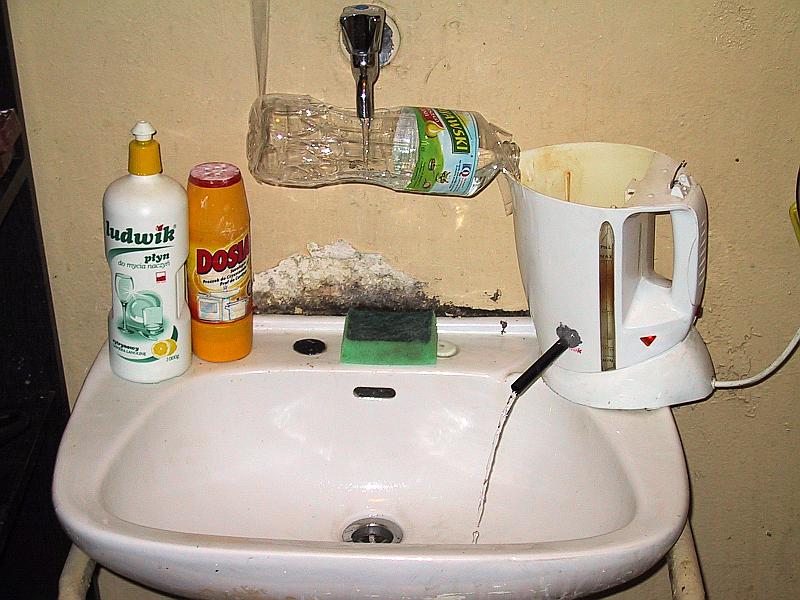
It would be so easy to change the presentation of Eleven Plus tests. Suppose that on section of a paper the children have to cope with interpretation.
Each of the following group of questions is worth 3 marks. You are expected to explain your answers.
56 What is the evidence that the tap is new?
57 Why is the spigot pouring water into the sink?
58 Is it likely that this photograph was taken in England?
59 Do you think that the kettle was turned on to make hot water?
60 Write a short account of your mother and father co-operating over a major DIY operation. You are encouraged to include the dialogue that was used when the tap DID NOT leak. This answer is worth 10 marks. Extra marks are offered for a short plan and the use of paragraphs.
Saturday, November 17, 2007
Nailing the Eleven Plus
In all DIY jobs preparation is the key. There are many of us who believe that there is no substitute for natural materials. Traditionalists enjoy the beauty, texture and warmth of a wooden floor. To prepare the floor takes time. There is a lot of vacuum and dust. Protective clothing, a nose mask and goggles are all used during the `little five minute’ job.
There is something really special in hiring an industrial sanding machine and using it to change a scratched and discoloured floor into a warm, smooth and golden colour. Thank goodness too for quick drying varnish.
One of the most enjoyable jobs is dealing with the nails that are holding the boards down. The nails have to be punched to about 3 mm below the surface. This takes lots of tapping and noise. It is a job where you start and go to the end.
In just the same way watching a child working systematically through eleven plus papers is a highly satisfying experience.
I watched a girl who `nailed’ a section of a non verbal reasoning paper. She brushed aside the explanation. She put her head down with a little twist. She mumbled a `thank you’ and went to work.
Three and a half minutes later her hand was in the air. She only smiled when the work had been marked – and everything was correct.
I don’t think that our eleven plus children will be able to take a powered nail gun into the examinations. Some of the highly able children that we work with, however, have the ability to power their way through a test. They don’t just master the work – they demolish it.
There is something really special in hiring an industrial sanding machine and using it to change a scratched and discoloured floor into a warm, smooth and golden colour. Thank goodness too for quick drying varnish.
One of the most enjoyable jobs is dealing with the nails that are holding the boards down. The nails have to be punched to about 3 mm below the surface. This takes lots of tapping and noise. It is a job where you start and go to the end.
In just the same way watching a child working systematically through eleven plus papers is a highly satisfying experience.
I watched a girl who `nailed’ a section of a non verbal reasoning paper. She brushed aside the explanation. She put her head down with a little twist. She mumbled a `thank you’ and went to work.
Three and a half minutes later her hand was in the air. She only smiled when the work had been marked – and everything was correct.
I don’t think that our eleven plus children will be able to take a powered nail gun into the examinations. Some of the highly able children that we work with, however, have the ability to power their way through a test. They don’t just master the work – they demolish it.
Friday, November 16, 2007
Eleven Plus Chances
Tom Brown's Schooldays is about a boy who goes to Public School, makes friends with a rather wild character and the two of them go on to defeat a bully called Flashman.
Later on in the book Tom is encouraged to look after George Arthur. George joined Rugby School as a weakling. Tom acted in the role of a `mentor’ and helped George. In the process Tom helped himself.
Arthur becomes worried about Tom – who has shown great qualities of manliness and honesty.
"Dear Tom, I ain't going to pitch into you," said Arthur piteously; "and it seems so cocky in me to be advising you, who've been my backbone ever since I've been at Rugby, and have made the school a paradise to me. Ah, I see I shall never do it, unless I go head over heels at once, as you said when you taught me to swim. Tom, I want you to give up using vulgus- books and cribs."
The `vulgus - book’ refers to a book where the boys had to translate Greek and Latin. Some boys copied from each other. Arthur wanted Tom to stop cheating. The `crib’ was the sheet that children used when they were trying to cheat in examinations.
We are extremely fortunate that children no longer have to be able translate Greek and Latin. Yet we select children for Grammar School using tests that require similar skills like the ability to interpret and translate. (What about those code noon = 5885.)
Thankfully too our children do not have any need for crib sheets – because there is certainly no place for them in competitive examinations.
One of our girls was chatting about the eleven plus arrangements in her school. The twenty odd children taking the examination were in the hall – with widely separated desks. The rest of the school had the morning off so that the Eleven Plus children had the best possible opportunity – with no noise or possible interruption. The Head Teacher, along with two of his staff supervised the tests.
Lucky children. Enlightened school!
Later on in the book Tom is encouraged to look after George Arthur. George joined Rugby School as a weakling. Tom acted in the role of a `mentor’ and helped George. In the process Tom helped himself.
Arthur becomes worried about Tom – who has shown great qualities of manliness and honesty.
"Dear Tom, I ain't going to pitch into you," said Arthur piteously; "and it seems so cocky in me to be advising you, who've been my backbone ever since I've been at Rugby, and have made the school a paradise to me. Ah, I see I shall never do it, unless I go head over heels at once, as you said when you taught me to swim. Tom, I want you to give up using vulgus- books and cribs."
The `vulgus - book’ refers to a book where the boys had to translate Greek and Latin. Some boys copied from each other. Arthur wanted Tom to stop cheating. The `crib’ was the sheet that children used when they were trying to cheat in examinations.
We are extremely fortunate that children no longer have to be able translate Greek and Latin. Yet we select children for Grammar School using tests that require similar skills like the ability to interpret and translate. (What about those code noon = 5885.)
Thankfully too our children do not have any need for crib sheets – because there is certainly no place for them in competitive examinations.
One of our girls was chatting about the eleven plus arrangements in her school. The twenty odd children taking the examination were in the hall – with widely separated desks. The rest of the school had the morning off so that the Eleven Plus children had the best possible opportunity – with no noise or possible interruption. The Head Teacher, along with two of his staff supervised the tests.
Lucky children. Enlightened school!
Thursday, November 15, 2007
Is there an easy approach to Eleven Plus work?
We sometime meet very able boys and girls who do very well on a test one day and then appear to struggle on similar material on another day.
Naturally thoughts turn to:
Diet – too many `incorrect’ foods
Fatigue – we should not have gone to that concert last night
Boredom – I did a paper that last week and scored over 90%. Do I really have to do the next paper as well? The last one was just too easy.
Argument – perhaps today was the day for a well planned and full scale argument
Motivation – “I just could not be bothered. I really tried my best but I did not feel like working today. I will do it tomorrow.”
Physical Problem – “You know you said I could go to play with my friends. Now you made me stay. Tuesday is my only day free to play with my friends.”
On Going Problem – “I really don’t’ want to go to that school. I want to go to all boys school. I know that it will be difficult to reach on a bus.”
Bribery – “You said we could go the cinema if I finished the paper yesterday. Well we have not gone yet. It is not fair.”
Ask someone from the family to record some of the pre Eleven Plus discussions. Type them up. Look at the dialogue. Think what it would be like to act the scene out before family and friends at Christmas.
Who said having children was easy?
Naturally thoughts turn to:
Diet – too many `incorrect’ foods
Fatigue – we should not have gone to that concert last night
Boredom – I did a paper that last week and scored over 90%. Do I really have to do the next paper as well? The last one was just too easy.
Argument – perhaps today was the day for a well planned and full scale argument
Motivation – “I just could not be bothered. I really tried my best but I did not feel like working today. I will do it tomorrow.”
Physical Problem – “You know you said I could go to play with my friends. Now you made me stay. Tuesday is my only day free to play with my friends.”
On Going Problem – “I really don’t’ want to go to that school. I want to go to all boys school. I know that it will be difficult to reach on a bus.”
Bribery – “You said we could go the cinema if I finished the paper yesterday. Well we have not gone yet. It is not fair.”
Ask someone from the family to record some of the pre Eleven Plus discussions. Type them up. Look at the dialogue. Think what it would be like to act the scene out before family and friends at Christmas.
Who said having children was easy?
Wednesday, November 14, 2007
Making Eleven Plus Waves
What is a hard mathematics question for an Eleven Plus child? Well it would be a lot easier to answer if parts of the mathematics papers were set by physics teachers.
At school we all did `Wave Theory’. An example of wave theory is when sound vibrates on a frequency. The pitch stays the same but the volume grows quieter and quieter. A tuning fork is lightly damped because the sound persists for a long time. A bottle, when blown across the top, only emits the sound for a short time because the bottle is heavily damped so the vibrations die away quickly.
We get water waves when we throw a stone into water.
We can get ultrasonic waves when the pitch of the sound wave is too high for the human ear.
So when a parent calls a child to do an Eleven Plus paper, and the child does not appear to hear, we can only question:
Is the lack of hearing due to damping?
Was our message too quiet so that it did not cause even a ripple of consciousness?
Was the tone of voice a little too high and forced?
So now onto the mathematics question. Is this too hard for a bright Eleven Plus candidate?
England were playing a crucial football match, one fifth of the spectators left ten minutes before the end and one quarter of the remainder left in the last five minutes.
Question 1
If 60 000 spectators were left in the ground when the final whistle sounded, how many spectators watched the game?
Question 2
If the game was at Wembley, was England winning or losing?
Now a mathematician would work out the answer.
A physicist would tell us not to make waves!
At school we all did `Wave Theory’. An example of wave theory is when sound vibrates on a frequency. The pitch stays the same but the volume grows quieter and quieter. A tuning fork is lightly damped because the sound persists for a long time. A bottle, when blown across the top, only emits the sound for a short time because the bottle is heavily damped so the vibrations die away quickly.
We get water waves when we throw a stone into water.
We can get ultrasonic waves when the pitch of the sound wave is too high for the human ear.
So when a parent calls a child to do an Eleven Plus paper, and the child does not appear to hear, we can only question:
Is the lack of hearing due to damping?
Was our message too quiet so that it did not cause even a ripple of consciousness?
Was the tone of voice a little too high and forced?
So now onto the mathematics question. Is this too hard for a bright Eleven Plus candidate?
England were playing a crucial football match, one fifth of the spectators left ten minutes before the end and one quarter of the remainder left in the last five minutes.
Question 1
If 60 000 spectators were left in the ground when the final whistle sounded, how many spectators watched the game?
Question 2
If the game was at Wembley, was England winning or losing?
Now a mathematician would work out the answer.
A physicist would tell us not to make waves!
Tuesday, November 13, 2007
Keeping Focused
I have never actually read one of her books but I have always admired her. She has provided so much pleasure to women over the years that she should have a statue to her outside Parliament.
I know that she dressed in the most appalling pink colours. I know too that she had some rather revolting little dogs.
I admire her because she was one of the hardest working women in the world. She wrote over 600 hundred books and sold over a billion copies.
I read once that she employed two secretaries. She dictated her books to one of the secretaries until the poor secretary began to tire. She then switched to secretary number two – and the words kept pouring out.
What a wonderful work ethic. What a desire to be loved and recognised.
So when your little one begins to waver and feels a little hard done by just remind her of a woman (Barbara Cartland) who gave a billion good reads to women.
I know that she dressed in the most appalling pink colours. I know too that she had some rather revolting little dogs.
I admire her because she was one of the hardest working women in the world. She wrote over 600 hundred books and sold over a billion copies.
I read once that she employed two secretaries. She dictated her books to one of the secretaries until the poor secretary began to tire. She then switched to secretary number two – and the words kept pouring out.
What a wonderful work ethic. What a desire to be loved and recognised.
So when your little one begins to waver and feels a little hard done by just remind her of a woman (Barbara Cartland) who gave a billion good reads to women.
Monday, November 12, 2007
Eleven Plus Mentors
Often when I am talking with parents and children about life, exams and `stuff’ in general we reach a point in the conversation where we need to find someone who can deliver the required message. Naturally thoughts turn to successful members of the family – an aunt who has done well academically – an uncle who is a `star’ or a grandparent who has continued to strive and develop.
“Why not arrange for your child and Aunt Alicia to have a little chat? See if Aunt Alicia can make the point that study needs to be disciplined. She may be able to suggest ways of working together – she may possible even take an interest and ask to have some regular contact.
Perhaps Uncle Kurt may be prepared to take your most loved offspring off to stock cars and then share his philosophy of life over a hot dog and a coke? (Better than a beer at the local!) Uncle Kurt may be able to expound the need to have a plan and strive for success. He may then even suggest ways to help your child develop a different type of relationship with you. (All your secrets exposed!)
This is called `mentoring’. Mentoring to your child can mean having someone he or she can trust and talk to informally. A mentor can offer dispassionate advice – but also warmth and interest.
“Why not arrange for your child and Aunt Alicia to have a little chat? See if Aunt Alicia can make the point that study needs to be disciplined. She may be able to suggest ways of working together – she may possible even take an interest and ask to have some regular contact.
Perhaps Uncle Kurt may be prepared to take your most loved offspring off to stock cars and then share his philosophy of life over a hot dog and a coke? (Better than a beer at the local!) Uncle Kurt may be able to expound the need to have a plan and strive for success. He may then even suggest ways to help your child develop a different type of relationship with you. (All your secrets exposed!)
This is called `mentoring’. Mentoring to your child can mean having someone he or she can trust and talk to informally. A mentor can offer dispassionate advice – but also warmth and interest.
Sunday, November 11, 2007
After the Eleven Plus
Post examination days are sometimes filled with noise and general disruption. Parents whose children have just finished the Eleven Plus examination will understand these sentiments. Indeed the noise of amplified ipods may reverberate around the house – and in the car and in other uncalled for situations or circumstances. Parents will repeat again and again: `Too many decibels. Tone it down.”
But think of the parents of young blue whales. We know that blue whales are the largest creatures ever to have lived on earth. A lesser known fact is that blue whales make the largest noises too. Its bass call sounds through the water for thirty seconds or more. The sound carries over vast distances.
One whale was recorded giving an output of 180 decibels. This would be deafening to our ears. We don’t really know what these loud noises mean. They are probably used for courtship, pairing and communication. Our ten year olds are probably using loud noise for these three reasons as well as a desire to irritate. Some of our ten year olds are also probably using loud noise for calling other like minded children to a frenzy of social gathering and talking nonsense.
Now why is it that if we put our ear to water and hear the sound of a great whale we weep with joy – but if we hear the sound generated by a liberated ten year old we feel anguished and full of anger?
A whale can project a sound that will travel fifteen miles through water. Pop your child into a wetsuit and encourage him or her to turn the ipod on to full blast.
The whale is the winner.
So if your child comes out of the examination and says excitedly: “Mum, I had a whale of a time!” Be happy.
If your child comes out and says: “Mum I blew it!” Be happy because even noisy little whales need to be loved.
But think of the parents of young blue whales. We know that blue whales are the largest creatures ever to have lived on earth. A lesser known fact is that blue whales make the largest noises too. Its bass call sounds through the water for thirty seconds or more. The sound carries over vast distances.
One whale was recorded giving an output of 180 decibels. This would be deafening to our ears. We don’t really know what these loud noises mean. They are probably used for courtship, pairing and communication. Our ten year olds are probably using loud noise for these three reasons as well as a desire to irritate. Some of our ten year olds are also probably using loud noise for calling other like minded children to a frenzy of social gathering and talking nonsense.
Now why is it that if we put our ear to water and hear the sound of a great whale we weep with joy – but if we hear the sound generated by a liberated ten year old we feel anguished and full of anger?
A whale can project a sound that will travel fifteen miles through water. Pop your child into a wetsuit and encourage him or her to turn the ipod on to full blast.
The whale is the winner.
So if your child comes out of the examination and says excitedly: “Mum, I had a whale of a time!” Be happy.
If your child comes out and says: “Mum I blew it!” Be happy because even noisy little whales need to be loved.
Saturday, November 10, 2007
Eleven Plus Causes and Symptoms
I have just cut the grass. It is Saturday afternoon – a time for all good gardeners to cut the grass. Sunday morning is also a traditional grass cutting time but I don’t like to disturb the neighbours.
The edges of the lawn have developed moss. This is highly disturbing. Moss is a tiny non-flowering plant and what the problem with moss is that it is a symptom not the cause. Every good gardener will immediately point to moss as being a by product of too little fertiliser. We have, however, had a highly unusual year in that many days have been damp. Moss just loves dampness. So it is not just compacted soil or poor drainage but too much rain.
The solution? Well, there are many. Probably first of all we have to scarify and aerate the lawn. Lots of heavy duty spiking will help drainage. We then need to feed the lawn with an autumn lawn food – that has a moss killer. Top dressing also helps.
So as you return from mowing the lawn to your poor child who has spent the last hour bent over an eleven plus paper try to analyse the situation. When you respond to the work your child has done think of the symptom not the cause.
Your child appears to answer back. Symptom or cause? Simply your child may be tired or hungry or bored. You can treat all of these quite easily – rest, food or a change of work.
You question: “Is that all you have done?” Symptom or cause? Simply the work may have been too hard, too easy or just plain boring. You can say: “Well done for trying so hard. What can I do to help? Do you want to talk about it?
So, just as you have used a combination of science, alchemy and theory to treat your grass you need to use a similar combination of thought and instinct to help your child. Pause for a second and ask yourself: “Am I trying to cope with the symptom or the cause?”
The edges of the lawn have developed moss. This is highly disturbing. Moss is a tiny non-flowering plant and what the problem with moss is that it is a symptom not the cause. Every good gardener will immediately point to moss as being a by product of too little fertiliser. We have, however, had a highly unusual year in that many days have been damp. Moss just loves dampness. So it is not just compacted soil or poor drainage but too much rain.
The solution? Well, there are many. Probably first of all we have to scarify and aerate the lawn. Lots of heavy duty spiking will help drainage. We then need to feed the lawn with an autumn lawn food – that has a moss killer. Top dressing also helps.
So as you return from mowing the lawn to your poor child who has spent the last hour bent over an eleven plus paper try to analyse the situation. When you respond to the work your child has done think of the symptom not the cause.
Your child appears to answer back. Symptom or cause? Simply your child may be tired or hungry or bored. You can treat all of these quite easily – rest, food or a change of work.
You question: “Is that all you have done?” Symptom or cause? Simply the work may have been too hard, too easy or just plain boring. You can say: “Well done for trying so hard. What can I do to help? Do you want to talk about it?
So, just as you have used a combination of science, alchemy and theory to treat your grass you need to use a similar combination of thought and instinct to help your child. Pause for a second and ask yourself: “Am I trying to cope with the symptom or the cause?”
Friday, November 09, 2007
Ten Things to Think About after the Examinations
Ten Things to do After the Eleven Plus Examinations
1. You may feel a little backlash after the Eleven Plus examinations. You will have been building your child up towards the examination so expect a period of relaxation and relief.
2. Deliver a little prayer of thanks to the Government for inventing the SATs tests. At least some of the energy will go into Level 5 work.
3. Be very grateful too for the Year 6 `week away’ where the children disappear into an adventure camp. It gives you and them a break from each other.
4. You may be offered the opportunity of being able to involve your child in an orgy of physical activity. This will help to relieve all that pent up energy.
5. Be prepared for some really major `discussions’ on all sorts of topics. Remember that your role has changed from mum or dad the Eleven Plus supporter to just an ordinary mum or dad.
6. Be aware that T.V. viewing habits may change very quickly. Careful monitoring may help.
7. There will certainly be more time available for MSN and other forms of communication over the computer.
8. The Eleven Plus examinations serve a form of `rite of passage’. The actual examination is like an initiation.
9. Back chat is not part of growing up.
10. Try to avoid talking about the examination too often. What is done is done.
1. You may feel a little backlash after the Eleven Plus examinations. You will have been building your child up towards the examination so expect a period of relaxation and relief.
2. Deliver a little prayer of thanks to the Government for inventing the SATs tests. At least some of the energy will go into Level 5 work.
3. Be very grateful too for the Year 6 `week away’ where the children disappear into an adventure camp. It gives you and them a break from each other.
4. You may be offered the opportunity of being able to involve your child in an orgy of physical activity. This will help to relieve all that pent up energy.
5. Be prepared for some really major `discussions’ on all sorts of topics. Remember that your role has changed from mum or dad the Eleven Plus supporter to just an ordinary mum or dad.
6. Be aware that T.V. viewing habits may change very quickly. Careful monitoring may help.
7. There will certainly be more time available for MSN and other forms of communication over the computer.
8. The Eleven Plus examinations serve a form of `rite of passage’. The actual examination is like an initiation.
9. Back chat is not part of growing up.
10. Try to avoid talking about the examination too often. What is done is done.
Thursday, November 08, 2007
Christmas Eleven Plus Course
We are taking bookings for our Christmas Courses in Gravesend and Kings Hill.
Parents are naturally concerned with the level of the courses.
"Do you want a course that tries to lift your child from 50% to 70% or from 70% to 90%?"
The Christmas Course is aimed at children working towards the Kent Eleven Plus tests.
We arrived at the content by making a master chart of all the mathematics questions taken from the current published Eleven Plus papers. These include the Bond and NFER publishers. We also looked at questions from the lesser publishers – for further confirmation.
We have a number of courses – at different levels aimed at different stages as the children prepare for the Eleven Plus examinations. This particular course is aimed at children who are achieving around 70% on a published Eleven Plus paper. We are trying to help the children with the questions and an approach to learning that will enable them to raise the standard of their work.
We have children from many different schools and backgrounds. The children have the common goal of a place at a grammar school. Some children are tutored; others are not, while some work happily with their parents. A course is not the same as individual tuition. Our courses try to give children the tools to be able to do well in an examination.
Progress
We think that many children find Day One challenging. Almost without exception the marks on the two tests on Day 2 are higher as the children find the rhythm of dealing with hard questions.
Some parents mention, at the time of booking, that their children may struggle with a course – but they still want their children to experience the pace of a course. We naturally provide these children with different material.
After the course children naturally go over problem areas with their parents or with their tutors. If we set the course at a level where every child gains one hundred percent we would be letting the children down. We try to show the children how to approach learning a new or unfamiliar topic. Read any hints. Copy any examples down. Do a few practice questions. The course is presented in a loose leaf format so that fresh pages can be inserted if the children go over the work again. If you work through the notes and go over the examples a few times you can then offer the tests to your child again.
Assessment of Ability at the Start of the Course
We look at a course as work that children will need to be able to pass an eleven plus examination.
An Assessment is a separate exercise. Some parents book an assessment before enrolling their child on a course. They do this by telephoning for a discussion on their child – they tell us about their wishes for the outcomes of the course. They also tell us about test results at school and about the percentage their child was able to achieve correctly on a commercially available paper. From this information we will be able to suggest an assessment or a different type of course or confirm that this is the correct standard of course to enroll on.
Verbal and Non Verbal
For the Verbal and Non Verbal Reasoning sessions we do not ask the children to do full papers. The verbal and non verbal elements of the course are not to do with tackling full papers – they are all about timing and coping with challenging questions.
Confidence
We deal with some of the brightest children in Kent every year. Our concern on the courses is giving bright children the tools to be able to cope with a competitive examination.
If you have any doubts about your child’s ability to cope with the 11+ examination we recommend that you telephone us on 01474 321658 and discuss the most appropriate course to enroll on.
Parents are naturally concerned with the level of the courses.
"Do you want a course that tries to lift your child from 50% to 70% or from 70% to 90%?"
The Christmas Course is aimed at children working towards the Kent Eleven Plus tests.
We arrived at the content by making a master chart of all the mathematics questions taken from the current published Eleven Plus papers. These include the Bond and NFER publishers. We also looked at questions from the lesser publishers – for further confirmation.
We have a number of courses – at different levels aimed at different stages as the children prepare for the Eleven Plus examinations. This particular course is aimed at children who are achieving around 70% on a published Eleven Plus paper. We are trying to help the children with the questions and an approach to learning that will enable them to raise the standard of their work.
We have children from many different schools and backgrounds. The children have the common goal of a place at a grammar school. Some children are tutored; others are not, while some work happily with their parents. A course is not the same as individual tuition. Our courses try to give children the tools to be able to do well in an examination.
Progress
We think that many children find Day One challenging. Almost without exception the marks on the two tests on Day 2 are higher as the children find the rhythm of dealing with hard questions.
Some parents mention, at the time of booking, that their children may struggle with a course – but they still want their children to experience the pace of a course. We naturally provide these children with different material.
After the course children naturally go over problem areas with their parents or with their tutors. If we set the course at a level where every child gains one hundred percent we would be letting the children down. We try to show the children how to approach learning a new or unfamiliar topic. Read any hints. Copy any examples down. Do a few practice questions. The course is presented in a loose leaf format so that fresh pages can be inserted if the children go over the work again. If you work through the notes and go over the examples a few times you can then offer the tests to your child again.
Assessment of Ability at the Start of the Course
We look at a course as work that children will need to be able to pass an eleven plus examination.
An Assessment is a separate exercise. Some parents book an assessment before enrolling their child on a course. They do this by telephoning for a discussion on their child – they tell us about their wishes for the outcomes of the course. They also tell us about test results at school and about the percentage their child was able to achieve correctly on a commercially available paper. From this information we will be able to suggest an assessment or a different type of course or confirm that this is the correct standard of course to enroll on.
Verbal and Non Verbal
For the Verbal and Non Verbal Reasoning sessions we do not ask the children to do full papers. The verbal and non verbal elements of the course are not to do with tackling full papers – they are all about timing and coping with challenging questions.
Confidence
We deal with some of the brightest children in Kent every year. Our concern on the courses is giving bright children the tools to be able to cope with a competitive examination.
If you have any doubts about your child’s ability to cope with the 11+ examination we recommend that you telephone us on 01474 321658 and discuss the most appropriate course to enroll on.
Wednesday, November 07, 2007
Last Minute Eleven Plus Swotting
Last weekend we have the privilege of being able to entertain Paul and Wendy Wright. They are very well known for their jewellery making and theirs stocks of fine jewels. We were joined by my brother Michael and his wife Angela who came over from Spain especially for the weekend.
Paul said that he would stay with us over the weekend if we would allow him to make a paella. We knew that he was serious when he carried his paella pan into our kitchen before his suitcases.
Now all of you who go to Spain on a regular basis know that paella is the name of the pan in which the rice is cooked. The rice used in the pan is usually of the short-grain variety. This is to allow the rice to absorb more liquid.
It is then up to the individual genius of the cook to determine the ingredients. Some use a variety of fish – along with eels and snails. Other cooks swear that there is a need to add quantities of chicken to add bulk and substance. Paul added the rice after the food had been simmering for about twenty minutes.
So all year you have been adding the ingredients that your child has needed as the Eleven Plus examinations have approached. You have been adding a little verbal reasoning and some non verbal reasoning. You have been working through papers purchased from the great books shops of the land. You have been buying papers off the internet and down loading free papers. You have been listening to other parents and adding your ideas. You have chatted to your teachers and the head teacher. Some of you will have provided your child with extra lessons. At other times the whole family will have united to solve problems and move the preparation on.
When you have a short time left to go to the examination don’t try to add anything extra. Just let it all simmer in your child’s mind. Don’t be tempted to do just that little bit more because whatever you do at the last minute may come of `half cooked’.
You have heated the big pan. You have given your child the best possible preparation. Just let your child rest for a short time before the actual day of the examination. After all every cook knows that you leave paella to rest for about five minutes before serving with wedges of lemon.
Find Paul and Wendy on:
www.paulwrightjewellery.com/blog
Find Michael and Angela on:
www.gomarbella.com/blog.html
Paul said that he would stay with us over the weekend if we would allow him to make a paella. We knew that he was serious when he carried his paella pan into our kitchen before his suitcases.
Now all of you who go to Spain on a regular basis know that paella is the name of the pan in which the rice is cooked. The rice used in the pan is usually of the short-grain variety. This is to allow the rice to absorb more liquid.
It is then up to the individual genius of the cook to determine the ingredients. Some use a variety of fish – along with eels and snails. Other cooks swear that there is a need to add quantities of chicken to add bulk and substance. Paul added the rice after the food had been simmering for about twenty minutes.
So all year you have been adding the ingredients that your child has needed as the Eleven Plus examinations have approached. You have been adding a little verbal reasoning and some non verbal reasoning. You have been working through papers purchased from the great books shops of the land. You have been buying papers off the internet and down loading free papers. You have been listening to other parents and adding your ideas. You have chatted to your teachers and the head teacher. Some of you will have provided your child with extra lessons. At other times the whole family will have united to solve problems and move the preparation on.
When you have a short time left to go to the examination don’t try to add anything extra. Just let it all simmer in your child’s mind. Don’t be tempted to do just that little bit more because whatever you do at the last minute may come of `half cooked’.
You have heated the big pan. You have given your child the best possible preparation. Just let your child rest for a short time before the actual day of the examination. After all every cook knows that you leave paella to rest for about five minutes before serving with wedges of lemon.
Find Paul and Wendy on:
www.paulwrightjewellery.com/blog
Find Michael and Angela on:
www.gomarbella.com/blog.html
Tuesday, November 06, 2007
Ten Minutes To Go
Once the examination has started very few of the children will have the time to be able to look at some words and wonder where the words came from. We know that English has developed over many years. The Ancient Britains mostly used spoken language – with many words derived from the Anglo-Saxon invaders.
Latin was important and the Norman Conquest brought French. So then we had a three tier system.
Latin was used by scholars and academics, lawyers and philosophers.
French was used by the aristocracy.
English was used by the rest of the people.
Schools, however, started teaching English around 1300 AD.
Our `Modern’ English probably developed around the 1500s. Since then there have many new words, influences and idioms added by different languages.
So our children will be meeting words in their verbal reasoning excises from the Ancient Britains, the Anglo-Saxons, the Romans, the French and many different languages.
At some stage the teacher in charge will say: “Ten minutes to go!”
`Ten' comes from Arabic
`minutes' from English
`to' from Old English
`go' from German
There will be time for a few more marks. Just be thankful that your child does not need to know the roots of the words!
Good Luck!
Latin was important and the Norman Conquest brought French. So then we had a three tier system.
Latin was used by scholars and academics, lawyers and philosophers.
French was used by the aristocracy.
English was used by the rest of the people.
Schools, however, started teaching English around 1300 AD.
Our `Modern’ English probably developed around the 1500s. Since then there have many new words, influences and idioms added by different languages.
So our children will be meeting words in their verbal reasoning excises from the Ancient Britains, the Anglo-Saxons, the Romans, the French and many different languages.
At some stage the teacher in charge will say: “Ten minutes to go!”
`Ten' comes from Arabic
`minutes' from English
`to' from Old English
`go' from German
There will be time for a few more marks. Just be thankful that your child does not need to know the roots of the words!
Good Luck!
Monday, November 05, 2007
Eleven Plus Timing
In life we always have to live by the rules. Some rules are very simple. The Eleven Plus examination lasts for a certain period of time. If your child has not finished the paper in the time allowed then there can be no dispensation.
Many years ago England used to rely on men making the rules – the men sat in rows in Parliament shouting at each other. Then came Mrs Pankhurst who was largely instrumental in giving women the ability to vote and determine the course of history. Every one knows that behind every good man is a better woman and today the Houses of Parliament have many women making the rules and leading the country through the cabinet.
So now we need to look at one rule that applies equally to men and to women. The Rules of Golf are set by the Royal and Ancient Golf Club of St Andrews and the United States Golf Association. This rule has existed for many years without being challenged.
If a player, when starting a hole, plays a ball from outside the teeing ground he/she shall incur a penalty of two strokes and shall then play a ball from within the teeing ground.
Now this seems a very fair rule. You do need to start off from the right place. After all the ball has to finish in the right place.
An Eleven Plus examination has to start in the right place and end in the right place. It also has to start at the right time and end at the right time.
The rules for conducting Eleven Plus examinations are made by the men and women who have continued to vote for Grammar Schools. Just as in golf the Eleven Plus tests have to be fair and properly monitored.
So now we know all this we just need to try to explain to our children that once they have started the examination they need to go on to the end. They must stick to the time limits. So please try to explain the passage of time in an examination. One hundred questions in fifty minutes gives thirty seconds a question. If an examination starts at ten minutes past nine it will end at ten o’clock. After twenty five minutes the candidate should have completed fifty questions. If you can remind your child to look at his or her watch half way through the examination you can really help.
Yes, you will need to supply a watch. Yes, you will need to talk about timing.
If you do, sadly, land up in an appeal situation you will not be able to use running out of time as an effective excuse. You can appeal laws and injustice to the Houses of Parliament. You can appeal unfair rules – or an interpretation - to the Rule Makers of Golf. You can appeal to an Eleven Plus appeal panel. But – you might not win unless your grounds are very strong.
Many years ago England used to rely on men making the rules – the men sat in rows in Parliament shouting at each other. Then came Mrs Pankhurst who was largely instrumental in giving women the ability to vote and determine the course of history. Every one knows that behind every good man is a better woman and today the Houses of Parliament have many women making the rules and leading the country through the cabinet.
So now we need to look at one rule that applies equally to men and to women. The Rules of Golf are set by the Royal and Ancient Golf Club of St Andrews and the United States Golf Association. This rule has existed for many years without being challenged.
If a player, when starting a hole, plays a ball from outside the teeing ground he/she shall incur a penalty of two strokes and shall then play a ball from within the teeing ground.
Now this seems a very fair rule. You do need to start off from the right place. After all the ball has to finish in the right place.
An Eleven Plus examination has to start in the right place and end in the right place. It also has to start at the right time and end at the right time.
The rules for conducting Eleven Plus examinations are made by the men and women who have continued to vote for Grammar Schools. Just as in golf the Eleven Plus tests have to be fair and properly monitored.
So now we know all this we just need to try to explain to our children that once they have started the examination they need to go on to the end. They must stick to the time limits. So please try to explain the passage of time in an examination. One hundred questions in fifty minutes gives thirty seconds a question. If an examination starts at ten minutes past nine it will end at ten o’clock. After twenty five minutes the candidate should have completed fifty questions. If you can remind your child to look at his or her watch half way through the examination you can really help.
Yes, you will need to supply a watch. Yes, you will need to talk about timing.
If you do, sadly, land up in an appeal situation you will not be able to use running out of time as an effective excuse. You can appeal laws and injustice to the Houses of Parliament. You can appeal unfair rules – or an interpretation - to the Rule Makers of Golf. You can appeal to an Eleven Plus appeal panel. But – you might not win unless your grounds are very strong.
Sunday, November 04, 2007
The Meat of the Eleven PLus
As a parent you have the responsibility of trying to help your child make mince meat of the Eleven Plus Examinations.
Before you can `mince’ the examination you need to know a little about the act of making mince.
Mince is usually made from lamb or beef. Some times pork is used. The strange thing is that mince is employed in some of the `forbidden’ recipes for children. (Big Mac?)
Lamb
We use lamb mince in dishes like moussaka and shepherd’s pie. The lamb’s neck and the leaner parts of the belly are often minced. (I have not yet written the blog about letting your child be led like a lamb to the slaughter!)
Beef
Beef mince is often made from the meat left on the carcass – from the neck and shoulders ad sometimes the shin or brisket. Your children will be relieved to know that mince is used in beef burgers, Bolognese and chilli con carne.
Pork
Pork mince is made from the hindquarters and is often made into meatballs.
A very large number of families celebrate Christmas with mince pies. The cooking instructions include mixing the ingredients, except for the brandy and then covering the bowl with a cloth and leaving the mixture for twelve hours. Then comes the `good’ part. To avoid fermentation place the mince meat in a cool oven for three hours. Once the mince meat is cold stir in the brandy.
So now we know why we want our children to make mince meat of their examinations.
They need to know something about the content of the examination. (Lamb, Beef or Pork?)
They need to be able to select appropriate material. (This is a bit like choosing the right type of meat to use in mince meat.)
They need to cool down before an examination. This will allow everything they have learned to ferment.)
They need to be able to add a touch of excitement and drama to their thinking. (Brandy?)
So what you want is for your child to walk up to you after the examination and say:
“I really minced that examination!”
Before you can `mince’ the examination you need to know a little about the act of making mince.
Mince is usually made from lamb or beef. Some times pork is used. The strange thing is that mince is employed in some of the `forbidden’ recipes for children. (Big Mac?)
Lamb
We use lamb mince in dishes like moussaka and shepherd’s pie. The lamb’s neck and the leaner parts of the belly are often minced. (I have not yet written the blog about letting your child be led like a lamb to the slaughter!)
Beef
Beef mince is often made from the meat left on the carcass – from the neck and shoulders ad sometimes the shin or brisket. Your children will be relieved to know that mince is used in beef burgers, Bolognese and chilli con carne.
Pork
Pork mince is made from the hindquarters and is often made into meatballs.
A very large number of families celebrate Christmas with mince pies. The cooking instructions include mixing the ingredients, except for the brandy and then covering the bowl with a cloth and leaving the mixture for twelve hours. Then comes the `good’ part. To avoid fermentation place the mince meat in a cool oven for three hours. Once the mince meat is cold stir in the brandy.
So now we know why we want our children to make mince meat of their examinations.
They need to know something about the content of the examination. (Lamb, Beef or Pork?)
They need to be able to select appropriate material. (This is a bit like choosing the right type of meat to use in mince meat.)
They need to cool down before an examination. This will allow everything they have learned to ferment.)
They need to be able to add a touch of excitement and drama to their thinking. (Brandy?)
So what you want is for your child to walk up to you after the examination and say:
“I really minced that examination!”
Saturday, November 03, 2007
Eleven Plus Pressure
It is easy to tell when the Eleven Plus examinations are growing closer. My thoughts turn more and more to keeping you and your child calm. Naturally you can both turn to prescribed drugs. Equally far more of us may want to turn to methods of keeping calm by less intrusive and addictive means.
So of course some of us allow our thoughts turn to Yoga. Now there must be many different types of yoga. Some of us think as yoga as being part of Eastern mysticism. To others it is way of slimming and keeping fit.
This is a bit like the Eleven Plus examinations. Some children set out to do very well. Other children just try to pass. There are also many children who do the work because their parents wish the examination on them.
So some of us do yoga because we think that it is a means of combating the stresses and stains of every day living. We hope that Yoga will help us to develop mental and physical fitness.
So we exhort our children to work through Eleven Plus papers because we want them to have a healthy and desirable attitude in the actual examination. We want them to be calm and relaxed when they face problems in the examinations. If your child is in a good mental state then he or she will be less likely to become worried, strained and tense in the examination.
But you also want to build mental toughness. This is when you child really desires to pass the examination and will do that extra bit of problem solving on a difficult question in the examination.
We accept that we will feel physically and mentally tired a lot of the time in our daily lives. We suppose that our children are also going to feel tired and strained. So if you go to bed feeling fit, healthy and happy then you hope that your Eleven Plus child will feel the same.
So simply lie in bed every morning for those few extra minutes and encourage your child to do the same. This means that on the day of the examination you hope your child will wake happy and refreshed – and climb quietly and peacefully out of bed. You want no strain, no pressure on the morning of the first examination. Never encourage your child to do any work at all. Mention the examination no more than once or twice. Take it in your stride and hope that your child does the same. That is Yoga. The frustration of the mental and the physical. In the examination you want a fusion of mental and physical alertness. So try to practice what you preach.
So of course some of us allow our thoughts turn to Yoga. Now there must be many different types of yoga. Some of us think as yoga as being part of Eastern mysticism. To others it is way of slimming and keeping fit.
This is a bit like the Eleven Plus examinations. Some children set out to do very well. Other children just try to pass. There are also many children who do the work because their parents wish the examination on them.
So some of us do yoga because we think that it is a means of combating the stresses and stains of every day living. We hope that Yoga will help us to develop mental and physical fitness.
So we exhort our children to work through Eleven Plus papers because we want them to have a healthy and desirable attitude in the actual examination. We want them to be calm and relaxed when they face problems in the examinations. If your child is in a good mental state then he or she will be less likely to become worried, strained and tense in the examination.
But you also want to build mental toughness. This is when you child really desires to pass the examination and will do that extra bit of problem solving on a difficult question in the examination.
We accept that we will feel physically and mentally tired a lot of the time in our daily lives. We suppose that our children are also going to feel tired and strained. So if you go to bed feeling fit, healthy and happy then you hope that your Eleven Plus child will feel the same.
So simply lie in bed every morning for those few extra minutes and encourage your child to do the same. This means that on the day of the examination you hope your child will wake happy and refreshed – and climb quietly and peacefully out of bed. You want no strain, no pressure on the morning of the first examination. Never encourage your child to do any work at all. Mention the examination no more than once or twice. Take it in your stride and hope that your child does the same. That is Yoga. The frustration of the mental and the physical. In the examination you want a fusion of mental and physical alertness. So try to practice what you preach.
Friday, November 02, 2007
Eleven Plus Problems
Please - ask your child to go through all the work done so far this year at school, at home and in lessons.
Make a list of any problems.
Go over the problems.
Build confidence.
There is little time left now to waste until the examinations.
I spent a lot of my childhood on my Grandparents farm. My Grandmother did not like food being wasted. She would often say: “To waste food is a sin.”
A lot of the food we ate came from the farm itself. The meat often came from our cattle – because my grandfather delivered meat on a regular basis to the local butchers. Ducks, chickens and turkeys were all bred for slaughter on the farm. The fruit came from in season fruit in the large orchard. Vegetables were grown for resale.
Milk, cream and butter came from the dairy herd.
One thing we never ate on the farm was rabbits. My grandmother would not allow them near the house.
So when you have fed what you eat you tend not to waste. When you have grown what you eat you savour. When you are a good cook the whole meal is delight.
So chat with your child. Encourage him or her to go over what has been done during the last year. Remind your child of happy sessions working together. Talk about all the work that has been done in preparation. Discuss how the whole family overcame problems. Explain that wonderful food is not always achieved by following a recipe slavishly. The challenge comes in doing well with what is in front of you. If you have a spare duck you eat it. If you chickens lay a few extra eggs eat them or share them out.
Above all try to make your child feel adventurous about solving problems in the examination. And please – a gentle reminder not to waste time on questions that are too hard.
"To waste time is a sin!"
Make a list of any problems.
Go over the problems.
Build confidence.
There is little time left now to waste until the examinations.
I spent a lot of my childhood on my Grandparents farm. My Grandmother did not like food being wasted. She would often say: “To waste food is a sin.”
A lot of the food we ate came from the farm itself. The meat often came from our cattle – because my grandfather delivered meat on a regular basis to the local butchers. Ducks, chickens and turkeys were all bred for slaughter on the farm. The fruit came from in season fruit in the large orchard. Vegetables were grown for resale.
Milk, cream and butter came from the dairy herd.
One thing we never ate on the farm was rabbits. My grandmother would not allow them near the house.
So when you have fed what you eat you tend not to waste. When you have grown what you eat you savour. When you are a good cook the whole meal is delight.
So chat with your child. Encourage him or her to go over what has been done during the last year. Remind your child of happy sessions working together. Talk about all the work that has been done in preparation. Discuss how the whole family overcame problems. Explain that wonderful food is not always achieved by following a recipe slavishly. The challenge comes in doing well with what is in front of you. If you have a spare duck you eat it. If you chickens lay a few extra eggs eat them or share them out.
Above all try to make your child feel adventurous about solving problems in the examination. And please – a gentle reminder not to waste time on questions that are too hard.
"To waste time is a sin!"
Thursday, November 01, 2007
An Eleven Plus Plot
November the 5th is nearly with us.
What happens if all the children who are preparing for Eleven Plus examinations decide to take action against the examinations?
Who should they plot against?
How severely will the plot be put down?
The children would unite through MSN. Can you imagine the content of the messages?
There would be a mixture of text, child speak, good spelling, suspect spelling and naturally a new vocabulary. Children of all backgrounds have the ability to create their own language and word patterns.
The excitement would build to the examination.
The messages would flow backwards and forwards in a huge vortex of frenzy.
I wonder if there would be a big bang or a little whimper. Having worked with so many bright and able children I think the plot would explode with the same force that made our galaxy.
What happens if all the children who are preparing for Eleven Plus examinations decide to take action against the examinations?
Who should they plot against?
How severely will the plot be put down?
The children would unite through MSN. Can you imagine the content of the messages?
There would be a mixture of text, child speak, good spelling, suspect spelling and naturally a new vocabulary. Children of all backgrounds have the ability to create their own language and word patterns.
The excitement would build to the examination.
The messages would flow backwards and forwards in a huge vortex of frenzy.
I wonder if there would be a big bang or a little whimper. Having worked with so many bright and able children I think the plot would explode with the same force that made our galaxy.
Wednesday, October 31, 2007
Eleven Plus Advice
I had a fascinating conversation with a mother today. She has a very bright ten year old child. She explained that her daughter wanted to be an accountant. I am sure there are accountants in the family.
As the conversation ranged over the Eleven Plus, school, entrance examinations and `A’ level choices it was clear that ’ level choices it was clear that careers guidance was a mere formality. I am sure that this mum could have written the book. What a pleasure!
When the phone went down I started thinking about what kind of questions would be asked in Accountancy examinations.
“A director is in a fiduciary relationship with his company. Explain the meaning and effect of this statement with reference to decided cases.” (This question came from the Institute of Company Accountants.) I did `Dog Latin’ at school for many years. The word `fides’ means faith. I suppose it means that a director has to be faithful to his company. I wonder if the relation is the same as a dog to his master or that of a cat? They are both animals but have a very different approach to their masters.
So thinking about this led to another question:
Explain by reference to statutory and common law examples what is meant by `lifting the veil of incorporation’. (Chartered Institute of management Accountants) Now I know of some ten year old who would love to debate the topic if they knew what the terms meant. To some people there must be real excitement when there is a seminar on `lifting the veil of incorporation’.
So over the years some of our ten year old will learn more about relationships and decisions. They will also learn about the difference between statutory and common law. We hope they will grow up to be both wealthy and wise. Who knows – perhaps one day one of these ten year old will be advising you on your pension! Oh happy days!
As the conversation ranged over the Eleven Plus, school, entrance examinations and `A’ level choices it was clear that ’ level choices it was clear that careers guidance was a mere formality. I am sure that this mum could have written the book. What a pleasure!
When the phone went down I started thinking about what kind of questions would be asked in Accountancy examinations.
“A director is in a fiduciary relationship with his company. Explain the meaning and effect of this statement with reference to decided cases.” (This question came from the Institute of Company Accountants.) I did `Dog Latin’ at school for many years. The word `fides’ means faith. I suppose it means that a director has to be faithful to his company. I wonder if the relation is the same as a dog to his master or that of a cat? They are both animals but have a very different approach to their masters.
So thinking about this led to another question:
Explain by reference to statutory and common law examples what is meant by `lifting the veil of incorporation’. (Chartered Institute of management Accountants) Now I know of some ten year old who would love to debate the topic if they knew what the terms meant. To some people there must be real excitement when there is a seminar on `lifting the veil of incorporation’.
So over the years some of our ten year old will learn more about relationships and decisions. They will also learn about the difference between statutory and common law. We hope they will grow up to be both wealthy and wise. Who knows – perhaps one day one of these ten year old will be advising you on your pension! Oh happy days!
Tuesday, October 30, 2007
The Sunday Before
The Sunday before the Eleven Plus examinations is approaching. The last thing you want to do is to mention the examination. By now you will have done your best. Your child will have done his or her best. The work is done, the talking is over. So how on earth are you going to fill your day?
8.00 Take the pre examination candidate a glass of warm water with a little lemon. This will flush the kidneys.
8.20 Run the bath for the pre examination candidate. Lay out the clothes just like you used to do in the old days.
8.30 Supply favourite breakfast. Try to avoid serving the meal as if it was the last meal of a condemned man.
8.45 Insist that you will do the washing up and that you do not require any help from any spouse or child. (Martyr?)
9.00 Depart for the swimming pool.
11.30 Supply further sustenance.
By now you are feeling the strain. Leave the children with the grand parents. Retire to the pub for a liquid lunch. Sleep lunch off. Ask to have the kids delivered. Allow the rest of the day to dissolve into a gental daze.
8.00 Take the pre examination candidate a glass of warm water with a little lemon. This will flush the kidneys.
8.20 Run the bath for the pre examination candidate. Lay out the clothes just like you used to do in the old days.
8.30 Supply favourite breakfast. Try to avoid serving the meal as if it was the last meal of a condemned man.
8.45 Insist that you will do the washing up and that you do not require any help from any spouse or child. (Martyr?)
9.00 Depart for the swimming pool.
11.30 Supply further sustenance.
By now you are feeling the strain. Leave the children with the grand parents. Retire to the pub for a liquid lunch. Sleep lunch off. Ask to have the kids delivered. Allow the rest of the day to dissolve into a gental daze.
Monday, October 29, 2007
Stretching Eleven Plus Children
Eleven plus children sometimes need stretching. We urge them to read a wide range of books. We want our children to be able to absorb an exuberant vocabulary. After all the children will rely on their vocabulary, at times, while they doing some verbal reasoning exercises.
So if we tell the children to read the classics, are we being reactionary? In The Three Musketeers we read language developed in a rather spectacular setting:
‘Whilst they were within the precincts of the camp, the four friends did not exchange a word: they were, besides, followed by the curious, who, having heard of the wager, wished to know how they would extricate themselves from the affair.’
So the story of The Three Musketeers is all about friends fighting with each other, the people are simply sorted by nationality (French or English), where they live, work and fight is important (Gascon or Norman) as is their social class (master or servant.). But when Athos stands on the parapet immune to the bullets we hope the children will identify with him.
We want our children to stand on the parapet, in the Eleven Plus room, immune to questions that may phase them. We want our children to feel that they are heroes and heroines as they tackle adversity. We want our children to feel that they can conquer all that lies before them.
Books that children read today are often full of characters with imperfections and problems. But we hope that as the story grips them and takes them on a journey of exploration they will react positively in a similar manner in the examination. Then our children will show that they have absorbed the `hard’ words and the complex concepts. They may also learn a little about punctuation! Just look with awe at the punctuation in the passage above. We hope that our children will replicate the confident use of commas in the examination.
So if we tell the children to read the classics, are we being reactionary? In The Three Musketeers we read language developed in a rather spectacular setting:
‘Whilst they were within the precincts of the camp, the four friends did not exchange a word: they were, besides, followed by the curious, who, having heard of the wager, wished to know how they would extricate themselves from the affair.’
So the story of The Three Musketeers is all about friends fighting with each other, the people are simply sorted by nationality (French or English), where they live, work and fight is important (Gascon or Norman) as is their social class (master or servant.). But when Athos stands on the parapet immune to the bullets we hope the children will identify with him.
We want our children to stand on the parapet, in the Eleven Plus room, immune to questions that may phase them. We want our children to feel that they are heroes and heroines as they tackle adversity. We want our children to feel that they can conquer all that lies before them.
Books that children read today are often full of characters with imperfections and problems. But we hope that as the story grips them and takes them on a journey of exploration they will react positively in a similar manner in the examination. Then our children will show that they have absorbed the `hard’ words and the complex concepts. They may also learn a little about punctuation! Just look with awe at the punctuation in the passage above. We hope that our children will replicate the confident use of commas in the examination.
Sunday, October 28, 2007
The Eleven Plus Letter
Every now and then every set of parents need to issue a rallying call to their children.
Our thoughts and inspiration can swing widely over a range of famous speeches that begin with familiar words:
“Once more into the breech dear friends.”
“We will fight them on the beaches.”
“Come on England.”
“You can only do your best.”
“What ever happens we will still love you.”
So long as the message is heartfelt I am sure that parents are allowed a little poetic licence – they don’t have to be word perfect.
With some Eleven Plus examinations only days away it is time for the `Annual Eleven Plus Letter’.
My dear son / daughter
In a few days time you will be writing your Eleven Plus examinations.
Naturally we all wish you the best of luck.
Read questions carefully.
Think before you write.
Do the best you can.
Lots of love
Your Mum and Dad.
Our thoughts and inspiration can swing widely over a range of famous speeches that begin with familiar words:
“Once more into the breech dear friends.”
“We will fight them on the beaches.”
“Come on England.”
“You can only do your best.”
“What ever happens we will still love you.”
So long as the message is heartfelt I am sure that parents are allowed a little poetic licence – they don’t have to be word perfect.
With some Eleven Plus examinations only days away it is time for the `Annual Eleven Plus Letter’.
My dear son / daughter
In a few days time you will be writing your Eleven Plus examinations.
Naturally we all wish you the best of luck.
Read questions carefully.
Think before you write.
Do the best you can.
Lots of love
Your Mum and Dad.
Saturday, October 27, 2007
The Right Eleven Plus Environment
As teachers and parents working towards the eleven plus examinations we tend to work on the assumption that home background plays a large part in determining educational progress.
It is very likely that economic level and social class are not as important in helping a child towards the eleven plus as the parents’ attitude to education. Some parents are content to leave the tuition the school and a `tutor’ while other parents want a close `hands on’ approach. Both methods must be equally effective – because no two children are the same and no two families are the same. Just because some parents may be earning lots of money does not automatically guarantee that their child will pass the eleven plus.
We tend to take support by the mother of the eleven plus child for granted. The father’s interest in school work and extra study can, however, sometimes prove to be an invigorating spur to the child.
So it is entirely possible that factors in the home may possibly be more likely to promote a good `eleven plus’ environment than those of the local neighbourhood.
It is very likely that economic level and social class are not as important in helping a child towards the eleven plus as the parents’ attitude to education. Some parents are content to leave the tuition the school and a `tutor’ while other parents want a close `hands on’ approach. Both methods must be equally effective – because no two children are the same and no two families are the same. Just because some parents may be earning lots of money does not automatically guarantee that their child will pass the eleven plus.
We tend to take support by the mother of the eleven plus child for granted. The father’s interest in school work and extra study can, however, sometimes prove to be an invigorating spur to the child.
So it is entirely possible that factors in the home may possibly be more likely to promote a good `eleven plus’ environment than those of the local neighbourhood.
Eleven Plus Vocabulary (Blog26/10)
One of the things that children have to think about as the eleven plus examinations grow closer is the need for a wide vocabulary while tackling eleven plus verbal reasoning papers.
“You really must read a wider range of books.”
“Aunt Mary’s daughter enjoyed this book. I am sure you will love it.”
Now any self respecting ten year old will naturally feel a real sense of resistance to weak points made like this. No, don’t be soft. Tell your ten year old to learn three new words every day. Today’s three words include:
Matriculate.
The `matricular’ is the list of people belonging to an order or society. So, rather loosely, if your child passes the Eleven Plus examination he or she will matriculate.
Adlibbing
Today we think of adlibbing as making jokes or employing quick fire repartee. So if your ten year old is inclined to cover up nerves by a sting of weak and spontaneous jokes you could think that you have an adlibbing genius on your hands.
Stentorian
The origin of this word goes back to a man called `Stentor’ who was a form of town crier or even a drill sergeant. (In other words a man with a loud voice.) This is the sort of voice that will echo in your thoughts as you drive away from leaving your poor eleven plus child to attempt the examination.
So now comes the Eleven Plus challenge to your child.
“Use all three words in a sentence.”
(Any advance on: “The adlibbing boy called out in a stentorian voice that he was about to matriculate with a full eleven plus pass”?)
“You really must read a wider range of books.”
“Aunt Mary’s daughter enjoyed this book. I am sure you will love it.”
Now any self respecting ten year old will naturally feel a real sense of resistance to weak points made like this. No, don’t be soft. Tell your ten year old to learn three new words every day. Today’s three words include:
Matriculate.
The `matricular’ is the list of people belonging to an order or society. So, rather loosely, if your child passes the Eleven Plus examination he or she will matriculate.
Adlibbing
Today we think of adlibbing as making jokes or employing quick fire repartee. So if your ten year old is inclined to cover up nerves by a sting of weak and spontaneous jokes you could think that you have an adlibbing genius on your hands.
Stentorian
The origin of this word goes back to a man called `Stentor’ who was a form of town crier or even a drill sergeant. (In other words a man with a loud voice.) This is the sort of voice that will echo in your thoughts as you drive away from leaving your poor eleven plus child to attempt the examination.
So now comes the Eleven Plus challenge to your child.
“Use all three words in a sentence.”
(Any advance on: “The adlibbing boy called out in a stentorian voice that he was about to matriculate with a full eleven plus pass”?)
Passing The Eleven Plus (Blog25/10)
Many youngsters take their driving test at the same time as they are studying for their `A’ levels. In theory the great majority of seventeen year olds are mature enough to be entrusted with a car.
So a number of driving instructors tend to emphasise the need for a driving plan. A basic driving plan would include:
What can be seen?
What can not be seen?
What may reasonably be expected to happen?
What can be seen is reasonably straight forward. The problem comes with what can not be seen. This is where driving defensively begins to make sense. What could lie around the bend? Will a high sided vehicle obstruct your view? Will two of your children break out into a pitched battle just as you are trying to over take a weaving bus? What happens when the third child in car unexpectedly turns round and screams at the battling two in the back seat?
I started thinking of this because there was a lot of traffic on the M25 while I was driving back from Salisbury this afternoon. I was in the slow lane when a large black MPV drove up beside me. We were only doing around fifteen miles an hour – so to be overtaken was no great feat on my part. The man driving the big black MPV was reading his newspaper. He took his eyes off the page to check why the traffic ahead was slowing down. He was reading a broad sheet so he needed to fold the page on the steering wheel while he was driving.
Now any good eleven year old will be able to run through some of the rules of the road with you while you are driving to the eleven plus examination.
It is no good looking at the map while you are driving to the Eleven Plus test centre.
Ensure that you always over take safely.
Try to avoid cutting in sharply at all stages of an overtaking manoeuvre.
Look, signal, manoeuvre. Look, signal, manoeuvre. Look, signal, manoeuvre.
So now we have some things to remember.
Make a plan of how to drive.
If you have to read while you are driving, try reading one of the papers with small pages.
Be thankful that your Eleven Plus child is not driving yet – so don’t promise a car if he or she passes. (You may be moved to offer one in just six years time!)
So a number of driving instructors tend to emphasise the need for a driving plan. A basic driving plan would include:
What can be seen?
What can not be seen?
What may reasonably be expected to happen?
What can be seen is reasonably straight forward. The problem comes with what can not be seen. This is where driving defensively begins to make sense. What could lie around the bend? Will a high sided vehicle obstruct your view? Will two of your children break out into a pitched battle just as you are trying to over take a weaving bus? What happens when the third child in car unexpectedly turns round and screams at the battling two in the back seat?
I started thinking of this because there was a lot of traffic on the M25 while I was driving back from Salisbury this afternoon. I was in the slow lane when a large black MPV drove up beside me. We were only doing around fifteen miles an hour – so to be overtaken was no great feat on my part. The man driving the big black MPV was reading his newspaper. He took his eyes off the page to check why the traffic ahead was slowing down. He was reading a broad sheet so he needed to fold the page on the steering wheel while he was driving.
Now any good eleven year old will be able to run through some of the rules of the road with you while you are driving to the eleven plus examination.
It is no good looking at the map while you are driving to the Eleven Plus test centre.
Ensure that you always over take safely.
Try to avoid cutting in sharply at all stages of an overtaking manoeuvre.
Look, signal, manoeuvre. Look, signal, manoeuvre. Look, signal, manoeuvre.
So now we have some things to remember.
Make a plan of how to drive.
If you have to read while you are driving, try reading one of the papers with small pages.
Be thankful that your Eleven Plus child is not driving yet – so don’t promise a car if he or she passes. (You may be moved to offer one in just six years time!)
Friday, October 26, 2007
The Content of the Eleven Plus (Blog of 24/10/07)
I wandered around the city of Salisbury this afternoon looking at the incredible diversity in the shops. Naturally the high street was dominated by the large chains and banks. But Salisbury is also equipped to cope with tourists. There seems to be an incredible number of tea shops.
I drifted through a number of antique shops. I was not really looking for anything – but marvelled at the range of items on sale. I didn’t see a moth eaten tiger – but did see a three foot high bronze pig. The pig was sitting on a chair reading a book. The content was to do with `Best Recipes for Pork’.
With this in mind what will happen if one day one of the Eleven Plus examiners decides to test children on their ability to recognise allusions? We know that an allusion is a figure of speech that compares aspects or counterparts in history, mythology, the scriptures or even contemporary culture.
If it did come about that some eleven plus questions were devoted to understanding allusions then we would need to educate our eleven plus children far more broadly.
To pass the Eleven Pus you will need to cross the Rubicon.
Well today, to cross the Rubicon, means to go beyond the point of no return. A long time ago in the days of Ancient Rome the Rubicon was a river. If an army crossed the river they were committing themselves to war.
He was really evasive about his Eleven Plus homework when he told yet another porker.
So if you tell a lie you tell a porker. Does that mean that Eleven Plus children can be reincarnated as little pigs if they fail to `come clean’ about their work?
What about the Eleven Plus child who day dreams so much that he or she could turn in a Lotus eater? So this goes back to Odysseus who came to the land of the Lotus Eaters. His men ate the lotus fruit and did not want to return home. So the men were pulled `kicking and screaming’ back to the boat. So we use the term lotus eater to describe a person who is oblivious to the world around him.
Don’t you agree that that having to explain allusions would shake the Eleven Plus world up?
(I still could not access the internet through the Travel Lodge connection.)
I drifted through a number of antique shops. I was not really looking for anything – but marvelled at the range of items on sale. I didn’t see a moth eaten tiger – but did see a three foot high bronze pig. The pig was sitting on a chair reading a book. The content was to do with `Best Recipes for Pork’.
With this in mind what will happen if one day one of the Eleven Plus examiners decides to test children on their ability to recognise allusions? We know that an allusion is a figure of speech that compares aspects or counterparts in history, mythology, the scriptures or even contemporary culture.
If it did come about that some eleven plus questions were devoted to understanding allusions then we would need to educate our eleven plus children far more broadly.
To pass the Eleven Pus you will need to cross the Rubicon.
Well today, to cross the Rubicon, means to go beyond the point of no return. A long time ago in the days of Ancient Rome the Rubicon was a river. If an army crossed the river they were committing themselves to war.
He was really evasive about his Eleven Plus homework when he told yet another porker.
So if you tell a lie you tell a porker. Does that mean that Eleven Plus children can be reincarnated as little pigs if they fail to `come clean’ about their work?
What about the Eleven Plus child who day dreams so much that he or she could turn in a Lotus eater? So this goes back to Odysseus who came to the land of the Lotus Eaters. His men ate the lotus fruit and did not want to return home. So the men were pulled `kicking and screaming’ back to the boat. So we use the term lotus eater to describe a person who is oblivious to the world around him.
Don’t you agree that that having to explain allusions would shake the Eleven Plus world up?
(I still could not access the internet through the Travel Lodge connection.)
Sunday, October 21, 2007
Doing Well in the Eleven Plus
Transport yourself into a school hall with parents chatting over a cup of tea at the school fete. There will be wide ranging discussions. The talk will cut across feelings on schools, teachers, children and the world in general. During the general dialogue a number of reasons will emerge as to why parents want their children to go to grammar schools.
“I hope that the standard of education will be better and that our children will learn more than at other schools.”
“I think you are right, but I hope that attending a grammar school will lead to better career prospects.”
“I have heard that a good grammar school curriculum will lend itself to valuable range of subjects.”
“The reason why I want my child to go to grammar school is to have a better chance of going to university.”
“Well our family likes the tradition and reputation of our grammar school.”
So to reach grammar school we know that children have to have a certain degree of intellectual and academic ability. Parents, however, want the ability to be able to make a choice. So good luck to all those parents who are trying to create a list of schools they would like their children to attend.
“I hope that the standard of education will be better and that our children will learn more than at other schools.”
“I think you are right, but I hope that attending a grammar school will lead to better career prospects.”
“I have heard that a good grammar school curriculum will lend itself to valuable range of subjects.”
“The reason why I want my child to go to grammar school is to have a better chance of going to university.”
“Well our family likes the tradition and reputation of our grammar school.”
So to reach grammar school we know that children have to have a certain degree of intellectual and academic ability. Parents, however, want the ability to be able to make a choice. So good luck to all those parents who are trying to create a list of schools they would like their children to attend.
Saturday, October 20, 2007
Oh Dear, Oh Dear!
Oh dear.
Not in the script.
I know I keep saying that parents must prepare themselves and their children for not passing the Eleven Plus. But the feeling of dispair as teh clock ticked down.
Thank gooodness for ITV and their adverts - so that we did not have to see the faces of the vanquished.
The words: "Never mind, next time," somehow just seem to leave a bad feeling. Sorry England.
What will you say to children?
Not in the script.
I know I keep saying that parents must prepare themselves and their children for not passing the Eleven Plus. But the feeling of dispair as teh clock ticked down.
Thank gooodness for ITV and their adverts - so that we did not have to see the faces of the vanquished.
The words: "Never mind, next time," somehow just seem to leave a bad feeling. Sorry England.
What will you say to children?
Eleven Plus Immortality
There is a saying: “Football is a game of two halves.”
If this is so then this blog must be the first half.
As a coach you can not afford to wind your players up too much. Somewhere along the way you have to remind them that they are playing a game – and at time they have to enjoy themselves.
As parents, with your eleven plus preparations, you have to remind yourself that the eleven plus is not the beginning or the end of education. It is simply one step on your child’s journey in life. If you have been working with your child over a sensible period then you and your child can afford to take a little pressure off.
I understand that the rugby players have not spent the week in a hard slog – but have been spending time on the mental side of their game.
So instead of forcing papers on your child spend time talking about timing and confidence. Discuss too how you will conduct yourself when you hear the results. Explain to your child what will happen if the desired results do not arrive in the post. If you are going to talk rewards try to make them realistic.
“If you pass the whole family will go to Disney Land. We have already bought the tickets. If you do not pass I will throw the tickets away – and no one will go.” (You may think that this is a little over the top but it has happened to one of our children.)
So tonight the reigning world champions are about to defend their crown. The lead up has started. I am sure we will have wonderful game. Our players are eighty minutes away from sporting immortality.
If this is so then this blog must be the first half.
As a coach you can not afford to wind your players up too much. Somewhere along the way you have to remind them that they are playing a game – and at time they have to enjoy themselves.
As parents, with your eleven plus preparations, you have to remind yourself that the eleven plus is not the beginning or the end of education. It is simply one step on your child’s journey in life. If you have been working with your child over a sensible period then you and your child can afford to take a little pressure off.
I understand that the rugby players have not spent the week in a hard slog – but have been spending time on the mental side of their game.
So instead of forcing papers on your child spend time talking about timing and confidence. Discuss too how you will conduct yourself when you hear the results. Explain to your child what will happen if the desired results do not arrive in the post. If you are going to talk rewards try to make them realistic.
“If you pass the whole family will go to Disney Land. We have already bought the tickets. If you do not pass I will throw the tickets away – and no one will go.” (You may think that this is a little over the top but it has happened to one of our children.)
So tonight the reigning world champions are about to defend their crown. The lead up has started. I am sure we will have wonderful game. Our players are eighty minutes away from sporting immortality.
Friday, October 19, 2007
A Two Way Conversation
Tomorrow we will be watching South Africa play England in the final of the Rugby World Cup.
The commentators from England will be yelling excitedly at times. The commentators from South Africa will be speaking in a number of languages.
Let us suppose that there is an argument about a try. The English speaking commentator will say most authoritatively:
A player who is on side scores a try when he carries the ball into his opponents’ ingoal or:
The ball is in his opponents’ ingoal and he first grounds it there.
In Afrikaans it is:
`n Speler wat speelkant is, teken `n drie aan waneer:
He die bal tot in sy teenstanders se doelgebied dra, of die bal in sy teenstanders de doelgebied is, en he eerste dir bal daar druk.
We really are lucky that the eleven plus examination is all in English. Imagine if we had to take into account the nationalities of all the children sitting the examination. That would give a lot of work to translators!
As it is referees referee in English.
Good luck to both teams tomorrow.
The commentators from England will be yelling excitedly at times. The commentators from South Africa will be speaking in a number of languages.
Let us suppose that there is an argument about a try. The English speaking commentator will say most authoritatively:
A player who is on side scores a try when he carries the ball into his opponents’ ingoal or:
The ball is in his opponents’ ingoal and he first grounds it there.
In Afrikaans it is:
`n Speler wat speelkant is, teken `n drie aan waneer:
He die bal tot in sy teenstanders se doelgebied dra, of die bal in sy teenstanders de doelgebied is, en he eerste dir bal daar druk.
We really are lucky that the eleven plus examination is all in English. Imagine if we had to take into account the nationalities of all the children sitting the examination. That would give a lot of work to translators!
As it is referees referee in English.
Good luck to both teams tomorrow.
Thursday, October 18, 2007
Good Luck on the Courses
We are about to start our Eleven Plus courses. We have tried to make sure that every child has the right course for the "Grammar School of Dreams".
I look forward to the courses because they give me the opportunity to teach. I left teaching when I was twenty six to start helping children with extra lessons. I still miss the class room.
Good luck to all the children on the courses.
I look forward to the courses because they give me the opportunity to teach. I left teaching when I was twenty six to start helping children with extra lessons. I still miss the class room.
Good luck to all the children on the courses.
Wednesday, October 17, 2007
Eleven Plus Dreams
At one time or another most of us will have played a game called: “Who do you most admire?”
I really admired Madam Curie when I was growing up. The story of Madam Curie and her struggles with radioactivity really did have an impact on my adolescent thinking.
I think it was to do with her struggles to establish herself – and her relish for fights with authority that stood out in my mind.
I can also remember too one of those rather pointless and informed discussions at school when we were urged to debate: “Should the house admire students who work so hard that they ignore meals?” Naturally Madam Curie was used as an example in the debate because it was well known that she was prepared to work though the night and skip important meals while she was still at school studying.
In today’s world if a school allowed a pupil to stay up and miss meals some very important person would think of prosecution. Imagine the out cry if was known that parents condoned their fifteen year’s studious and ambitious behaviour.
I once heard of some parents who had their daughter out every night of the week in different activities. Their daughter explained that she really wanted to pass the eleven plus but did not have time to do any reading or work through any papers.
Madam Curie was driven to succeed. She was clearly gifted and made an incredible contribution to the world. She won two Nobel prizes – one for Physics and the other for Chemistry.
So if you are realistic enough to accept that their might be a slight possibility that your child will not earn a Nobel prize then you will be able to sleep comfortably at night. You will be able to help your child develop a balance of work and play. You may present a balanced outlook to the public but as a parent are still allowed to dream! Please let me know in a few years time how well your daughter did after university.
I really admired Madam Curie when I was growing up. The story of Madam Curie and her struggles with radioactivity really did have an impact on my adolescent thinking.
I think it was to do with her struggles to establish herself – and her relish for fights with authority that stood out in my mind.
I can also remember too one of those rather pointless and informed discussions at school when we were urged to debate: “Should the house admire students who work so hard that they ignore meals?” Naturally Madam Curie was used as an example in the debate because it was well known that she was prepared to work though the night and skip important meals while she was still at school studying.
In today’s world if a school allowed a pupil to stay up and miss meals some very important person would think of prosecution. Imagine the out cry if was known that parents condoned their fifteen year’s studious and ambitious behaviour.
I once heard of some parents who had their daughter out every night of the week in different activities. Their daughter explained that she really wanted to pass the eleven plus but did not have time to do any reading or work through any papers.
Madam Curie was driven to succeed. She was clearly gifted and made an incredible contribution to the world. She won two Nobel prizes – one for Physics and the other for Chemistry.
So if you are realistic enough to accept that their might be a slight possibility that your child will not earn a Nobel prize then you will be able to sleep comfortably at night. You will be able to help your child develop a balance of work and play. You may present a balanced outlook to the public but as a parent are still allowed to dream! Please let me know in a few years time how well your daughter did after university.
Tuesday, October 16, 2007
Predicting Eleven Plus Success
One of the uses of eleven plus examination is to act as a tool to predict future academic success. Some educators believe that the higher the scores in eleven plus examination the more likely the child will achieve good `A’ level and university grades.
But why do we have to wait until the child is in the `eleven’ years? Why can’t we start at five years? I know that some five year olds will not be ready for a competitive examination – but so then are some eleven year olds. But if we think that an examination at eleven will produce the grammar school children of the future I am sure we can solve lots of heartache if we sort it all out at five years old.
We may need to conduct some form of an interview. Naturally the interviewers would need to be properly trained and equipped with a broad range of skills – but our eleven plus teachers also need good training and broad range of skills.
So look at the scenario. Mother, father and prospective eleven plus candidate arrive at the `Pre Grammar Selection Centre’.
Parents show birth certificate and produce some form of identification of their child. They are then taken though a series of key questions:
Motor Development:
Age the child walked.
Method the child used to climb stairs.
Mastery of tricycle
Language Behaviour
Joins two words
Gives full name
Fetches an object from another room
Play behaviour
Favourite activity
Likes story read
Imaginary playmates
Domestic behaviour
Feeds self
Helps mother or father at home
Emotional behaviour
Attitude to strangers
Play with other children
Health history
General health
Unusual experiences
So what results do we expect to emerge? It is easy. We want a child of the right age with appropriate motor development, able to put some words together, with a range of interests, able to help parents at home, reasonably stable and hopefully healthy.
If your five year old fits these rather loose criteria then you know that your dreams of eleven plus success are reasonably achievable. You just can’t start too young!
But why do we have to wait until the child is in the `eleven’ years? Why can’t we start at five years? I know that some five year olds will not be ready for a competitive examination – but so then are some eleven year olds. But if we think that an examination at eleven will produce the grammar school children of the future I am sure we can solve lots of heartache if we sort it all out at five years old.
We may need to conduct some form of an interview. Naturally the interviewers would need to be properly trained and equipped with a broad range of skills – but our eleven plus teachers also need good training and broad range of skills.
So look at the scenario. Mother, father and prospective eleven plus candidate arrive at the `Pre Grammar Selection Centre’.
Parents show birth certificate and produce some form of identification of their child. They are then taken though a series of key questions:
Motor Development:
Age the child walked.
Method the child used to climb stairs.
Mastery of tricycle
Language Behaviour
Joins two words
Gives full name
Fetches an object from another room
Play behaviour
Favourite activity
Likes story read
Imaginary playmates
Domestic behaviour
Feeds self
Helps mother or father at home
Emotional behaviour
Attitude to strangers
Play with other children
Health history
General health
Unusual experiences
So what results do we expect to emerge? It is easy. We want a child of the right age with appropriate motor development, able to put some words together, with a range of interests, able to help parents at home, reasonably stable and hopefully healthy.
If your five year old fits these rather loose criteria then you know that your dreams of eleven plus success are reasonably achievable. You just can’t start too young!
Monday, October 15, 2007
Eleven Plus Vocabulary
We often tell our children not to stray from the straight and narrow path. We expect all of our children to follow a largely similar path towards the eleven plus.
Parents learn about the examination. (Usually well before their child is born.)
Some years later the reality of the proximity of the examination prompts action.
Parents move home to get onto a bus route to the favoured grammar school.
First child enters nursery.
Parents ask the Nursery Teacher if their child will pass the eleven plus.
Parents ask the Reception Teacher if their child will pass the eleven plus.
Parents ask the First Year Teacher if their child will pass the eleven plus.
Parents adopt a philosophical approach to the question: “Do you think that your child will pass the eleven plus?”
Parents adopt a philosophical approach to the question: “What will you do if your child does not pass the eleven plus?”
At some stage parents start talking in some form of a code. They throw words like `standardised’ around. They talk about their experiences with verbal reasoning papers. They complain about some of the vocabulary in eleven plus verbal reasoning papers. Picture the play ground conversation:
“We found some strange words in the latest verbal reasoning paper. There was one word `groma’ that neither my husband nor I recognised.”
“Was that Question Fourteen in Paper Four?”
“Yes, we knew the question had something to do with angles but we could not work out why groma was not the odd one out.”
“How did you explain the answer?”
“We had to telephone the mother-in-law. She was a teacher, if you remember and she could recall teaching her class about the groma when she was a student teacher. She did say that she does not often use the word.”
“Well, what doe sit mean?”
“Well Grandmother Enid said that a groma is an instrument used by a Roman surveyor to establish straight lines and right angles. As you can imagine it would be almost impossible to build a completely straight road but the Romans used the groma to set the road builders off on the straight path.”
“Oh, so when we are working towards the eleven plus we are really trying to make sure that our children are on the right path?”
“Even so, Grandmother Enid reminded me to try not to deviate too much from the eleven plus syllabus. She told me to keep her grandchild on the straight and narrow. Above all Grandmother Enid exhorted me avoid taking any short cuts.”
Parents learn about the examination. (Usually well before their child is born.)
Some years later the reality of the proximity of the examination prompts action.
Parents move home to get onto a bus route to the favoured grammar school.
First child enters nursery.
Parents ask the Nursery Teacher if their child will pass the eleven plus.
Parents ask the Reception Teacher if their child will pass the eleven plus.
Parents ask the First Year Teacher if their child will pass the eleven plus.
Parents adopt a philosophical approach to the question: “Do you think that your child will pass the eleven plus?”
Parents adopt a philosophical approach to the question: “What will you do if your child does not pass the eleven plus?”
At some stage parents start talking in some form of a code. They throw words like `standardised’ around. They talk about their experiences with verbal reasoning papers. They complain about some of the vocabulary in eleven plus verbal reasoning papers. Picture the play ground conversation:
“We found some strange words in the latest verbal reasoning paper. There was one word `groma’ that neither my husband nor I recognised.”
“Was that Question Fourteen in Paper Four?”
“Yes, we knew the question had something to do with angles but we could not work out why groma was not the odd one out.”
“How did you explain the answer?”
“We had to telephone the mother-in-law. She was a teacher, if you remember and she could recall teaching her class about the groma when she was a student teacher. She did say that she does not often use the word.”
“Well, what doe sit mean?”
“Well Grandmother Enid said that a groma is an instrument used by a Roman surveyor to establish straight lines and right angles. As you can imagine it would be almost impossible to build a completely straight road but the Romans used the groma to set the road builders off on the straight path.”
“Oh, so when we are working towards the eleven plus we are really trying to make sure that our children are on the right path?”
“Even so, Grandmother Enid reminded me to try not to deviate too much from the eleven plus syllabus. She told me to keep her grandchild on the straight and narrow. Above all Grandmother Enid exhorted me avoid taking any short cuts.”
Sunday, October 14, 2007
Re-Sitting the Eleven Plus
One major criticism of the eleven plus examinations is that the children only have one chance. This is very hard on the children who are referred to as the `We just hope they come right on the day’ group.
At the `A’ level stage children can take an examination a year early and then repeat the examination in an effort to gain a higher grade. So a bright pupil can raise a `B’ grade to an `A’ or `A*’. In one sense this is very fair. Illness, falling in love, the acquisition of a new car can all affect `A’ level results.
So for some poor eleven plus children, who younger and less mature, it does not seem right to have a `One strike and you are out’ policy.
There must be some workable solutions to the problem.
Holding a lottery would not be a fait solution.
Banning coaching would be difficult to achieve.
Taking the examination a year early would allow for some re-sits.
If you do think of a solution please let me know.
At the `A’ level stage children can take an examination a year early and then repeat the examination in an effort to gain a higher grade. So a bright pupil can raise a `B’ grade to an `A’ or `A*’. In one sense this is very fair. Illness, falling in love, the acquisition of a new car can all affect `A’ level results.
So for some poor eleven plus children, who younger and less mature, it does not seem right to have a `One strike and you are out’ policy.
There must be some workable solutions to the problem.
Holding a lottery would not be a fait solution.
Banning coaching would be difficult to achieve.
Taking the examination a year early would allow for some re-sits.
If you do think of a solution please let me know.
Saturday, October 13, 2007
Good Luck!
“We never give up.”
“We always had belief in ourselves.”
“Every time he is on the pitch he makes a difference.”
“He brings confidence to players.”
“We know that we can play.”
“We are back in the final.”
I had to wait until after the semi final for this blog. What an exciting game.
I just hope that your children take the same “bull dog” spirit of never giving up into their examinations.
Good luck to all eleven plus children. Good luck to England too.
“We always had belief in ourselves.”
“Every time he is on the pitch he makes a difference.”
“He brings confidence to players.”
“We know that we can play.”
“We are back in the final.”
I had to wait until after the semi final for this blog. What an exciting game.
I just hope that your children take the same “bull dog” spirit of never giving up into their examinations.
Good luck to all eleven plus children. Good luck to England too.
Friday, October 12, 2007
Reading Eleven Plus Questions
My wife’s father worked on radar during the Second World War. He was a tool maker. Tool makers are given the drawings and instructions – and their role is to fashion the components – from moulds implements.
The word `radar’ is an abbreviated form of the name `radio detecting and ranging’. Radio waves are sent out by a powerful transmitter. When the waves collide with a solid object they bounce back and can be collected by a receiving set. The set and the transmitter are usually in the same place.
You can tell how far away the obstacle is by the calculating how long it takes for a signal to come back.
We use radar everywhere – airports, tracking satellites and even by the police to detect speeding cars.
So when you child misses an easy question and you remark, `You must be as blind as bat!’ you need to think about the poor maligned bat. All the bat has done is to send a little sound – and then receive the signal back on two little antennae – rather like ears. So to compare your poor eleven plus child to a little furry creature is really unfair.
A bat send out between ten and a hundred bursts of sound a second. Your eleven plus child may read the question only once! Some eleven plus children may not even read the question before they start to develop an answer.
Think of the poor bat. It has been hanging upside down all day. It is flying in darkness. It is sending out hundreds of little squeaks very few seconds. Your eleven plus child has it easy. You have not made your love one hang upside down. (Even though you may feel like it at times.) You allow your child to work in the best possible light. You do not force you child to make hundreds of little noises.
So the very next time you are minded to remark about reading questions carefully: “Oh you really as blind as a bat!” please take a little pause and allow yourself and your child to be very, very grateful!
The word `radar’ is an abbreviated form of the name `radio detecting and ranging’. Radio waves are sent out by a powerful transmitter. When the waves collide with a solid object they bounce back and can be collected by a receiving set. The set and the transmitter are usually in the same place.
You can tell how far away the obstacle is by the calculating how long it takes for a signal to come back.
We use radar everywhere – airports, tracking satellites and even by the police to detect speeding cars.
So when you child misses an easy question and you remark, `You must be as blind as bat!’ you need to think about the poor maligned bat. All the bat has done is to send a little sound – and then receive the signal back on two little antennae – rather like ears. So to compare your poor eleven plus child to a little furry creature is really unfair.
A bat send out between ten and a hundred bursts of sound a second. Your eleven plus child may read the question only once! Some eleven plus children may not even read the question before they start to develop an answer.
Think of the poor bat. It has been hanging upside down all day. It is flying in darkness. It is sending out hundreds of little squeaks very few seconds. Your eleven plus child has it easy. You have not made your love one hang upside down. (Even though you may feel like it at times.) You allow your child to work in the best possible light. You do not force you child to make hundreds of little noises.
So the very next time you are minded to remark about reading questions carefully: “Oh you really as blind as a bat!” please take a little pause and allow yourself and your child to be very, very grateful!
Thursday, October 11, 2007
Changing the Elleven Plus
I am very keen on the idea of a total rethink of the eleven plus examination. I know that on the day of the examination the child will be sitting at a desk working through a series of papers. This is how examinations have been taken for many, many years.
The world, however, is changing – and possibly the eleven plus examination also needs to change. We have seen how applications like Facebook have changed the manner in which we can communicate. We know that people are inclined to use a wiki to add knowledge and develop fresh ways of looking at information. `You Tube’ is also an invaluable source of information and entertainment. We also need to look at the tools that children use on the internet to chat to each other.
So why does the eleven plus examination continue to need to be approached in very much the same way as the eleven plus examination were written fifty years ago? Why can’t children be tested on their ability to communicate with each other? Why can’t children be tested on their ability to solve problems using the internet and cyberspace? Why can’t children be challenged with reasoning problems where they have to roam the internet to find the answers? Probing the internet is not the whole answer – but it is the learning tool of the future and examiners should be aware of this.
We are opening up a new digital world at an incredible pace. Perhaps we need to look into the future and simply abandon some of the old fashioned methods of examining children.
The world, however, is changing – and possibly the eleven plus examination also needs to change. We have seen how applications like Facebook have changed the manner in which we can communicate. We know that people are inclined to use a wiki to add knowledge and develop fresh ways of looking at information. `You Tube’ is also an invaluable source of information and entertainment. We also need to look at the tools that children use on the internet to chat to each other.
So why does the eleven plus examination continue to need to be approached in very much the same way as the eleven plus examination were written fifty years ago? Why can’t children be tested on their ability to communicate with each other? Why can’t children be tested on their ability to solve problems using the internet and cyberspace? Why can’t children be challenged with reasoning problems where they have to roam the internet to find the answers? Probing the internet is not the whole answer – but it is the learning tool of the future and examiners should be aware of this.
We are opening up a new digital world at an incredible pace. Perhaps we need to look into the future and simply abandon some of the old fashioned methods of examining children.
Wednesday, October 10, 2007
Relaxing before the Eleven Plus
I grew up in Zimbabwe. I went on a school trip when I was fourteen to Botswana. The school children traveled on the back of an open five ton lorry. Teachers traveled in land rovers and the cook, possibly the most important person on the whole trip, was driven in his smaller high sided lorry.
We could opt for different interests. Some boys selected ornithology, other the fauna and flora – and I wanted to look at ethnology. (The study of people and practices.) Botswana was, as is, the home to bushmen and women.
Camping out under the stars was a magical experience. We were camped on the side of the Makgadikgadi Salt Pans. Great flocks of flamingoes flew over the pans in the evening looking for resting places and food. The remarkably ugly wildebeest came in hundreds to drink near us.
I was kindly taken to meet a family of bushmen. They were a fascinating experience – these proud little people with their bulging stomachs and buttocks. The term `steatopygia’ is used to describe the accumulation of fat on the buttocks. Quite simply the bush people eat an incredible amount of food in a very short time. They have no fridges to keep meat cool!
The head man kept looking at my trainers. Through a translator it seems that he coveted them! I exchanged my trainers for his mbira. This is a musical instrument with a range of tuned metal strips. The strips are wound onto a wooden base and the music is made inside a gourd.
To play the mbira you pluck the strips of metal with your thumbs. I brought my mbira with me when we moved to England. There are good examples of the mbira in the Horniman Museum in South London.
The songs that are played and sung are about everyday events. There are songs about the need for food and shelter. There are prayers for safekeeping. Some songs are to do with ceremonies and other to do with birth and death.
So if our eleven plus children were encouraged to learn to play a musical instrument – to help them to express themselves – I wonder what they would choose.
I assume that a few boys, and possibly some girls, would select the big kettle drums to make as much noise as possible.
Others may select little flutes or even piccolos.
I am sure at least one person would want to push a large grand piano into the hall.
So picture the scene. There are ten minutes to the examination. Every child would be playing an instrument – and the children would be working on relieving tension and feeling creative.
The noise would be so disjointed that it would become harmonious. The eleven plus children would laugh and smile with pleasure. They would feel part of a large community. The examination would start with the children feeling happy and relaxed.
Oh, by the way, if any one can think of a better way of relaxing the children please let me know.
We could opt for different interests. Some boys selected ornithology, other the fauna and flora – and I wanted to look at ethnology. (The study of people and practices.) Botswana was, as is, the home to bushmen and women.
Camping out under the stars was a magical experience. We were camped on the side of the Makgadikgadi Salt Pans. Great flocks of flamingoes flew over the pans in the evening looking for resting places and food. The remarkably ugly wildebeest came in hundreds to drink near us.
I was kindly taken to meet a family of bushmen. They were a fascinating experience – these proud little people with their bulging stomachs and buttocks. The term `steatopygia’ is used to describe the accumulation of fat on the buttocks. Quite simply the bush people eat an incredible amount of food in a very short time. They have no fridges to keep meat cool!
The head man kept looking at my trainers. Through a translator it seems that he coveted them! I exchanged my trainers for his mbira. This is a musical instrument with a range of tuned metal strips. The strips are wound onto a wooden base and the music is made inside a gourd.
To play the mbira you pluck the strips of metal with your thumbs. I brought my mbira with me when we moved to England. There are good examples of the mbira in the Horniman Museum in South London.
The songs that are played and sung are about everyday events. There are songs about the need for food and shelter. There are prayers for safekeeping. Some songs are to do with ceremonies and other to do with birth and death.
So if our eleven plus children were encouraged to learn to play a musical instrument – to help them to express themselves – I wonder what they would choose.
I assume that a few boys, and possibly some girls, would select the big kettle drums to make as much noise as possible.
Others may select little flutes or even piccolos.
I am sure at least one person would want to push a large grand piano into the hall.
So picture the scene. There are ten minutes to the examination. Every child would be playing an instrument – and the children would be working on relieving tension and feeling creative.
The noise would be so disjointed that it would become harmonious. The eleven plus children would laugh and smile with pleasure. They would feel part of a large community. The examination would start with the children feeling happy and relaxed.
Oh, by the way, if any one can think of a better way of relaxing the children please let me know.
Tuesday, October 09, 2007
Eleven Plus Exercises
We do explain in detail to children why sport is good from them while they are studying for Eleven Plus examinations. We know that a sumo wrestler needs a very different of body shape to a high board diver. The wrestler must be able to move very quickly, at times, in spite of his or her bulk. The diver needs a very different kind of couragealong with extraordinary agility and suppleness.
The wrestler would need to bulk up with special foods to help muscles grow strong. I believe to achieve this they also eat late in the day. Divers also need special food. I should imagine, however, that a deep sea diver eats very different food to a high board diver. I hope the deep sea diver eats lots fish. The high board diver would not see very many fish in the local swimming pool!
So while our children are writing their examinations, at the very least they need the muscles in their eyes, the big muscle of their brains and their ability to move their arms and hands.
As the examination progresses some children may find their necks becoming stiffer and stiffer. Other children may find the muscles in their abdomen in need of a little stretch. The spine is another key area that may become fatigued. Each vertebra can only make a slight movement because gross movement is prevented by hard ligaments.
So we now need to develop a set of eleven plus muscles:
Eleven Plus hands and fingers need loose and supple joints. A few daily shakes may do the trick.
The Eleven Plus eyes need to be able to read and digest information, words and ideas. The children could practice rolling their eyes, crossing them as well as opening and closing them very quickly.
Eleven Plus backs needs to be strong enough to be able to last through out a test. Rolling on the floor and doing sit ups may help.
So if we practice these exercises enough we will build muscle memory. Just think how off putting it will be to the other children in the examination if your specially trained child enters the examination room in a trance like state. Can’t you just see the hands and arms shaking, the eye balls swivelling and your child rolling along in a protective ball?
The wrestler would need to bulk up with special foods to help muscles grow strong. I believe to achieve this they also eat late in the day. Divers also need special food. I should imagine, however, that a deep sea diver eats very different food to a high board diver. I hope the deep sea diver eats lots fish. The high board diver would not see very many fish in the local swimming pool!
So while our children are writing their examinations, at the very least they need the muscles in their eyes, the big muscle of their brains and their ability to move their arms and hands.
As the examination progresses some children may find their necks becoming stiffer and stiffer. Other children may find the muscles in their abdomen in need of a little stretch. The spine is another key area that may become fatigued. Each vertebra can only make a slight movement because gross movement is prevented by hard ligaments.
So we now need to develop a set of eleven plus muscles:
Eleven Plus hands and fingers need loose and supple joints. A few daily shakes may do the trick.
The Eleven Plus eyes need to be able to read and digest information, words and ideas. The children could practice rolling their eyes, crossing them as well as opening and closing them very quickly.
Eleven Plus backs needs to be strong enough to be able to last through out a test. Rolling on the floor and doing sit ups may help.
So if we practice these exercises enough we will build muscle memory. Just think how off putting it will be to the other children in the examination if your specially trained child enters the examination room in a trance like state. Can’t you just see the hands and arms shaking, the eye balls swivelling and your child rolling along in a protective ball?
Monday, October 08, 2007
Hot Eleven Plus Topics
I was teaching this afternoon in a local leisure centre. I walked through the changing room and saw a people dryer. It is quite simple. You put a pound into the slot, walk in and hot air dries the whole body in no time at all. This relieves the necessity for having to cope with wet towels. It seems that there are a number of infra red lamps that warm the body as fans blow warm air.
This naturally brought to mind the advantages of developing a mobile eleven plus unit. This would be a large bus. The children would stand on an escalator holding onto straps set out the height of an average ten year old.
There would be a number of eleven plus zones. Your child would be able to select the zone appropriate to the eleven plus examination of their choice.
Bronze Zone (Three minutes)
Verbal and Non Verbal reasoning.
Silver Zone (Four and a half minutes)
Verbal and Non Verbal reasoning along with mathematics and English.
Gold Zone (Six minutes)
Verbal and Non Verbal reasoning along with mathematics and English.
Additional help with study methods.
Help with timing.
The bus would arrive in a central car park. Children would pass through the hot air. (We would leave out the need for infra red lamps.) Just three minutes of hot verbal and non verbal reasoning would be enough for most children. Your child would emerge feeling invigorated and pumped.
Just think. There would be no need for the whole family to be involved in working through eleven plus papers at home. You would save on tutors and other eleven plus aids. You would not need to worry about the quality and quantity as the hot air would be `Top Quality’.
Even if you are too late for this examination there may be a chance of having the `Eleven Plus Hot Air Blower’ ready for next year. (By the way children would need to remove their headphones and ipods before entering the blower. This would give you just three minutes to be able to load a good educational exercise onto the ipod. You can do a lot in three minutes!)
This naturally brought to mind the advantages of developing a mobile eleven plus unit. This would be a large bus. The children would stand on an escalator holding onto straps set out the height of an average ten year old.
There would be a number of eleven plus zones. Your child would be able to select the zone appropriate to the eleven plus examination of their choice.
Bronze Zone (Three minutes)
Verbal and Non Verbal reasoning.
Silver Zone (Four and a half minutes)
Verbal and Non Verbal reasoning along with mathematics and English.
Gold Zone (Six minutes)
Verbal and Non Verbal reasoning along with mathematics and English.
Additional help with study methods.
Help with timing.
The bus would arrive in a central car park. Children would pass through the hot air. (We would leave out the need for infra red lamps.) Just three minutes of hot verbal and non verbal reasoning would be enough for most children. Your child would emerge feeling invigorated and pumped.
Just think. There would be no need for the whole family to be involved in working through eleven plus papers at home. You would save on tutors and other eleven plus aids. You would not need to worry about the quality and quantity as the hot air would be `Top Quality’.
Even if you are too late for this examination there may be a chance of having the `Eleven Plus Hot Air Blower’ ready for next year. (By the way children would need to remove their headphones and ipods before entering the blower. This would give you just three minutes to be able to load a good educational exercise onto the ipod. You can do a lot in three minutes!)
Sunday, October 07, 2007
Eleven Plus Fitness
We all know the rewards that follow winning at golf. The days are long gone when a winner can rely on maintaining a high standard with out some regular weight training. We can see how increased strength supports the body’s ability to turn. A golfer, at times, needs to be able to hit the ball hard. A strong body allows increased speed at the end of the club. The ball goes further. So what are the advantages of doing some extra exercise?
• A better athletic posture.
• Increased reflexes and a more sympathetic feeling for the ball.
• Feeling good about your self.
• A body in better condition.
• An improved ability to concentrate.
So let us see if there could be any benefit in trying to help our eleven plus children to better at school and in examinations.
If our children are fitter we should find:
• They are able to concentrate for longer periods.
• They will be less likely to slump in a chair.
• They will feel better about themselves.
So how are we going to help our eleven plus children?
• Promote a variety of physical exercises.
• Try to help your child to be really good at least one physical activity.
• Encourage your child to watch winners in action.
P.S. We do a lot of our teaching in leisure centres. Without pushing it down anyone’s throat we are trying to show that some children learn better in the right environment. We are trying to promote the idea that children learn better in leisure centres. It is also fascinating to see how parents build a gym session or a swim into the time their child is attending a lesson. After all fit mums and dads are probably more likely to have fit children.
• A better athletic posture.
• Increased reflexes and a more sympathetic feeling for the ball.
• Feeling good about your self.
• A body in better condition.
• An improved ability to concentrate.
So let us see if there could be any benefit in trying to help our eleven plus children to better at school and in examinations.
If our children are fitter we should find:
• They are able to concentrate for longer periods.
• They will be less likely to slump in a chair.
• They will feel better about themselves.
So how are we going to help our eleven plus children?
• Promote a variety of physical exercises.
• Try to help your child to be really good at least one physical activity.
• Encourage your child to watch winners in action.
P.S. We do a lot of our teaching in leisure centres. Without pushing it down anyone’s throat we are trying to show that some children learn better in the right environment. We are trying to promote the idea that children learn better in leisure centres. It is also fascinating to see how parents build a gym session or a swim into the time their child is attending a lesson. After all fit mums and dads are probably more likely to have fit children.
Saturday, October 06, 2007
An Eleven Plus Chorus
Four years ago England beat Australia in the final of the Rugby World Cup.
The Australians, we understand, have been plotting revenge for the full four years.
Today’s rugby match has just finished with England beating Australia by just two points. It was a wonderful game.
The Australians have always been very proud of their heritage. They will be the only country in the world who would consider adopting a song about a worker making tea and stealing a sheep.
Once a jolly swagman camped by a billabong,
Under the shade of a coolibah tree,
And he sang as he watched and waited 'til his billy boiled
"Who'll come a-Waltzing Matilda, with me?"
The swagman tried to evade the police and drowned himself in a lake. The swagman then became a ghost.
The Australians are great fighters and give stern pledges that they will never give up. In this game, as in the previous world cup, the Australians kept fighting to the end. Today the England team simply wanted to win and played to win. Two great teams – both with a never say die attitude.
We hope our children keep fighting too as the Eleven Plus examinations grow closer. We need to give our girls confidence to tackle mathematics papers. They must answer questions that they know how to answer. Our boys must just stop being `cool’ and get on with their work.
Here is verse one sung to the tune of Waltzing Mathilda:
Once a happy pupil tried to pass a big test,
Wanting to pass into grammar school.
And she sag as she watched and waited till her TV stopped,
“Who'll do papers with poor old me?”
I would be grateful for the chorus.
Many thanks…..
The Australians, we understand, have been plotting revenge for the full four years.
Today’s rugby match has just finished with England beating Australia by just two points. It was a wonderful game.
The Australians have always been very proud of their heritage. They will be the only country in the world who would consider adopting a song about a worker making tea and stealing a sheep.
Once a jolly swagman camped by a billabong,
Under the shade of a coolibah tree,
And he sang as he watched and waited 'til his billy boiled
"Who'll come a-Waltzing Matilda, with me?"
The swagman tried to evade the police and drowned himself in a lake. The swagman then became a ghost.
The Australians are great fighters and give stern pledges that they will never give up. In this game, as in the previous world cup, the Australians kept fighting to the end. Today the England team simply wanted to win and played to win. Two great teams – both with a never say die attitude.
We hope our children keep fighting too as the Eleven Plus examinations grow closer. We need to give our girls confidence to tackle mathematics papers. They must answer questions that they know how to answer. Our boys must just stop being `cool’ and get on with their work.
Here is verse one sung to the tune of Waltzing Mathilda:
Once a happy pupil tried to pass a big test,
Wanting to pass into grammar school.
And she sag as she watched and waited till her TV stopped,
“Who'll do papers with poor old me?”
I would be grateful for the chorus.
Many thanks…..
Friday, October 05, 2007
The Eleven Plus Journey
I started thinking today about final journeys. The eleven plus examinations are approaching One day parents – and their children - will be walking or driving to school for the all important test. What do you say on the way to a test?
Do you spend your time reminding your child of all the problem areas that have come up over the past months? (Don’t forget to read each question twice. Look for the key words.)
Are you determinedly cheerful and say: “Of course you will pass. You know you will pass.”
Do you complain if your poor child suddenly vomits over the upholstery of your brand new car?
Do you even mention the examination?
Do you avoid mentioning the examination?
However you and your loved one will feel on the day of the examination must be better than Marie Antoinette’s emotions on the day of her execution. I wonder if she stopped to look closely at the weave of the basket that was to receive her head after the guillotine had fallen.
We know that while Dick Turpin was sitting beside the gibbet waiting to be hung he chatted to his executioners and the crowd that had come to watch him die.
Someone else who springs to mind is poor Red Riding Hood. Imagine how she felt as the big bad wolf blasted hot smelly breath all over her. What went though her mind as the large teeth came closer and closer? Was she fearful? Did she meet her anticipated fate with some degree of equanimity?
So somehow you want your eleven plus child to walk into the examination feeling reasonably relaxed. You do want some degree of excitement and anticipation – but not too much! You certainly don’t want a feeling of dread and fear.
You will probably find that you will need much more calming down than your child. So give yourself a hearty breakfast – if you can. Take that last big box of chocolates out of the refrigerator and prepare to stuff yourself silly. Give that last hug. Turn your face aside and walk bravely away.
Do you spend your time reminding your child of all the problem areas that have come up over the past months? (Don’t forget to read each question twice. Look for the key words.)
Are you determinedly cheerful and say: “Of course you will pass. You know you will pass.”
Do you complain if your poor child suddenly vomits over the upholstery of your brand new car?
Do you even mention the examination?
Do you avoid mentioning the examination?
However you and your loved one will feel on the day of the examination must be better than Marie Antoinette’s emotions on the day of her execution. I wonder if she stopped to look closely at the weave of the basket that was to receive her head after the guillotine had fallen.
We know that while Dick Turpin was sitting beside the gibbet waiting to be hung he chatted to his executioners and the crowd that had come to watch him die.
Someone else who springs to mind is poor Red Riding Hood. Imagine how she felt as the big bad wolf blasted hot smelly breath all over her. What went though her mind as the large teeth came closer and closer? Was she fearful? Did she meet her anticipated fate with some degree of equanimity?
So somehow you want your eleven plus child to walk into the examination feeling reasonably relaxed. You do want some degree of excitement and anticipation – but not too much! You certainly don’t want a feeling of dread and fear.
You will probably find that you will need much more calming down than your child. So give yourself a hearty breakfast – if you can. Take that last big box of chocolates out of the refrigerator and prepare to stuff yourself silly. Give that last hug. Turn your face aside and walk bravely away.
Thursday, October 04, 2007
Eleven Plus Information
We need to start with some useful information you can pass on to your eleven plus child. You never know when your child may need to know this little piece of etiquette. It is to do with placing guests at a dinner party.
The guest of honour, if a man, is placed on the hostess’s right, if a woman on the host’s right. When there is no `guest of honour’ the senior man sits on the hostesses right and the senior married woman on the host’s right, the next senior on the left and so on – alternating men and women of course. Women take their seniority from their husbands – never seat husband and wife together.
We are indebted to Lady Enid Cumings for this information.
Now there may be some mums and dads today who would take issue with these nuggets of information. I wonder how some women would approach taking their seniority from their husbands!
What brought this to mind was that I wanted to ask someone whether they thought that garlic would be a useful addition to the eleven plus tool kit.
We know that garlic has been used in cooking and for medicine since the times of the ancient Egyptians. Even today some families use the remedy of honey and garlic mixed together for chest infections.
Now we all know that any medicinal benefit is lost by cooking. So we have to take the garlic raw. Naturally the breath will smell a little – but you get used to this. A trick that will make your children very happy is when you rub the soles their feet with garlic then you will eventually be able to smell garlic on their breath.
To convince children, however, of the benefit of taking garlic is to remind them that garlic has the ability to ward off vampires!
So now we know. If you invite your child’s teacher home for a meal you know where to seat the teacher. If you want your child to be popular at school make sure that you include some garlic in the lunch box – after all your loved one can spend break time rubbing the soles of the classmates with garlic! And finally, if you want your child to banish fearful thoughts at night, and keep the you know whats at bay, then wrap a piece of garlic into the pillow.
The guest of honour, if a man, is placed on the hostess’s right, if a woman on the host’s right. When there is no `guest of honour’ the senior man sits on the hostesses right and the senior married woman on the host’s right, the next senior on the left and so on – alternating men and women of course. Women take their seniority from their husbands – never seat husband and wife together.
We are indebted to Lady Enid Cumings for this information.
Now there may be some mums and dads today who would take issue with these nuggets of information. I wonder how some women would approach taking their seniority from their husbands!
What brought this to mind was that I wanted to ask someone whether they thought that garlic would be a useful addition to the eleven plus tool kit.
We know that garlic has been used in cooking and for medicine since the times of the ancient Egyptians. Even today some families use the remedy of honey and garlic mixed together for chest infections.
Now we all know that any medicinal benefit is lost by cooking. So we have to take the garlic raw. Naturally the breath will smell a little – but you get used to this. A trick that will make your children very happy is when you rub the soles their feet with garlic then you will eventually be able to smell garlic on their breath.
To convince children, however, of the benefit of taking garlic is to remind them that garlic has the ability to ward off vampires!
So now we know. If you invite your child’s teacher home for a meal you know where to seat the teacher. If you want your child to be popular at school make sure that you include some garlic in the lunch box – after all your loved one can spend break time rubbing the soles of the classmates with garlic! And finally, if you want your child to banish fearful thoughts at night, and keep the you know whats at bay, then wrap a piece of garlic into the pillow.
Subscribe to:
Posts (Atom)