There are no short cuts to Eleven Plus success.
Every single athlete at the approaching Olympics will have prepared and planned.
Our ten year olds also have to prepare and plan. Some will relish the challenge while others will be a lot more cautious.
Some of the grammar schools in our area require a written exercise. The English is only used for evidence - so there is no pass or fail mark.
We show the children a series of different type of essays and give help with planning. One topic was: Should there be speed cameras near schools?
We were offered a remarkably mature and carefully reasoned answer. It could have been an adult writing. In the penultimate paragraph, however, she appeared to move onto another plane and started writing about congestion charging.
If any one has ever been fined for a late payment of a congestion charge please let me know. This little would be lawyer will be able to out argue the whole of Transport for London. It seems the father paid the enhanced fine in the end.
I hope that this little one does not go to work for Transport for London in future years - otherwise we will all be paying as an super-expensive rate.
We can safely think that her Eleven Plus preparation will be meticulous and carefully planned. I doubt that she will have much to say about the amount of work she does. If she does communicate about her studies it will be to a most trusted person. She, no doubt, will have read Alice in Wonderland at a very early age:
For this ever be
A secret, kept from the rest,
Between yourself and me.
Wednesday, August 06, 2008

Tuesday, August 05, 2008
Eleven Plus and the Role of Parents
When your child sits the Eleven Plus you hope that the seat is comfortable, the desk is the right size, there is sufficient light, the room is neither too hot nor too cold and there is a reasonable amount of `quiet’ noise.
Way back in 1924 there was an experiment about lighting in America. The study was to do with the optimum amount of light for workers. The results were difficult to follow. The measured output of the test group went up with changes in light. The problem was that the work of the control group also improved. The control group did not have any changes in lighting but their output still improved.
When the lighting of the test group was lowered – the work output improved – but so did that of the control group. These surprising results were called the `Hawthorne Experiment’.
In Eleven Plus terms if parents take an interest in the Eleven Plus preparation their child’s work will improve.
If a child attends a one to one tutor the work will improve.
If a child takes part in individualised learning – the work will improve.
If a child goes on a course – the work will improve.
With a good report from school the child’s work should also improve.
There are so many different variables affecting a child’s progress towards the Eleven Plus. On our course today the children had three different `pep talks’. The first was from a teacher in a local Grammar school – talking about early days in the grammar system. The next talk came from a widely travelled teacher who stimulated the children by telling them about the need for hard work to be able to earn enough money to be able to travel. The third `pep talk’ was from a young woman who had attended a local grammar school, with wonderful results, and had just completed her first year as a medical student. She described cutting up bodies along with a need for unrelenting work.
The `Hawthorne Experiment’ took place at the Hawthorne plant of the Western Electric Company in America.
We want all our children to feel inspired, involved, supported and confident.
We just hope that one day they simply: “See the light.”
Way back in 1924 there was an experiment about lighting in America. The study was to do with the optimum amount of light for workers. The results were difficult to follow. The measured output of the test group went up with changes in light. The problem was that the work of the control group also improved. The control group did not have any changes in lighting but their output still improved.
When the lighting of the test group was lowered – the work output improved – but so did that of the control group. These surprising results were called the `Hawthorne Experiment’.
In Eleven Plus terms if parents take an interest in the Eleven Plus preparation their child’s work will improve.
If a child attends a one to one tutor the work will improve.
If a child takes part in individualised learning – the work will improve.
If a child goes on a course – the work will improve.
With a good report from school the child’s work should also improve.
There are so many different variables affecting a child’s progress towards the Eleven Plus. On our course today the children had three different `pep talks’. The first was from a teacher in a local Grammar school – talking about early days in the grammar system. The next talk came from a widely travelled teacher who stimulated the children by telling them about the need for hard work to be able to earn enough money to be able to travel. The third `pep talk’ was from a young woman who had attended a local grammar school, with wonderful results, and had just completed her first year as a medical student. She described cutting up bodies along with a need for unrelenting work.
The `Hawthorne Experiment’ took place at the Hawthorne plant of the Western Electric Company in America.
We want all our children to feel inspired, involved, supported and confident.
We just hope that one day they simply: “See the light.”
Monday, August 04, 2008
Eleven Plus Power Plays
Many of our Eleven Plus children will become leaders one day. There are many definitions of the word `leader’ – but in Eleven Plus terms we could think of a leader as a person with a status that allows him or her to exercise influence over other people.
A clear cut expansion of the word `leader’ can be seen over and over again in politics. Here a leader is offered status by followers who can withdraw the leadership in a variety of ways. A coup seems a popular method these days.
A different example of leadership can be demonstrated by Michael Vaughan. He will be remembered as the captain who led England to their greatest triumph in modern day cricket, when he won the Ashes back in 2005 in one of the best Test series ever played. Here he showed leadership and was a fine example to all in the land. He was rewarded with an OBE.
As a child I was fascinated by the story of Madame Curie. She overcame so much misfortune to become a revered Nobel Prize winner for her work on radium. She was so selfless that she gave away the money she received for her prize. She was a leader – but did not live in the limelight in early years. She simply worked and focused on the task in hand. The rewards and publicity came later in life.
So a leader collects followers because he or she is superior in some way. It could be financial – in the way that men with money have taken over so many football clubs in the Premier League. In spite of their financial clout the owners have had to find leaders to manage their football clubs.
A child has to listen to parents. The parents are still the leaders of the family because they are the adults. A child can not initiate a coup. They can’t go out and buy new parents. Eleven Plus children, however, do need to be focused and have a clear picture of what they hope to achieve.
So when a mother or a father says: “Go and work.”
The child has to say: “How high?”
A clear cut expansion of the word `leader’ can be seen over and over again in politics. Here a leader is offered status by followers who can withdraw the leadership in a variety of ways. A coup seems a popular method these days.
A different example of leadership can be demonstrated by Michael Vaughan. He will be remembered as the captain who led England to their greatest triumph in modern day cricket, when he won the Ashes back in 2005 in one of the best Test series ever played. Here he showed leadership and was a fine example to all in the land. He was rewarded with an OBE.
As a child I was fascinated by the story of Madame Curie. She overcame so much misfortune to become a revered Nobel Prize winner for her work on radium. She was so selfless that she gave away the money she received for her prize. She was a leader – but did not live in the limelight in early years. She simply worked and focused on the task in hand. The rewards and publicity came later in life.
So a leader collects followers because he or she is superior in some way. It could be financial – in the way that men with money have taken over so many football clubs in the Premier League. In spite of their financial clout the owners have had to find leaders to manage their football clubs.
A child has to listen to parents. The parents are still the leaders of the family because they are the adults. A child can not initiate a coup. They can’t go out and buy new parents. Eleven Plus children, however, do need to be focused and have a clear picture of what they hope to achieve.
So when a mother or a father says: “Go and work.”
The child has to say: “How high?”
Sunday, August 03, 2008
Website Apologies
I am sorry that part of our website is not working.
The service provider over in America had a problem - and their backup has yet to be restored.
We hope to be back to normal very soon.
The service provider over in America had a problem - and their backup has yet to be restored.
We hope to be back to normal very soon.
Saturday, August 02, 2008
Eleven Plus Anxiety
We meet children, every now and again, who are really anxious about taking a test, meeting strange teachers and the unexpected. It must be quite `normal’ for most children to feel anxious about the Eleven Plus examinations.
There is a lot riding on passing:
Gaining access to a desirable school
The promise of a good education
Meeting and making like minded friends
Enjoying an atmosphere where is it acceptable to be bright
The chance of being able to go to a `good’ university
The hope that one day a good job will emerge.
I suppose we all need to understand just what the children are worried about. We also need to appreciate just how real the concerns are. It also helps some children to realise that there are some other children who feel the same way.
How can we build confidence?
Help your child to learn that while it is important to be able to keep up – it is not essential to keep up with everyone.
Structure the day so that there is time to do the extra work involved in passing an examination. A round of activities and clubs will not leave enough time for study and contemplation.
Help your child to understand what is in the examination. Go over the language that will be used in the instructions on how to do the test.
Do lots of work on meeting deadlines – especially with practice papers.
Build timing into the daily life of the family. “How time flies when you are having fun,” is true. “How time flies in an examination,” is equally apposite. Help your child to wear and use a watch! (I recently met a mother who talked about her child and problems with timing. She did not wear a watch and neither did her child. This is fine for daily life – but not in a pressured examination situation.)
Try to reason with your child about what needs to be done immediately and what can wait.
Develop a climate of confidence where parents and Eleven Plus children feel that they can speak freely about worries and perceived anxiety.
Try not to believe and hope that it will: “Be all right on the day.” Your child may not believe you.
There is a lot riding on passing:
Gaining access to a desirable school
The promise of a good education
Meeting and making like minded friends
Enjoying an atmosphere where is it acceptable to be bright
The chance of being able to go to a `good’ university
The hope that one day a good job will emerge.
I suppose we all need to understand just what the children are worried about. We also need to appreciate just how real the concerns are. It also helps some children to realise that there are some other children who feel the same way.
How can we build confidence?
Help your child to learn that while it is important to be able to keep up – it is not essential to keep up with everyone.
Structure the day so that there is time to do the extra work involved in passing an examination. A round of activities and clubs will not leave enough time for study and contemplation.
Help your child to understand what is in the examination. Go over the language that will be used in the instructions on how to do the test.
Do lots of work on meeting deadlines – especially with practice papers.
Build timing into the daily life of the family. “How time flies when you are having fun,” is true. “How time flies in an examination,” is equally apposite. Help your child to wear and use a watch! (I recently met a mother who talked about her child and problems with timing. She did not wear a watch and neither did her child. This is fine for daily life – but not in a pressured examination situation.)
Try to reason with your child about what needs to be done immediately and what can wait.
Develop a climate of confidence where parents and Eleven Plus children feel that they can speak freely about worries and perceived anxiety.
Try not to believe and hope that it will: “Be all right on the day.” Your child may not believe you.
Friday, August 01, 2008
Eleven Plus Mothers
This blog is for mothers who have ten to eleven year old sons who occasionally make smart remarks.
There is a tribe called the Marquesans where there is shortage of women. The result is that there are households made up of a head `husband and father’, a wife and a group of `secondary husbands’. The women tend to be the dominant members of `the family’.
The job of bringing up the children is left to the secondary husbands.
So when our Eleven Plus mother says: ’I don’t know, ask your father’, the Marquesan child can choose any number of fathers. If Number 2 Dad can’t work it out the lucky Eleven Plus child could ask Dad Number 3.
All I can think is, that the typical Marquesan mother is a very lucky woman to have all those men running around after her.
Imagine being able to call on six different husbands to have `a serious talk’ with your ten year old about any alleged smart remarks.
There is a tribe called the Marquesans where there is shortage of women. The result is that there are households made up of a head `husband and father’, a wife and a group of `secondary husbands’. The women tend to be the dominant members of `the family’.
The job of bringing up the children is left to the secondary husbands.
So when our Eleven Plus mother says: ’I don’t know, ask your father’, the Marquesan child can choose any number of fathers. If Number 2 Dad can’t work it out the lucky Eleven Plus child could ask Dad Number 3.
All I can think is, that the typical Marquesan mother is a very lucky woman to have all those men running around after her.
Imagine being able to call on six different husbands to have `a serious talk’ with your ten year old about any alleged smart remarks.
Eleven Plus Multiple Choice
We listen with great fascination to stories of gamblers. There are the men and women who believe that the `system’ they have developed is good enough to beat the odds.
Our next door neighbour in Zimbabwe was Baron Hercules Robinson of Culcreuch. His castle back in Scotland was very old and very cold. The walls were grey and the countryside was green. As a young man he brought the first ball point pens to Southern Africa. He was a gambler. When he left Arica he gambled in London and Monte Carlo. On one visit to his castle we were regaled with stories about some of his epic games with Omar Sharif.
At one time or another we all try to beat the odds. It could be an unwary traffic light, or an extra five minutes on a parking meter. There is that little part of all of us that wants to beat the system.
Our children learn this before they can walk and talk. It could be a cry for attention when there is nothing wrong at all or even a heartfelt plea for an ice cream when there is no need what so ever for any more sustenance.
One habit we do need to beak in children is the desire to gamble when they are working on multiple choice papers. We tell them over and over again:”Look for the answers that can not possibly be right. Eliminate the obvious red herrings.”
If all else fails teach your children to play bridge over the summer holidays. In bridge the players arrive at a contract – and say how many tricks they hope to win. Money can change hands. You will naturally not mention money with your children – but could play for other commodities. Your child will learn that to gamble (i.e. just guess the answer) is not an attractive way of conducting an exercise. If you guess you are unlikely to win. “If you guess too many answers it is unlikely that you will pass your Eleven Plus.”
Our next door neighbour in Zimbabwe was Baron Hercules Robinson of Culcreuch. His castle back in Scotland was very old and very cold. The walls were grey and the countryside was green. As a young man he brought the first ball point pens to Southern Africa. He was a gambler. When he left Arica he gambled in London and Monte Carlo. On one visit to his castle we were regaled with stories about some of his epic games with Omar Sharif.
At one time or another we all try to beat the odds. It could be an unwary traffic light, or an extra five minutes on a parking meter. There is that little part of all of us that wants to beat the system.
Our children learn this before they can walk and talk. It could be a cry for attention when there is nothing wrong at all or even a heartfelt plea for an ice cream when there is no need what so ever for any more sustenance.
One habit we do need to beak in children is the desire to gamble when they are working on multiple choice papers. We tell them over and over again:”Look for the answers that can not possibly be right. Eliminate the obvious red herrings.”
If all else fails teach your children to play bridge over the summer holidays. In bridge the players arrive at a contract – and say how many tricks they hope to win. Money can change hands. You will naturally not mention money with your children – but could play for other commodities. Your child will learn that to gamble (i.e. just guess the answer) is not an attractive way of conducting an exercise. If you guess you are unlikely to win. “If you guess too many answers it is unlikely that you will pass your Eleven Plus.”
Wednesday, July 30, 2008
Eleven Plus Promises
Sometimes you may have the feeling that your child is working passively. This is when you realise that your child is simply waiting for instructions and information.
You may feel that all you are doing is repeating your instructions – but your child does not really understand what you are saying – or even making an effort to understand.
You notice the yawns and the: “I am so bored with this work. Please can I do this later when I am not so tired?”
You hear the challenging sentiment of: “Mum, do I really have to do this work? You know I can do non verbal reasoning. You know I am better than you at non verbal.”
You say to yourself that enough is enough. You call a family meeting. Decisions are made. You write down the outcomes. Your Eleven Plus child will maintain the following precepts:
I promise to be more involved in what I am learning.
I will try harder to listen to what you are saying.
I will never again eat chocolate just before I am due to do some work.
I will make sure that I concentrate on my work. I will not argue that I need music or the T.V. on when I am working.
I will try to avoid having a short break every few minutes to check on what is happening in the rest of the world.
If you actually are right, I promise that I will acknowledge that, and try not to argue.
I will try hard to do my work when it is convenient to the rest of the family.
I will remember to say: “Thank You”.
You may feel that all you are doing is repeating your instructions – but your child does not really understand what you are saying – or even making an effort to understand.
You notice the yawns and the: “I am so bored with this work. Please can I do this later when I am not so tired?”
You hear the challenging sentiment of: “Mum, do I really have to do this work? You know I can do non verbal reasoning. You know I am better than you at non verbal.”
You say to yourself that enough is enough. You call a family meeting. Decisions are made. You write down the outcomes. Your Eleven Plus child will maintain the following precepts:
I promise to be more involved in what I am learning.
I will try harder to listen to what you are saying.
I will never again eat chocolate just before I am due to do some work.
I will make sure that I concentrate on my work. I will not argue that I need music or the T.V. on when I am working.
I will try to avoid having a short break every few minutes to check on what is happening in the rest of the world.
If you actually are right, I promise that I will acknowledge that, and try not to argue.
I will try hard to do my work when it is convenient to the rest of the family.
I will remember to say: “Thank You”.
Tuesday, July 29, 2008
Eleven Plus Verbal Reasoning
We don’t really know when language arose. It probably goes back over half a million years. It is possible that there was a need for language when man started making tools. In the Stone Age man made flint tools – and later on the tools of bone, ivory and antler.
We can see wonderful painting on walls of caves from long ago – along with carvings and engravings. The finest achievements of Stone Age man are only around one hundred thousand years ago – so it is possible that language was flowering in those days.
When we look at the language our Eleven Plus children need we have to be aware that a child’s language needs are very different from those of adults. So while we expect a child to learn words like `mummy’ and `doll’ and `spoon’, it is possible that adults many years ago were developing language around hunting, fishing and feeding families.
The Bronze Age was a mere five thousand years ago – and the Industrial Revolution is far more recent. Since the onset of the Industrial Revolution language has developed at an extraordinary rate.
If the Eskimos had Eleven Plus examination then the examiners would have to be very careful of the word `snow’. The Eskimos have words for `soft snow’, `new fallen snow’ and `hard snow’. We visited the Science Museum over the weekend – and saw, once again, Stevenson’s Rocket. The impact of this machine on the world must have generated many new and descriptive words.
Bright eleven year old children use language to influence the behaviour of their family, friends and school mates. The children want (or need) food, money, sleep entertainment – along with a desire to pass examinations. If the child does not have a wide vocabulary it becomes very difficult to manipulate words and ideas.
Eleven Plus children need to read and write. It does seem hard to reduce language to: “as AB is to CD find the letters after EF …….”
We can see wonderful painting on walls of caves from long ago – along with carvings and engravings. The finest achievements of Stone Age man are only around one hundred thousand years ago – so it is possible that language was flowering in those days.
When we look at the language our Eleven Plus children need we have to be aware that a child’s language needs are very different from those of adults. So while we expect a child to learn words like `mummy’ and `doll’ and `spoon’, it is possible that adults many years ago were developing language around hunting, fishing and feeding families.
The Bronze Age was a mere five thousand years ago – and the Industrial Revolution is far more recent. Since the onset of the Industrial Revolution language has developed at an extraordinary rate.
If the Eskimos had Eleven Plus examination then the examiners would have to be very careful of the word `snow’. The Eskimos have words for `soft snow’, `new fallen snow’ and `hard snow’. We visited the Science Museum over the weekend – and saw, once again, Stevenson’s Rocket. The impact of this machine on the world must have generated many new and descriptive words.
Bright eleven year old children use language to influence the behaviour of their family, friends and school mates. The children want (or need) food, money, sleep entertainment – along with a desire to pass examinations. If the child does not have a wide vocabulary it becomes very difficult to manipulate words and ideas.
Eleven Plus children need to read and write. It does seem hard to reduce language to: “as AB is to CD find the letters after EF …….”
Monday, July 28, 2008
Eleven Plus and Examination Traditions
I have a `First Impression” copy of the book `Hearts not Heads in the School’ by AS Neil. It was published in 1945 with the warning: THIS BOOK IS PRODUCED IN COMPLETE CONFORMITY WITH THE AUTHORISED ECONOMY STANDARDS.”
He was publishing ideas on education around the time that early thought on Eleven Plus examinations were being formulated.
On Page 40 he writes:
I grant that, owing to our iniquitous examination system, most children are compelled to develop the head at the expense of the emotions and the body, but I am taking it for granted that in the school of tomorrow the child will not be ruled by the old men who keep up the examination tradition.”
The school of tomorrow has arrived. To some bright children the Eleven Plus is still an `iniquitous examination system’.
He was publishing ideas on education around the time that early thought on Eleven Plus examinations were being formulated.
On Page 40 he writes:
I grant that, owing to our iniquitous examination system, most children are compelled to develop the head at the expense of the emotions and the body, but I am taking it for granted that in the school of tomorrow the child will not be ruled by the old men who keep up the examination tradition.”
The school of tomorrow has arrived. To some bright children the Eleven Plus is still an `iniquitous examination system’.
Sunday, July 27, 2008
Eleven Plus Roles
On any given Sunday a ten to eleven year old child can assume many different roles.
On waking the child can be a child – eating food brought by loving hands.
After breakfast the child can suddenly become a T.V. critic – with a great and determined desire to `just see the end of the program’.
Then there could be time for a little Eleven Plus work. Here we see the role of the serious student. Irritable, short tempered and wanting help `NOW!’. (Please.)
In the car the child becomes a navigator – and starts arguing with the Sat Nav. “We didn’t go this way last time.”
On arrival at the Science Museum the child becomes a child again – wondering afresh at the range of exhibits that span such diversity and depth.
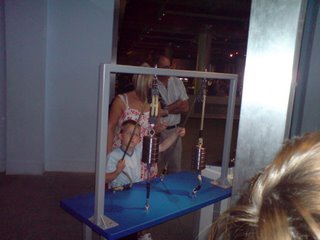
The Launch Pad is very popular. All we can do is hope that the Eleven Plus candidate feels happy, secure and highly stimulated.

Co-operation suddenly becomes more than a buzz word.
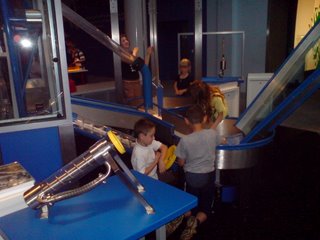
Children work together without arguing.
Grandparents give love and stability. This allows the child to change from being a prospective scientist to a much loved grandchild.

On waking the child can be a child – eating food brought by loving hands.
After breakfast the child can suddenly become a T.V. critic – with a great and determined desire to `just see the end of the program’.
Then there could be time for a little Eleven Plus work. Here we see the role of the serious student. Irritable, short tempered and wanting help `NOW!’. (Please.)
In the car the child becomes a navigator – and starts arguing with the Sat Nav. “We didn’t go this way last time.”
On arrival at the Science Museum the child becomes a child again – wondering afresh at the range of exhibits that span such diversity and depth.
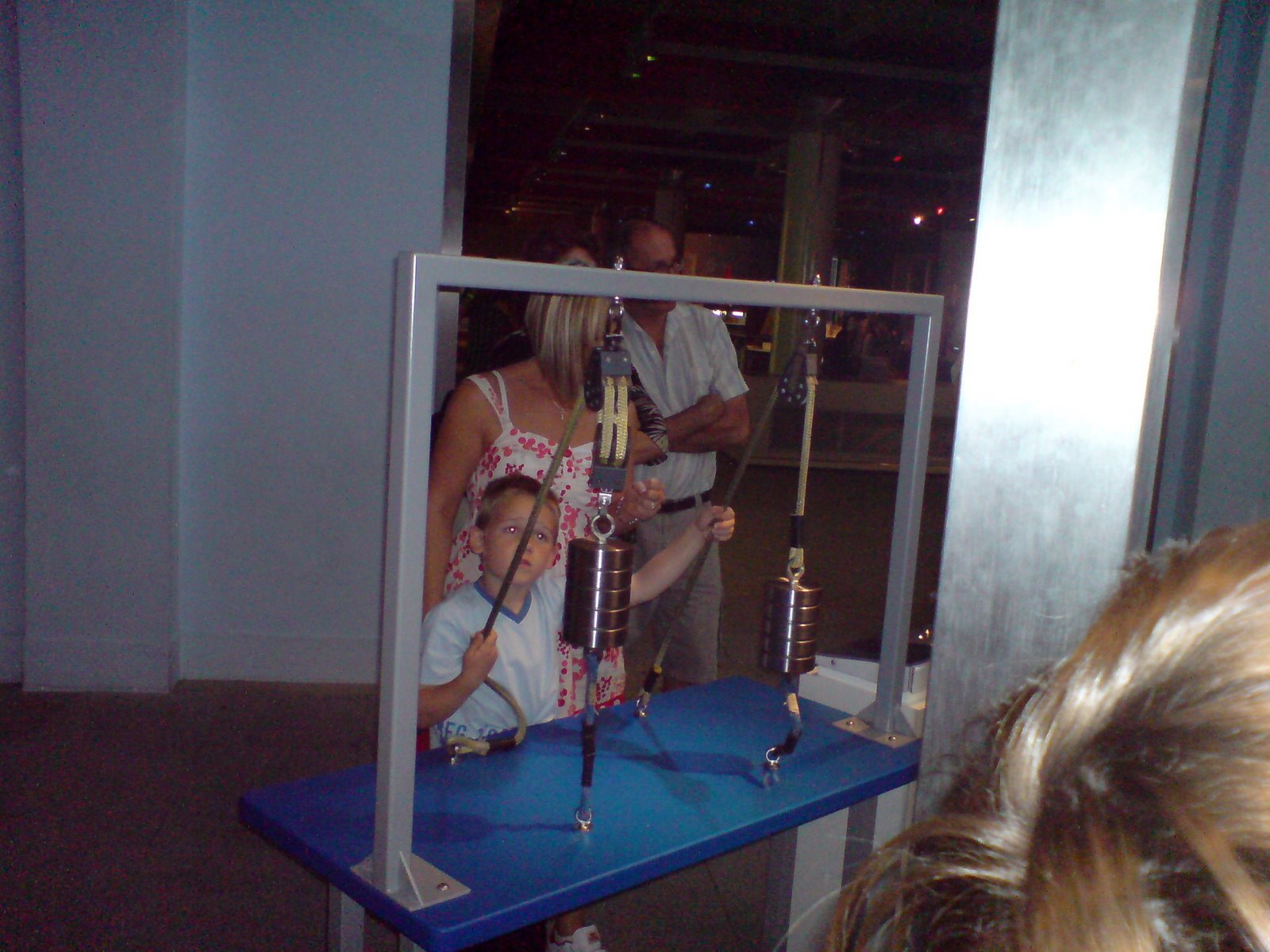
The Launch Pad is very popular. All we can do is hope that the Eleven Plus candidate feels happy, secure and highly stimulated.
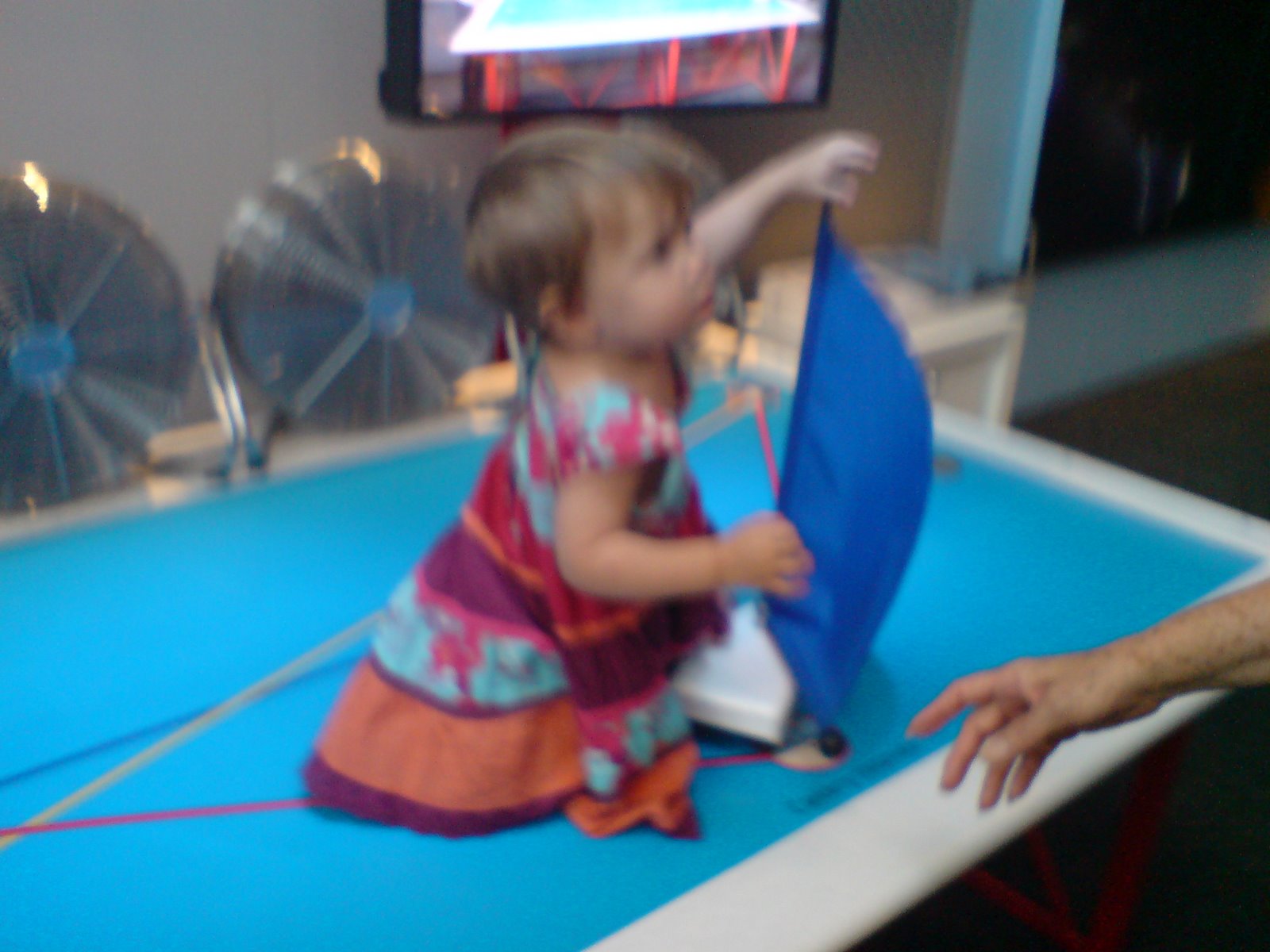
Co-operation suddenly becomes more than a buzz word.
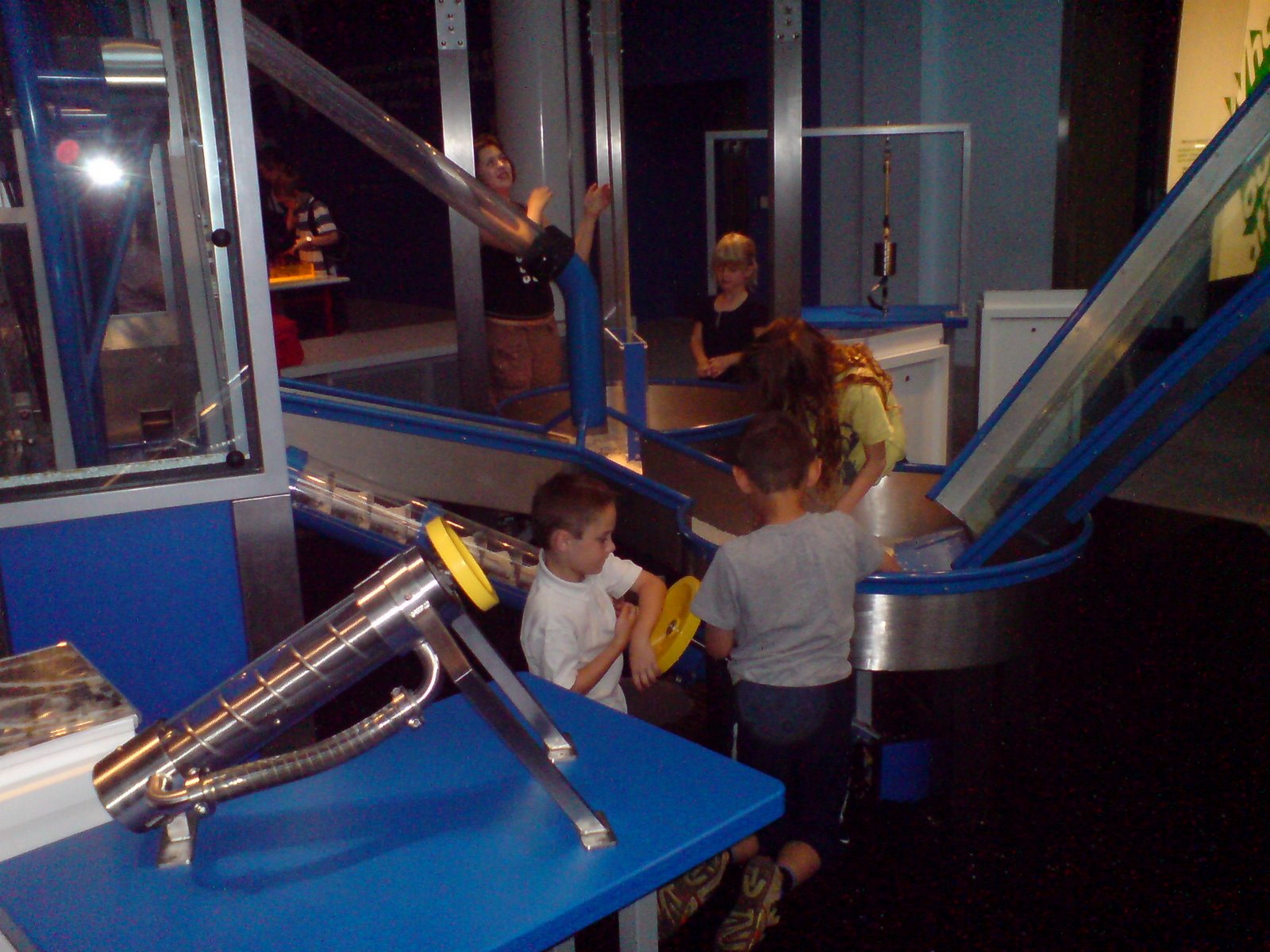
Children work together without arguing.
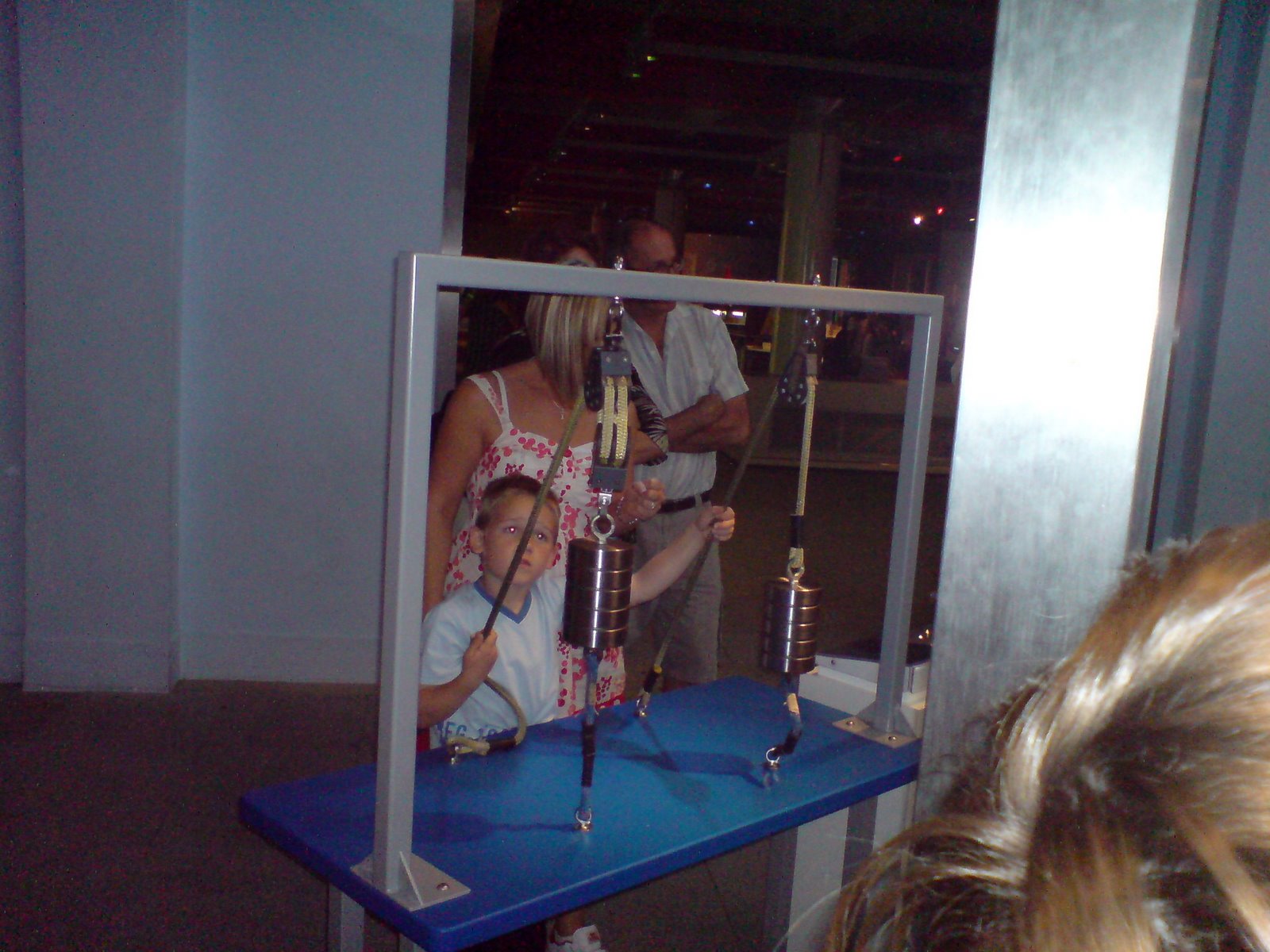
Grandparents give love and stability. This allows the child to change from being a prospective scientist to a much loved grandchild.

Saturday, July 26, 2008
Eleven Plus Reading
“What can I do? I’m bored of the books I have. I want something to read.” Familiar words? I hope so.
You will probably have read aloud all the well known books like “Wind in the Willows” by Kenneth Grahame when your `Eleven Plus Candidate’ was little. Even though this book was written in 1908 it could still be enchanting to a ten year old – because it has fantasy characters and the story is about an illusion. Your child may want to re-read a timeless classic.
No doubt the Dr Dolittle stories (Hugh Lofting), which date back to the 1920s could also give still a good re-read to a ten year old. Other authors from the twenties like A.A, Milne with `Winnie the Poo’ and J.R.R. Tolkien with `The Hobbit’ could also stand the test of being read aloud. All you have to do is find an audience for your child to read to.
In the 1930s authors like Arthur Ransom’s Swallows and Amazons and Emil Kastner’s Emil and the Detective enthralled many children – and the appeal persists today.
Recently members of our family have been listening to the Enid Blyton’s Famous Five stories on audio and the romance of the stories persist. Perhaps you could encourage the writing of a short and simple book – and then recording the book to read to others.
In today’s world there is such a proliferation of books – that there must be something out there that will catch your child’s interest. T.V. brings stories to life in a different way to words on a page. Reading books based on television series can bring great pleasure. The Hannah Montana books, for example, are deeply satisfying to some ten to eleven year olds.
Even though paper back books are relatively cheap – buying ten to twelve of them quickly adds up.
You will probably have read aloud all the well known books like “Wind in the Willows” by Kenneth Grahame when your `Eleven Plus Candidate’ was little. Even though this book was written in 1908 it could still be enchanting to a ten year old – because it has fantasy characters and the story is about an illusion. Your child may want to re-read a timeless classic.
No doubt the Dr Dolittle stories (Hugh Lofting), which date back to the 1920s could also give still a good re-read to a ten year old. Other authors from the twenties like A.A, Milne with `Winnie the Poo’ and J.R.R. Tolkien with `The Hobbit’ could also stand the test of being read aloud. All you have to do is find an audience for your child to read to.
In the 1930s authors like Arthur Ransom’s Swallows and Amazons and Emil Kastner’s Emil and the Detective enthralled many children – and the appeal persists today.
Recently members of our family have been listening to the Enid Blyton’s Famous Five stories on audio and the romance of the stories persist. Perhaps you could encourage the writing of a short and simple book – and then recording the book to read to others.
In today’s world there is such a proliferation of books – that there must be something out there that will catch your child’s interest. T.V. brings stories to life in a different way to words on a page. Reading books based on television series can bring great pleasure. The Hannah Montana books, for example, are deeply satisfying to some ten to eleven year olds.
Even though paper back books are relatively cheap – buying ten to twelve of them quickly adds up.
Friday, July 25, 2008
Eleven Plus Learning
The house is quiet.
The television is off.
The siblings are involved in something or other.
A parent sits down with an Eleven Plus child.
The very bright and highly motivated child does not seem to understand. Oh dear! Emergency! Think of hiring a tutor. Phone the partner. Consider a little parental temper tantrum. Call in reinforcements. Oh dear!
It may help to remember that the way an adult learns is different to the way a child learns.
An adult is able to rely on prior knowledge.
An adult is able to rely on previous experience.
An adult may think that the method that is being used to explain to the child should be easily understood.
An adult may have a set attitude towards learning.
So the parent must say:
“Oh dear – I must remember that to understand this, my child needs information.”
“Oh dear – My child has no previous experience of this. How can I help?”
“Perhaps my method may not be the best.”
“I need to be a little more flexible.”
The television is off.
The siblings are involved in something or other.
A parent sits down with an Eleven Plus child.
The very bright and highly motivated child does not seem to understand. Oh dear! Emergency! Think of hiring a tutor. Phone the partner. Consider a little parental temper tantrum. Call in reinforcements. Oh dear!
It may help to remember that the way an adult learns is different to the way a child learns.
An adult is able to rely on prior knowledge.
An adult is able to rely on previous experience.
An adult may think that the method that is being used to explain to the child should be easily understood.
An adult may have a set attitude towards learning.
So the parent must say:
“Oh dear – I must remember that to understand this, my child needs information.”
“Oh dear – My child has no previous experience of this. How can I help?”
“Perhaps my method may not be the best.”
“I need to be a little more flexible.”
Thursday, July 24, 2008
Class and the Eleven Plus
There is a fascinating article in the New Statesmen today by Danny Dorling.
One of the points he made was that in time gone by more boys were able to attempt Eleven Plus examinations because there were more places for boys.
He argued that the Grammar School boys created a class classification based on men's occupations.
If we look forward to twenty years time, our present Eleven Plus boys and girls will be busy building a new world.
I have the feeling that ability, money and privilege will still count.
One of the points he made was that in time gone by more boys were able to attempt Eleven Plus examinations because there were more places for boys.
He argued that the Grammar School boys created a class classification based on men's occupations.
If we look forward to twenty years time, our present Eleven Plus boys and girls will be busy building a new world.
I have the feeling that ability, money and privilege will still count.
Wednesday, July 23, 2008
Sleep and the Eleven Plus
There is great excitement in the shires tonight. A mother has just re-invented a Sleep Learning.
She spent the afternoon going over percentages with her ten year child. At one stage both parties were in tears. There were hugs and kisses – and a general air of reconciliation developed – and emerged.
The much loved daughter went to bed – and mother sat beside her for an hour reading the notes they had developed on percentages.
“To find ten percent of a number, simply divide by ten.”
We understand that the daughter finally dropped off to sleep with her mother’s voice extolling the delights of percentages. A few minutes later the mother fell asleep in mid sentence – but continuing to read percentage rules to her daughter.
The mother is working on the theme that the brain keeps working - even when the body is asleep.
She spent the afternoon going over percentages with her ten year child. At one stage both parties were in tears. There were hugs and kisses – and a general air of reconciliation developed – and emerged.
The much loved daughter went to bed – and mother sat beside her for an hour reading the notes they had developed on percentages.
“To find ten percent of a number, simply divide by ten.”
We understand that the daughter finally dropped off to sleep with her mother’s voice extolling the delights of percentages. A few minutes later the mother fell asleep in mid sentence – but continuing to read percentage rules to her daughter.
The mother is working on the theme that the brain keeps working - even when the body is asleep.
Tuesday, July 22, 2008
Eleven Plus Class Sizes
Class sizes up to sixty children were common a hundred years ago. There used to be a single teacher who was both revered and feared. Discipline had to be taut. Control had to be absolute. Pain and beatings were administered for small misdemeanours.
The teachers used lots of drill exercises. The class could not progress at the speed of the most able. The teacher could only allow the class to move forward at the speed of the slowest. The children who learnt quickly were expected to help the less able.
Gradually teachers and educationalists were able to argue that education was there to help a child achieve his or her potential. To achieve this laudable aim class sizes had to drop.
We still have one teacher teaching a class. The size and composition of the class can show considerable variation.
Many of our Eleven Plus children are very bright. We tested a child in one of our centres this week who only made three mistakes on two standardised tests. This places the class teacher in his school under tremendous pressure.
The teachers used lots of drill exercises. The class could not progress at the speed of the most able. The teacher could only allow the class to move forward at the speed of the slowest. The children who learnt quickly were expected to help the less able.
Gradually teachers and educationalists were able to argue that education was there to help a child achieve his or her potential. To achieve this laudable aim class sizes had to drop.
We still have one teacher teaching a class. The size and composition of the class can show considerable variation.
Many of our Eleven Plus children are very bright. We tested a child in one of our centres this week who only made three mistakes on two standardised tests. This places the class teacher in his school under tremendous pressure.
Monday, July 21, 2008
Group Tests and the Eleven Plus
Most of the children are writing Eleven Plus examinations will be writing in a group setting Some children will be in their own school. Other children could be at a variety of venues including the local grammar school, the Authority headquarters and sometimes, a different primary school.
Some children will have the advantage of sitting the examination with their own peer group – while others will be working with strangers in an unfamiliar environment.
Some children will relish the idea of a new setting – because they will be pleased to show just what they can do. Others will be less sure of the physical surroundings.
Before the children go into the examination the test will have been standardised and validated on a large number of children. All children, therefore, will be offered the same set of written and oral instructions.
The reliability of the test can only be questioned if the physical circumstances are vastly different from one group of children to another.
Group tests are naturally going to be less accurate than a test administered on a one to one or more personal basis.
Talk to your child – explain what you think will happen in the actual examination room or hall.
Discuss the toilet facilities.
Explain that even in a group setting, with unfamiliar children all around, that it is essential that your child asks for help if there is a problem. There will be little help once the examination is under way – but your child should ask if he or she does not know exactly what to do.
Some children will have the advantage of sitting the examination with their own peer group – while others will be working with strangers in an unfamiliar environment.
Some children will relish the idea of a new setting – because they will be pleased to show just what they can do. Others will be less sure of the physical surroundings.
Before the children go into the examination the test will have been standardised and validated on a large number of children. All children, therefore, will be offered the same set of written and oral instructions.
The reliability of the test can only be questioned if the physical circumstances are vastly different from one group of children to another.
Group tests are naturally going to be less accurate than a test administered on a one to one or more personal basis.
Talk to your child – explain what you think will happen in the actual examination room or hall.
Discuss the toilet facilities.
Explain that even in a group setting, with unfamiliar children all around, that it is essential that your child asks for help if there is a problem. There will be little help once the examination is under way – but your child should ask if he or she does not know exactly what to do.
Sunday, July 20, 2008
The Challenge of the Eleven Plus
We have been told over and over again that an individual’s intelligence develops as a result of interaction between nature and nurture. We would also like to think that the majority of the children writing the Eleven Plus will have had a broadly normal development. All things being equal; the Eleven Plus children will have enjoyed the fruits of a similar environment. We must presume that if a child attends a good school he or she will be stimulated and extended. We all hope that a good home background will contribute towards good results on intelligence tests.
Psychologists, however, can not agree on what intelligence is so the Eleven Plus Authorities have turned towards reasoning tests as a primary selection tool. A reasoning test is designed to use pre-planned questions in order to arrive at a normal curve of distribution. The questions are analysed on an item by item basis. Questions that do discriminate are kept – and the rest discarded.
The scores on Reasoning Tests are then validated against similar tests – and if all is satisfactory – the test is standardised. All books, papers and Eleven Plus exercises are designed to try to help a child to do as well as possible on the reasoning tests.
At the start of the first `real’ Eleven Plus test we all hope that test sophistication will have a bearing on the final scores. It does not necessarily follow that eleven year old children need to do a practice Eleven Plus paper every day. After all ability to do well on reasoning papers is a combination of a number of different abilities. It would be exciting for all of us if provenance of the present reasoning tests could be challenged.
Psychologists, however, can not agree on what intelligence is so the Eleven Plus Authorities have turned towards reasoning tests as a primary selection tool. A reasoning test is designed to use pre-planned questions in order to arrive at a normal curve of distribution. The questions are analysed on an item by item basis. Questions that do discriminate are kept – and the rest discarded.
The scores on Reasoning Tests are then validated against similar tests – and if all is satisfactory – the test is standardised. All books, papers and Eleven Plus exercises are designed to try to help a child to do as well as possible on the reasoning tests.
At the start of the first `real’ Eleven Plus test we all hope that test sophistication will have a bearing on the final scores. It does not necessarily follow that eleven year old children need to do a practice Eleven Plus paper every day. After all ability to do well on reasoning papers is a combination of a number of different abilities. It would be exciting for all of us if provenance of the present reasoning tests could be challenged.
Saturday, July 19, 2008
Eleven Plus Relationships
“Thank you, but why do we need to learn algebra?”
Some children are not simply passive learners – they want to know why and how.
Algebra deals mainly with equations, which are mathematical statements. The statements contain an equals sign such as 3x + 6 = 12. Early on in the primary school the algebra is mainly shown in diagrams and drawings. As children move towards the end of KS2 into KS3 more formal notation is used.
When children say that they `love mathematics’ they are often talking about the creative side of mathematics – where they are encouraged to solve problem. We sometimes work with our more able Eleven Plus children on the equation: y = mx + c.
There would be a general outcry if Eleven Plus papers asked children to cope with ‘y = mx and c’, but bright ten year old mathematics can cope – and enjoy.
“Algebra helps to describe relationships between numbers.”
Some teachers and parents are to be envied if there is time to be able to spend a morning exploring the relationships between numbers.
Some children are not simply passive learners – they want to know why and how.
Algebra deals mainly with equations, which are mathematical statements. The statements contain an equals sign such as 3x + 6 = 12. Early on in the primary school the algebra is mainly shown in diagrams and drawings. As children move towards the end of KS2 into KS3 more formal notation is used.
When children say that they `love mathematics’ they are often talking about the creative side of mathematics – where they are encouraged to solve problem. We sometimes work with our more able Eleven Plus children on the equation: y = mx + c.
There would be a general outcry if Eleven Plus papers asked children to cope with ‘y = mx and c’, but bright ten year old mathematics can cope – and enjoy.
“Algebra helps to describe relationships between numbers.”
Some teachers and parents are to be envied if there is time to be able to spend a morning exploring the relationships between numbers.
Friday, July 18, 2008
Eleven Plus Marking Problems.
There has been lots of discussion on the recent debacle with the results of the SATs tests.
At the turn of the century the `early’ objective tests often had essay questions. The problem then, as today, was that there was considerable difference in the marking. Different examiners marking the same paper would give different marks. The same examiner marking the same paper on a different occasion could give different marks.
This lead objective testing to tend towards lots of short answers. Then along came multiple choice testing. Multiple Choice is the commonest form of objective testing.
The construction and standardisation of tests is done by the large organisations like (NFER) and Moray House.
Reuters has prepared an informative article on the state of progress towards nationwide SATs results.
Within this BBC website:there is a fascinating article on the problems facing markers.
Eleven Plus examinations are now, however, usually multiple choice.
We sometimes have the pleasure, however, of preparing children for Eleven Plus tests where there are no multiple choice questions on certain papers.
At the turn of the century the `early’ objective tests often had essay questions. The problem then, as today, was that there was considerable difference in the marking. Different examiners marking the same paper would give different marks. The same examiner marking the same paper on a different occasion could give different marks.
This lead objective testing to tend towards lots of short answers. Then along came multiple choice testing. Multiple Choice is the commonest form of objective testing.
The construction and standardisation of tests is done by the large organisations like (NFER) and Moray House.
Reuters has prepared an informative article on the state of progress towards nationwide SATs results.
Within this BBC website:there is a fascinating article on the problems facing markers.
Eleven Plus examinations are now, however, usually multiple choice.
We sometimes have the pleasure, however, of preparing children for Eleven Plus tests where there are no multiple choice questions on certain papers.
Thursday, July 17, 2008
Eleven Plus Vocabulary
Our children writing Eleven Plus examinations first of all have to know something. They can not write an Eleven Plus examination with some knowledge.
The children also have to understand what they know. It will be almost impossible for them to be able to answer a question on volume without some understanding of the concept.
In some Eleven plus questions our children will need to be able to think. This could be critical thinking – or distinguishing between facts and opinions or even `thinking outside of the box’.
The children will also need to be able to demonstrate technical ability. This could be the ability to read and understand the instructions at the start of a section and then proceed to answer a number of questions correctly.
There is also the question of communication. This is more than an Eleven Plus child communicating with his or her parents, communication be simply writing down the right answer.
We know, for example, that vocabulary is a vital factor in many different types of examinations. A good vocabulary is essential in verbal reasoning.
Suppose the children were asked to define the concept of `orange’.
Some children would immediately opt for the colour orange.
Other children would interpret the definition of orange being a fruit – and thus describe the word orange in terms of a member of a family or grapefruit, lemons and limes.
Any children watching the recent European Football Championships will recall the vast swathes of orange as Holland played. The orange there was celebrating the House of Orange.
To arrive at the right answer in a verbal reasoning test – where the word `orange’ is involved - our children need to be able to follow different thought processes:
They will need to know in which context the word is being used.
They will have to think to distinguish between the different definitions.
They also have to be able to communicate the answer.
Question 1A: The fruit of an evergreen tree
Question 1B: A colour between read and yellow
Question 1C: The colour of a ruling family in Europe
Eleven plus parents will be working with their children on vocabulary but, as we have just seen, even everyday words can stimulate discussion and conjecture. Keep a dictionary close to hand – especially when working through papers. Talk about words and ideas. Help your child to recognise that exploring words can be exciting and refreshing.
The children also have to understand what they know. It will be almost impossible for them to be able to answer a question on volume without some understanding of the concept.
In some Eleven plus questions our children will need to be able to think. This could be critical thinking – or distinguishing between facts and opinions or even `thinking outside of the box’.
The children will also need to be able to demonstrate technical ability. This could be the ability to read and understand the instructions at the start of a section and then proceed to answer a number of questions correctly.
There is also the question of communication. This is more than an Eleven Plus child communicating with his or her parents, communication be simply writing down the right answer.
We know, for example, that vocabulary is a vital factor in many different types of examinations. A good vocabulary is essential in verbal reasoning.
Suppose the children were asked to define the concept of `orange’.
Some children would immediately opt for the colour orange.
Other children would interpret the definition of orange being a fruit – and thus describe the word orange in terms of a member of a family or grapefruit, lemons and limes.
Any children watching the recent European Football Championships will recall the vast swathes of orange as Holland played. The orange there was celebrating the House of Orange.
To arrive at the right answer in a verbal reasoning test – where the word `orange’ is involved - our children need to be able to follow different thought processes:
They will need to know in which context the word is being used.
They will have to think to distinguish between the different definitions.
They also have to be able to communicate the answer.
Question 1A: The fruit of an evergreen tree
Question 1B: A colour between read and yellow
Question 1C: The colour of a ruling family in Europe
Eleven plus parents will be working with their children on vocabulary but, as we have just seen, even everyday words can stimulate discussion and conjecture. Keep a dictionary close to hand – especially when working through papers. Talk about words and ideas. Help your child to recognise that exploring words can be exciting and refreshing.
Wednesday, July 16, 2008
The Eleven Plus
Many years ago Charles Darwin became involved in studying children. He watched their behaviour and development – and presented a picture of children who were genetically structured to adjust to the environment.
His half-cousin, Francis Galton, demonstrated that children really were individuals – and that they conformed to norms.
It was left to Burt, back in 1921, who popularised testing on a more scientific basis.
Today there are many teachers, educationists and parents who feel that the SATs testing at 7, 11 and 14 is un-necessary.
There are also many opponents of Eleven Plus testing. We met a mum at the recent Kent Show who argued vehemently against the Eleven Plus. She maintained that her bright and able child would do just as well, if not better, in a comprehensive school. We wish the family well.
Standardised tests give us the ability to select on as level a playing field as possible. The problem is the tests we are using today to test children are remarkably similar to those set all those years ago when selection tests were first mooted.
After the Second World Way the five day cricket test was all important. Today every one is talking about Twenty Twenty. The game is still cricket – but the rules have changed. We still have two sides. We still have a wicket. There is still a ball, bowlers, fielders and batsmen. Standing at either end there are the umpires. Today, however, the umpires are aided by modern technology – and a match judge. Twenty Twenty is pulling in the crowds. The game is still cricket – but not cricket as it was known fifty years ago. Time has marched on.
Time must also march on for the psychologists who are devising Eleven Plus tests. New and exciting tests are needed. Children today have had TV from birth; they have mobile phones and access to technology that was not even dreamed of fifty years ago. Surely the Eleven Plus tests should reflect this?
Our organisation is responsible for preparing hundreds of children. There are many more thousands of Eleven Plus children working hard towards the examinations. Surely our children deserve more? It is just not cricket!
His half-cousin, Francis Galton, demonstrated that children really were individuals – and that they conformed to norms.
It was left to Burt, back in 1921, who popularised testing on a more scientific basis.
Today there are many teachers, educationists and parents who feel that the SATs testing at 7, 11 and 14 is un-necessary.
There are also many opponents of Eleven Plus testing. We met a mum at the recent Kent Show who argued vehemently against the Eleven Plus. She maintained that her bright and able child would do just as well, if not better, in a comprehensive school. We wish the family well.
Standardised tests give us the ability to select on as level a playing field as possible. The problem is the tests we are using today to test children are remarkably similar to those set all those years ago when selection tests were first mooted.
After the Second World Way the five day cricket test was all important. Today every one is talking about Twenty Twenty. The game is still cricket – but the rules have changed. We still have two sides. We still have a wicket. There is still a ball, bowlers, fielders and batsmen. Standing at either end there are the umpires. Today, however, the umpires are aided by modern technology – and a match judge. Twenty Twenty is pulling in the crowds. The game is still cricket – but not cricket as it was known fifty years ago. Time has marched on.
Time must also march on for the psychologists who are devising Eleven Plus tests. New and exciting tests are needed. Children today have had TV from birth; they have mobile phones and access to technology that was not even dreamed of fifty years ago. Surely the Eleven Plus tests should reflect this?
Our organisation is responsible for preparing hundreds of children. There are many more thousands of Eleven Plus children working hard towards the examinations. Surely our children deserve more? It is just not cricket!
Tuesday, July 15, 2008
The Eleven Plus Journey
For some children the Eleven Plus examinations represent a form of rite of passage.
Initiation ceremonies prevail in many civilisations. Most of us will carry images of young African children taking part in ceremonies that may seem to be hostile to our eyes. We are also aware of the transition that marked, many years ago, the passage of young Red Indians into adulthood.
At one time the gentle Christian confirmation marked the initiation of children into adults. This was not so much a confirmation ceremony, however, but acceptance into the Church.
For some Eleven Plus children preparing and passing a competitive examination can be likened to some form of initiation. We start with a child, closely protected by parents and teachers, and suddenly thrust `The Candidate’ into the world of competition and work.
Many years ago boys were sent to sea as cabin boys – and then on to become Midshipmen. Imagine your eight year old being pushed onto a ship leaving for far off lands. You would worry that you might not see your child again. Your child would need to adapt from a child centred life to one where everything is adult orientated.
In the Eleven Plus examination your child will be faced with a battery of questions. The work will be timed. You will naturally prepare your child as best you can.
On the day of the examination you will make sure that you offer a healthy meal. You will check for a clean handkerchief. You will offer a warm hug and final words of advice. Your child will leave your arms and go forward bravely (you hope).
To all intents and purposes your child will leave you as a primary school child and return as a potential grammar school pupil. A big jump for both of you!
Initiation ceremonies prevail in many civilisations. Most of us will carry images of young African children taking part in ceremonies that may seem to be hostile to our eyes. We are also aware of the transition that marked, many years ago, the passage of young Red Indians into adulthood.
At one time the gentle Christian confirmation marked the initiation of children into adults. This was not so much a confirmation ceremony, however, but acceptance into the Church.
For some Eleven Plus children preparing and passing a competitive examination can be likened to some form of initiation. We start with a child, closely protected by parents and teachers, and suddenly thrust `The Candidate’ into the world of competition and work.
Many years ago boys were sent to sea as cabin boys – and then on to become Midshipmen. Imagine your eight year old being pushed onto a ship leaving for far off lands. You would worry that you might not see your child again. Your child would need to adapt from a child centred life to one where everything is adult orientated.
In the Eleven Plus examination your child will be faced with a battery of questions. The work will be timed. You will naturally prepare your child as best you can.
On the day of the examination you will make sure that you offer a healthy meal. You will check for a clean handkerchief. You will offer a warm hug and final words of advice. Your child will leave your arms and go forward bravely (you hope).
To all intents and purposes your child will leave you as a primary school child and return as a potential grammar school pupil. A big jump for both of you!
Monday, July 14, 2008
Handwriting and the Eleven Plus
A very pleasant couple approached me at the Kent Show yesterday and asked if we could help with hand writing. Naturally I went through a short series of key questions:
Is he left handed or right handed? (Right)
How old (14 years)
Where is he at school? (Grammar School in Kent)
Has he always had a problem? (Yes – always.)
What is the problem he is having? (Generally untidy.)
Does he want to improve? (Oh yes. The teachers are complaining – and one teacher said he won’t mark any work next year.)
A few suggestions:
Remind him that his work had to have been relatively neat at one time or else he could not have survived at grammar school.
Point out too that in the days of Queen Elizabeth the First `gentlemen’ had to have neat writing.
Suggest too that most teachers have untidy writing because they see so much untidy writing from their pupils.
Conform that in years to come he won’t have to write any thing down because of computers, phones and keyboards. (At school he has to be neat – or else!)
Some practical points:
Never let any letters touch the line. Always write just above the line.
Space the words very carefully – this makes the writing look regular.
Write with both feet flat on the floor – to drive a good posture.
Angle the page correctly – the page should be faced away from the body.
Work especially on the tails top letters for example the tails on a `y’ or a `g’.
Don’t slouch.
Want to write neatly.
Accept a `big’ bribe gracefully.
Is he left handed or right handed? (Right)
How old (14 years)
Where is he at school? (Grammar School in Kent)
Has he always had a problem? (Yes – always.)
What is the problem he is having? (Generally untidy.)
Does he want to improve? (Oh yes. The teachers are complaining – and one teacher said he won’t mark any work next year.)
A few suggestions:
Remind him that his work had to have been relatively neat at one time or else he could not have survived at grammar school.
Point out too that in the days of Queen Elizabeth the First `gentlemen’ had to have neat writing.
Suggest too that most teachers have untidy writing because they see so much untidy writing from their pupils.
Conform that in years to come he won’t have to write any thing down because of computers, phones and keyboards. (At school he has to be neat – or else!)
Some practical points:
Never let any letters touch the line. Always write just above the line.
Space the words very carefully – this makes the writing look regular.
Write with both feet flat on the floor – to drive a good posture.
Angle the page correctly – the page should be faced away from the body.
Work especially on the tails top letters for example the tails on a `y’ or a `g’.
Don’t slouch.
Want to write neatly.
Accept a `big’ bribe gracefully.
Sunday, July 13, 2008
Eleven Plus Future
A conversation at today’s Kent Show.
The time about 08.45. (The show opened officially at 09.00.)
A couple walking by our stand:
“Nice to see you again. My two came to your centre some years ago. X. is twenty nine now and Y is twenty seven.”
“Good morning. Thank you for stopping. It is good to see you again.”
“Yes your people were brilliant. Both children loved the centre.”
“Thank you. What do they do now?”
“They both went to university. X is working as a management consultant. Y is still in Kent. He has started on a new job”
The time about 08.45. (The show opened officially at 09.00.)
A couple walking by our stand:
“Nice to see you again. My two came to your centre some years ago. X. is twenty nine now and Y is twenty seven.”
“Good morning. Thank you for stopping. It is good to see you again.”
“Yes your people were brilliant. Both children loved the centre.”
“Thank you. What do they do now?”
“They both went to university. X is working as a management consultant. Y is still in Kent. He has started on a new job”
Saturday, July 12, 2008
Is this an Eleven Plus Question?
I heard this at the Kent Show today. Please help.
The scenario: A woman and a child standing a few feet from our stand - deep in conversation:
"I am fourteen years older than you."
"How old are you now?"
"Six."
"That is right. I had you fourteen years ago."
If any one can work this out - please let me know.
The scenario: A woman and a child standing a few feet from our stand - deep in conversation:
"I am fourteen years older than you."
"How old are you now?"
"Six."
"That is right. I had you fourteen years ago."
If any one can work this out - please let me know.
Friday, July 11, 2008
Eleven Plus and a White Paper
There was a Government White Paper in 1958 “Secondary Education For All: A New Drive.” (Sounds familiar?)
The paper contended that since children were different they needed courses that would nourish their individual abilities and interests.
The White Paper felt, however, that that it was wrong for a child’s future to be determined by a selection test at the 11-Plus. The government wanted to experiment with comprehensive education in rural communities – and in selected urban communities.
The major political parties voted against each other – and drew battle lines – just as today.
Today’s parents could look back in their family history and work out who voted for the Eleven Plus – and who was against.
The paper contended that since children were different they needed courses that would nourish their individual abilities and interests.
The White Paper felt, however, that that it was wrong for a child’s future to be determined by a selection test at the 11-Plus. The government wanted to experiment with comprehensive education in rural communities – and in selected urban communities.
The major political parties voted against each other – and drew battle lines – just as today.
Today’s parents could look back in their family history and work out who voted for the Eleven Plus – and who was against.
Thursday, July 10, 2008
Eleven Plus Bullies
I listened to a mum today at the leisure centre. She described the problems her daughter has had with bullying at school. The girl is now ten years old and will be taking her Eleven Plus after the summer holidays.
The girl is very bright. She has found Level 5 work easy to cope with and loves the challenge of new work. She is perfectly happy to tackle hard and demanding questions – and is friendly and unassuming. We have enjoyed her company.
It transpires that she has been bullied at school on a regular basis.
Her parents have followed the correct paths. They have spoken to the various teachers, and the head teacher. The mum said: “The teachers have been brilliant. We could not ask for more.”
The girl has had counselling because, in spite of energetic intervention, the problem has persisted. The bullies, apparently, have been unrelenting.
This is a sad tale. The statement was made that it was unlikely that the bullies would follow the girl to grammar school.
The academically gifted have been persecuted for ages. History abounds with able people who have been hounded and pilloried.
The girl is very bright. She has found Level 5 work easy to cope with and loves the challenge of new work. She is perfectly happy to tackle hard and demanding questions – and is friendly and unassuming. We have enjoyed her company.
It transpires that she has been bullied at school on a regular basis.
Her parents have followed the correct paths. They have spoken to the various teachers, and the head teacher. The mum said: “The teachers have been brilliant. We could not ask for more.”
The girl has had counselling because, in spite of energetic intervention, the problem has persisted. The bullies, apparently, have been unrelenting.
This is a sad tale. The statement was made that it was unlikely that the bullies would follow the girl to grammar school.
The academically gifted have been persecuted for ages. History abounds with able people who have been hounded and pilloried.
Wednesday, July 09, 2008
The Eleven Plus and the Psychologist
If your daughter showed precocious athletic talent aged nine it is very likely that you would, at some stage, turn to a sports psychologist for help and advice.
You would want the psychologist to help your child to relax and focus – and really pay attention.
You may agree to your child engaging in other forms of exercise – like Andy Murray did very recently with yoga. He was, we are told, aiming at strength and direction. Before that he had attended an academy in Spain to hone and develop his skills.
The wonderful little Laura Robson who won the Wimbledon Junior Girls title had been coached when she was nine years old by Jo Durie. Over the years Laura must have had the best possible preparation.
So here are some of the components of future Eleven Plus champions:
If you feel you need extra help, find best possible teacher who can relate to your child.
Be prepared for you, and your child, to move out of your comfort zone.
Recognise your child’s strengths and weaknesses – and accept them.
Keep smiling and cheering and offer lots of praise even when all seems to be going down hill. After all your child may, at times, be able to fight back.
If some one other than you appears to understand your child better than you – listen and use what you need for your on-going relationship with your child.
You would want the psychologist to help your child to relax and focus – and really pay attention.
You may agree to your child engaging in other forms of exercise – like Andy Murray did very recently with yoga. He was, we are told, aiming at strength and direction. Before that he had attended an academy in Spain to hone and develop his skills.
The wonderful little Laura Robson who won the Wimbledon Junior Girls title had been coached when she was nine years old by Jo Durie. Over the years Laura must have had the best possible preparation.
So here are some of the components of future Eleven Plus champions:
If you feel you need extra help, find best possible teacher who can relate to your child.
Be prepared for you, and your child, to move out of your comfort zone.
Recognise your child’s strengths and weaknesses – and accept them.
Keep smiling and cheering and offer lots of praise even when all seems to be going down hill. After all your child may, at times, be able to fight back.
If some one other than you appears to understand your child better than you – listen and use what you need for your on-going relationship with your child.
Tuesday, July 08, 2008
11+ Mothers
A mother mentioned today that she thought she would `put her child in' for a number of Eleven Plus examination.
The first examination would be `as a trial'.
The second examination would be the `real examination'
The other two would be backup tests.
Two of the mathematics examinations are multiple choice.
One examination has a story which is not marked. (Unless it is needed.)
In a different Eleven Plus examination the English is marked.
All four examinations do verbal reasoning. Two with multiple choice and two traditional answers.
Fortunately the `Eleven Plus Candidate' is a bright boy - and should enjoy the challenge.
He will write in four different locations.
If he passes one of the Authority Eleven Plus examinations he will be allowed to appeal to try to reach the school of his choice - even if he has already sat the examination and not passed.
Now most mothers have quite busy days. On top of looking after the family, the spouse, a job and serving as an unpaid taxi driver the poor mum has to try to keep everything in her head. Examination dates, transport problems, extra lessons, horse riding, drama, cricket, and Irish Dancing all have to be satisfied and classified.
We wish the family well.
The first examination would be `as a trial'.
The second examination would be the `real examination'
The other two would be backup tests.
Two of the mathematics examinations are multiple choice.
One examination has a story which is not marked. (Unless it is needed.)
In a different Eleven Plus examination the English is marked.
All four examinations do verbal reasoning. Two with multiple choice and two traditional answers.
Fortunately the `Eleven Plus Candidate' is a bright boy - and should enjoy the challenge.
He will write in four different locations.
If he passes one of the Authority Eleven Plus examinations he will be allowed to appeal to try to reach the school of his choice - even if he has already sat the examination and not passed.
Now most mothers have quite busy days. On top of looking after the family, the spouse, a job and serving as an unpaid taxi driver the poor mum has to try to keep everything in her head. Examination dates, transport problems, extra lessons, horse riding, drama, cricket, and Irish Dancing all have to be satisfied and classified.
We wish the family well.
Monday, July 07, 2008
Parents and the Eleven Plus
Parents sometimes have difficulty in encouraging their children to participate fully in the `Eleven Plus Experience’. Another way of developing this concept is to suggest that the much loved child, on this occasion, simply does not want to do any extra work.
Naturally this calls for a parental pep talk. A pep talk where parents go though the full range of emotions. One moment they are appealing to their child’s better side, the next a threatening frown flutters across the face and then the straight forward bribe is offered. Only a parent can rationalise all these three threads into one three minute pep talk.
You child needs to understand that it is essential that he or she is attentive.
It is also important that your child wants to learn.
And thirdly the work must be appropriate. It is no good asking for a speed test on a full Eleven Plus paper when your child simply does not feel like doing the work.
Naturally this calls for a parental pep talk. A pep talk where parents go though the full range of emotions. One moment they are appealing to their child’s better side, the next a threatening frown flutters across the face and then the straight forward bribe is offered. Only a parent can rationalise all these three threads into one three minute pep talk.
You child needs to understand that it is essential that he or she is attentive.
It is also important that your child wants to learn.
And thirdly the work must be appropriate. It is no good asking for a speed test on a full Eleven Plus paper when your child simply does not feel like doing the work.
Sunday, July 06, 2008
Eleven Plus Food
“You have had your chips. I am going to sort this out!”
If you tell your child that he or she had had his chips it either means that something bad is going to happen or that he or she is going to get what is deserved.
The Schools Minister has just announced children at secondary school are going to have to stay at school at lunch time to encourage healthier eating. Primary school children have much less freedom to leave the school’s premises within school hours.
When you child arrives at grammar school, after all that hard work, it could be that a basic freedom is denied. No lunch time chips.
This means that there is possibly a third meaning, which your Eleven Plus child will have to get used to. “You have had your chips,” may mean no more than no more potato chips until your child has left school.
If you tell your child that he or she had had his chips it either means that something bad is going to happen or that he or she is going to get what is deserved.
The Schools Minister has just announced children at secondary school are going to have to stay at school at lunch time to encourage healthier eating. Primary school children have much less freedom to leave the school’s premises within school hours.
When you child arrives at grammar school, after all that hard work, it could be that a basic freedom is denied. No lunch time chips.
This means that there is possibly a third meaning, which your Eleven Plus child will have to get used to. “You have had your chips,” may mean no more than no more potato chips until your child has left school.
Saturday, July 05, 2008
Starting Eleven Plus Work.
Four sets of parents asked today:
"My son is leaving Year Three. When should he start lessons?"
"Is he reading?"
"Yes, a little, but he loves maths."
"Please encourage him to read. Develop his reading vocabulary. He will find that he needs a strong reading vocabulary."
"My son is leaving Year Three. When should he start lessons?"
"Is he reading?"
"Yes, a little, but he loves maths."
"Please encourage him to read. Develop his reading vocabulary. He will find that he needs a strong reading vocabulary."
Friday, July 04, 2008
Sats and Eleven Plus
We heard today that the SATs results are to be delayed by a week.
Poor children.
Poor parents.
Poor teachers.
How sad for every head teacher.
We hope that this will not happen to the Eleven Plus results.
Poor children.
Poor parents.
Poor teachers.
How sad for every head teacher.
We hope that this will not happen to the Eleven Plus results.
Thursday, July 03, 2008
New Eleven Plus Examinations
"Have you got your phone, dear?"
"Yes mum."
"Is it fully charged?"
Yes thank you mum."
"Did your sister give you back your sim card?"
"Yes thank you mum."
"You are not on pay as you go. You are on a new contract so you take your time over the answers. Don't rush!"
"Yes mum."
Conversations like this will be taking place all over England when a radical change is made to the Eleven Plus examinations. Children will be tested through their mobile phones. They won't need to sit in stiff rows answering questions. They will be able to `chill' and do their examinations in comfort. Many boys and girls will love the challenge of the new technology.
Eleven Plus standards will rise. Grammar schools will benefit.
Why?
Because a lecturer has found a new way of communicating with his students. We can use this leap in technology to force through much needed changes to the way the Eleven Plus examinations are administered.
"Yes mum."
"Is it fully charged?"
Yes thank you mum."
"Did your sister give you back your sim card?"
"Yes thank you mum."
"You are not on pay as you go. You are on a new contract so you take your time over the answers. Don't rush!"
"Yes mum."
Conversations like this will be taking place all over England when a radical change is made to the Eleven Plus examinations. Children will be tested through their mobile phones. They won't need to sit in stiff rows answering questions. They will be able to `chill' and do their examinations in comfort. Many boys and girls will love the challenge of the new technology.
Eleven Plus standards will rise. Grammar schools will benefit.
Why?
Because a lecturer has found a new way of communicating with his students. We can use this leap in technology to force through much needed changes to the way the Eleven Plus examinations are administered.
Wednesday, July 02, 2008
Eleven Plus Papers
There is more to preparing for the Eleven Plus than working through a range of Eleven Plus papers. We need to draw a little picture. We have a boy who is the `top’ groups at school. He is well liked by everyone in the class, good at games and enjoys work. He tells his parents that he wants to go to grammar school.
The family go out to buy the latest Eleven Plus papers. They also download lots of free papers. They lay the papers out all over the floor and try to get a picture of just how much has to be done. They down load a copy of the prospectus from the internet.
The next morning the family drive to the nearest grammar school and walk as far as they can around the perimeter. They sit in the shadow of a big tree and pass pages of the prospectus around. The family then find the nearest bus stop and work out the logistics of school journeys.
This then is evidence of good preparation – possibly even establishing an Eleven Plus framework. But when the hammer beats down how will our Eleven Plus candidate react?
He will need to be able to cope with lots of verbal information. He will need to learn facts, make generalisations and, at times, think!
He will need to be able to demonstrate that he has high level intellectual skills. It is a temptation to call a person an `intellectual’ when they are given the opportunity to be able to demonstrate their wide vocabulary.
He will need to have the right attitude. He must be able to listen – and reflect. He must be willing to learn. He must want to `get to grammar’.
Finally, he must want to work through a selection of Eleven Plus papers.
The family go out to buy the latest Eleven Plus papers. They also download lots of free papers. They lay the papers out all over the floor and try to get a picture of just how much has to be done. They down load a copy of the prospectus from the internet.
The next morning the family drive to the nearest grammar school and walk as far as they can around the perimeter. They sit in the shadow of a big tree and pass pages of the prospectus around. The family then find the nearest bus stop and work out the logistics of school journeys.
This then is evidence of good preparation – possibly even establishing an Eleven Plus framework. But when the hammer beats down how will our Eleven Plus candidate react?
He will need to be able to cope with lots of verbal information. He will need to learn facts, make generalisations and, at times, think!
He will need to be able to demonstrate that he has high level intellectual skills. It is a temptation to call a person an `intellectual’ when they are given the opportunity to be able to demonstrate their wide vocabulary.
He will need to have the right attitude. He must be able to listen – and reflect. He must be willing to learn. He must want to `get to grammar’.
Finally, he must want to work through a selection of Eleven Plus papers.
Tuesday, July 01, 2008
Are Eleven Plus Children the Elite?
In any discussion on the Eleven Plus the question of elitism must be aired. Why should bright and able children be offered extra resources when it is possible that they should be able to make good use of the existing educational system?
A number of Eleven Plus children must fall into the group called the very able or `gifted’. We, in Etc, are sometimes privileged to be able to work with children who are in the top one or two percent of the population. We then have the opportunity of being able to try to help to develop the children in a variety of way.
As we are dealing with nine to eleven year olds we are sometimes able to discuss the type of Eleven Plus work with the child and the parents. Some `families’ opt for acceleration so that the child is able to do the work of older children. We have a specialist Eleven Plus room in one of our centres where very bright children can meet once a week and work together in an atmosphere of endeavour and excitement. Other children, and their parents, simply prefer enrichment and more directed Eleven Plus work.
Coping with a wide range of Eleven Plus children does demand a need for individualised learning programs. Many of our brighter children love having the feeling of control over their work. Some children are perfectly happy to work on their own, at times, and relish in a struggle to solve problems. Some of the less able candidates prefer to have the work explained to them in fine detail. Occasionally, however, we meet a really bright child who demands to have work explained – just to be able to have the opportunity of engaging in endless discussions and arguments.
We do expect `Eleven Plus’ children to make a significant contribution later on in life. Some of the Eleven Plus children will go on to become important leaders. Naturally some children who did not go to grammar school will also emerge as leaders. Attending a grammar school will open some doors – but not every door. Thank goodness that `born leaders’ will emerge from a wide spectrum of schools.
A number of Eleven Plus children must fall into the group called the very able or `gifted’. We, in Etc, are sometimes privileged to be able to work with children who are in the top one or two percent of the population. We then have the opportunity of being able to try to help to develop the children in a variety of way.
As we are dealing with nine to eleven year olds we are sometimes able to discuss the type of Eleven Plus work with the child and the parents. Some `families’ opt for acceleration so that the child is able to do the work of older children. We have a specialist Eleven Plus room in one of our centres where very bright children can meet once a week and work together in an atmosphere of endeavour and excitement. Other children, and their parents, simply prefer enrichment and more directed Eleven Plus work.
Coping with a wide range of Eleven Plus children does demand a need for individualised learning programs. Many of our brighter children love having the feeling of control over their work. Some children are perfectly happy to work on their own, at times, and relish in a struggle to solve problems. Some of the less able candidates prefer to have the work explained to them in fine detail. Occasionally, however, we meet a really bright child who demands to have work explained – just to be able to have the opportunity of engaging in endless discussions and arguments.
We do expect `Eleven Plus’ children to make a significant contribution later on in life. Some of the Eleven Plus children will go on to become important leaders. Naturally some children who did not go to grammar school will also emerge as leaders. Attending a grammar school will open some doors – but not every door. Thank goodness that `born leaders’ will emerge from a wide spectrum of schools.
Monday, June 30, 2008
The Value of the Eleven Plus
Demitri Coryton, the Editor of the Education Journal, puts forward a strong case for comprehensives creating opportunities for children to do well academically.
The four comments which follow the article are equally telling – as they expose a wide range of opinion on the value of the grammar school.
The four comments which follow the article are equally telling – as they expose a wide range of opinion on the value of the grammar school.
Sunday, June 29, 2008
Eleven Plus Balance
There must be a strong relationship between what your child has to learn for the Eleven Plus and your child’s self concept.
`Self Concept’ is to do with your child’s self image. Does your child feel that he or she is hard working and attentive during eleven plus work? As parents and teachers we have to try to build a realistic self image. If your child is feeling a little under pressure you are going to struggle to build a positive self image.
As well as trying to help your child build a positive self image you will also need to build your child’s self esteem. Esteem is to do with self evaluation.
If your child experiences failure, while working through eleven plus exercises, you will not be building a good self image. There is a real problem; however, that one child’s failure is possibly another child’s success. This is where parents have to be realistic in what they say while they are trying to motivate their child.
“I am so proud of you. You are trying so hard. We are making good progress.” Words like these could be music in the ears of one child – but serve to alienate another child.
Parents can possibly get caught up in hoping that a form of `self prophecy’ will catapult their child towards better marks in eleven plus preparation and, in time, towards passing the Eleven Plus. Your child may, however, make better strides towards examination success by working through a series of graded exercises than by a battery of exhortations. If expectations are too high, and demands too unrealistic, then you could be damaging your child’s self concept.
It must be easy for some children working towards a competitive examination to assimilate the anxiety of the parent. This in itself could inhibit learning.
It would also be easy for a minority of parents to use the `anxiety tool’ to try to motivate their child to want to study. After all fear of failure is a very strong emotion in most of us. Some children may feel fearful if they do not maintain consistently high marks on Eleven Plus papers. Other children may be fearful about the consequences of not passing the Eleven Plus.
Maintaining a balance between trying to build a child up and being realistic must be tricky for some parents. After all, no mother wants to labelled `pushy’. No father will want to fall into the category of being `an over anxious’ dad.
The mantra probably needs to be: “Just do the best you can, dear.”
`Self Concept’ is to do with your child’s self image. Does your child feel that he or she is hard working and attentive during eleven plus work? As parents and teachers we have to try to build a realistic self image. If your child is feeling a little under pressure you are going to struggle to build a positive self image.
As well as trying to help your child build a positive self image you will also need to build your child’s self esteem. Esteem is to do with self evaluation.
If your child experiences failure, while working through eleven plus exercises, you will not be building a good self image. There is a real problem; however, that one child’s failure is possibly another child’s success. This is where parents have to be realistic in what they say while they are trying to motivate their child.
“I am so proud of you. You are trying so hard. We are making good progress.” Words like these could be music in the ears of one child – but serve to alienate another child.
Parents can possibly get caught up in hoping that a form of `self prophecy’ will catapult their child towards better marks in eleven plus preparation and, in time, towards passing the Eleven Plus. Your child may, however, make better strides towards examination success by working through a series of graded exercises than by a battery of exhortations. If expectations are too high, and demands too unrealistic, then you could be damaging your child’s self concept.
It must be easy for some children working towards a competitive examination to assimilate the anxiety of the parent. This in itself could inhibit learning.
It would also be easy for a minority of parents to use the `anxiety tool’ to try to motivate their child to want to study. After all fear of failure is a very strong emotion in most of us. Some children may feel fearful if they do not maintain consistently high marks on Eleven Plus papers. Other children may be fearful about the consequences of not passing the Eleven Plus.
Maintaining a balance between trying to build a child up and being realistic must be tricky for some parents. After all, no mother wants to labelled `pushy’. No father will want to fall into the category of being `an over anxious’ dad.
The mantra probably needs to be: “Just do the best you can, dear.”
Saturday, June 28, 2008
Eleven Plus Realism
There were a number of school fetes today – in our area – and more than likely round the country. The essential ingredients of a fete are:
• A small, but dedicated, group of parents who are willing to talk, and plan.
• A date set far in advance – but about to be overcome by a larger event somewhere else in town.
• A willingness of other parents to attend, participate and spend money!
• Good weather.
• Many stalls manned, and `womaned’, by enthusiastic parents who want to share in the excitement of the day.
• Lots of children who `need’ a myriad of discards from other families.
• A caretaker who wants everything to go well.
• A warm and caring Head Teacher and Staff who look forward to the event.
In terms of extra tuition it means that some teachers are happily willing to sacrifice their Saturday jobs to go to the fete. (This I how I landed up testing today.)
A mother and child came in. He was the first child we had seen who had passed through the Making Good Progress pilot scheme. The mother was highly complementary about the benefits to her son. He had had help with tables and division. He had really enjoyed the one to one contact with a different teacher from his school.
So this is a `good feeling’ account. Good weather, great children and a wonderful and realistic mother. Being a teacher is incredibly rewarding at times.
• A small, but dedicated, group of parents who are willing to talk, and plan.
• A date set far in advance – but about to be overcome by a larger event somewhere else in town.
• A willingness of other parents to attend, participate and spend money!
• Good weather.
• Many stalls manned, and `womaned’, by enthusiastic parents who want to share in the excitement of the day.
• Lots of children who `need’ a myriad of discards from other families.
• A caretaker who wants everything to go well.
• A warm and caring Head Teacher and Staff who look forward to the event.
In terms of extra tuition it means that some teachers are happily willing to sacrifice their Saturday jobs to go to the fete. (This I how I landed up testing today.)
A mother and child came in. He was the first child we had seen who had passed through the Making Good Progress pilot scheme. The mother was highly complementary about the benefits to her son. He had had help with tables and division. He had really enjoyed the one to one contact with a different teacher from his school.
So this is a `good feeling’ account. Good weather, great children and a wonderful and realistic mother. Being a teacher is incredibly rewarding at times.
Friday, June 27, 2008
Eleven Plus News
Laura Clarke, in the Mail Online, reported on the number of children in Grammar School growing.
There is an Eleven Plus test in the Telegraph for interested parties to try.
The is also news about a book on the Eleven Plus in the Telegraph.
There is an Eleven Plus test in the Telegraph for interested parties to try.
The is also news about a book on the Eleven Plus in the Telegraph.
Thursday, June 26, 2008
Eleven Plus Questions
A Brief Survey on Parental Aspirations: (Where 0 is low and 5 is high)
Why do you want your child to go to grammar school?
The standard of teaching and learning would be better
0 – 1 – 2 – 3 – 4- 5
Children would learn more than at other schools.
0 – 1 – 2 – 3 – 4- 5
Grammar schools lead to better career prospects
0 – 1 – 2 – 3 – 4- 5
The grammar school curriculum is `better’.
0 – 1 – 2 – 3 – 4- 5
The subjects a grammar school offers will interest the children.
0 – 1 – 2 – 3 – 4- 5
Grammar schools will stretch academic ability.
0 – 1 – 2 – 3 – 4- 5
Grammar schools will develop intellectual ability
0 – 1 – 2 – 3 – 4- 5
Grammar schools will develop leaders.
0 – 1 – 2 – 3 – 4- 5
There are social advantages in going to grammar school.
0 – 1 – 2 – 3 – 4- 5
The traditions of grammar school are an advantage.
0 – 1 – 2 – 3 – 4- 5
Grammar schools develop character.
0 – 1 – 2 – 3 – 4- 5
Grammar schools prepare children for life.
0 – 1 – 2 – 3 – 4- 5
Parents feel that their children will mix with the `right type of child’.
0 – 1 – 2 – 3 – 4- 5
Some of these statements may stimulate discussion.
Why do you want your child to go to grammar school?
The standard of teaching and learning would be better
0 – 1 – 2 – 3 – 4- 5
Children would learn more than at other schools.
0 – 1 – 2 – 3 – 4- 5
Grammar schools lead to better career prospects
0 – 1 – 2 – 3 – 4- 5
The grammar school curriculum is `better’.
0 – 1 – 2 – 3 – 4- 5
The subjects a grammar school offers will interest the children.
0 – 1 – 2 – 3 – 4- 5
Grammar schools will stretch academic ability.
0 – 1 – 2 – 3 – 4- 5
Grammar schools will develop intellectual ability
0 – 1 – 2 – 3 – 4- 5
Grammar schools will develop leaders.
0 – 1 – 2 – 3 – 4- 5
There are social advantages in going to grammar school.
0 – 1 – 2 – 3 – 4- 5
The traditions of grammar school are an advantage.
0 – 1 – 2 – 3 – 4- 5
Grammar schools develop character.
0 – 1 – 2 – 3 – 4- 5
Grammar schools prepare children for life.
0 – 1 – 2 – 3 – 4- 5
Parents feel that their children will mix with the `right type of child’.
0 – 1 – 2 – 3 – 4- 5
Some of these statements may stimulate discussion.
Wednesday, June 25, 2008
Adding a Challenge to Eleven Plus Tests
Back in 1926 Goodenough suggested a test of mental and perceptual ability.
The test is cheap and easy to administrate. The instructions are remarkably simple. Children were asked to draw three figures: a man, a woman and them selves.
Mental age is worked out by adding a selection of key targets.
Head 1 point
Neck 1 point
Eyes 1 point
Nose 1 point
Mouth 1 point
Hair 1 point
Naturally the more points a child can `draw’ the higher the mental age. This may seem a crude type of test when we look at a one of today’s commercially available nfer tests – but the Goodenough test does demand attention to detail. Some of the present non verbal reasoning tests require children to count little lines and dots. This is like expecting a child to remember to include eyebrows and knobbly knees in a drawing.
If the Goodenough Draw a Man test was to be included in Eleven Plus examinations parents would need to recruit tutors and teachers with strength in drawing.
Pre Eleven Plus children would walk around with sketch books looking for `interesting’ faces to draw. Members of the public would walk around with horse collars – to show that they had the ability to `gurn’. After all no self respecting Eleven Plus child would want to draw a stylised baby face. An unlikely looking gurn would be far more attractive.
Grandparents would know what to give for birthdays and Christmas – a quality sketch book and a selection of suitable pencils. Stationers would welcome the increased sales.
Pictures formerly stuck on the fridge would be retained in folders – as evidence of early artistic ability. (Just in case artistic ability would become a factor in any appeal situation.)
Long neglected maiden aunts – with artistic ability – would be courted by the family. After all the mildly eccentric `Aunty’ would become a valuable commodity in the search for the perfect Eleven Plus Score.
Visits to the National Gallery by families with eleven year old children would double. Children would sit in front of paintings by the masters – looking for inspiration. Families would not visit Paris to go on Disneyland rides – but would sit on the banks of the Seine searching for the perfect face to draw.
Finally just think how an attentive mother could help her child to collect extra points. She could steal a march on other parents by directing her child’s attention to feet. After all the foot has 26 bones, 33 joints, and more than 100 tendons, muscles, and ligaments.
Eleven Plus examinations are supposed to challenge and stimulate children. The ability to execute a series of lightening sketches would certainly add another element.
The test is cheap and easy to administrate. The instructions are remarkably simple. Children were asked to draw three figures: a man, a woman and them selves.
Mental age is worked out by adding a selection of key targets.
Head 1 point
Neck 1 point
Eyes 1 point
Nose 1 point
Mouth 1 point
Hair 1 point
Naturally the more points a child can `draw’ the higher the mental age. This may seem a crude type of test when we look at a one of today’s commercially available nfer tests – but the Goodenough test does demand attention to detail. Some of the present non verbal reasoning tests require children to count little lines and dots. This is like expecting a child to remember to include eyebrows and knobbly knees in a drawing.
If the Goodenough Draw a Man test was to be included in Eleven Plus examinations parents would need to recruit tutors and teachers with strength in drawing.
Pre Eleven Plus children would walk around with sketch books looking for `interesting’ faces to draw. Members of the public would walk around with horse collars – to show that they had the ability to `gurn’. After all no self respecting Eleven Plus child would want to draw a stylised baby face. An unlikely looking gurn would be far more attractive.
Grandparents would know what to give for birthdays and Christmas – a quality sketch book and a selection of suitable pencils. Stationers would welcome the increased sales.
Pictures formerly stuck on the fridge would be retained in folders – as evidence of early artistic ability. (Just in case artistic ability would become a factor in any appeal situation.)
Long neglected maiden aunts – with artistic ability – would be courted by the family. After all the mildly eccentric `Aunty’ would become a valuable commodity in the search for the perfect Eleven Plus Score.
Visits to the National Gallery by families with eleven year old children would double. Children would sit in front of paintings by the masters – looking for inspiration. Families would not visit Paris to go on Disneyland rides – but would sit on the banks of the Seine searching for the perfect face to draw.
Finally just think how an attentive mother could help her child to collect extra points. She could steal a march on other parents by directing her child’s attention to feet. After all the foot has 26 bones, 33 joints, and more than 100 tendons, muscles, and ligaments.
Eleven Plus examinations are supposed to challenge and stimulate children. The ability to execute a series of lightening sketches would certainly add another element.
Tuesday, June 24, 2008
Eleven Plus Sampling
We often hear talk about how `experts' draw inferences from data taken in a sample.
If we could do a study on all children who gained places in grammar schools this year we would not be drawing on a normally distributed sample of children. We would be looking at bright and able children who had the ability to do well on tests. This would be a biased sample of all the children spread across England.
Another example of a biased sample would be if views on grammar schools were sought from all families who owned three cars. This would not be a representative sample of every one in the whole country.
To obtain a sample that avoids bias, use is made of random samples. This would involve writing every name of the parents of every Year Six child on a slip of paper. We would then need to put all the slips into a great big drum, and then draw out a number of names. If only three names were drawn then this could not be considered a truly unbiased sample. As the data can only from Year 6 parents, we would need to treat the Year 6 data as not being truly representative of the all the children in England.
When our children sit an Eleven Plus test they are working from a sample of questions held in a data base.
If we could do a study on all children who gained places in grammar schools this year we would not be drawing on a normally distributed sample of children. We would be looking at bright and able children who had the ability to do well on tests. This would be a biased sample of all the children spread across England.
Another example of a biased sample would be if views on grammar schools were sought from all families who owned three cars. This would not be a representative sample of every one in the whole country.
To obtain a sample that avoids bias, use is made of random samples. This would involve writing every name of the parents of every Year Six child on a slip of paper. We would then need to put all the slips into a great big drum, and then draw out a number of names. If only three names were drawn then this could not be considered a truly unbiased sample. As the data can only from Year 6 parents, we would need to treat the Year 6 data as not being truly representative of the all the children in England.
When our children sit an Eleven Plus test they are working from a sample of questions held in a data base.
Monday, June 23, 2008
The Reliability of Eleven Plus Tests
Some of our children will be sitting an Eleven Plus test set by the Local Authority. Some of same children could also be sitting an Eleven Plus test in a different Authority.
Some children will sit a Local Authority tests as well as an entrance test for a local school. (One year we had a very bright girl who passed two different Local Authority tests and three entrance examinations set by different schools. She passed all five examinations – and was offered a place by all five!)
When GL Assessments are asked to provide tests they are able to draw on a wide variety of questions that have been properly validated. GL Assessments is the new name for NferNelson.
To make sure that the tests are reliable, the items in the test, and the results, have to be able to demonstrate consistency. To do this the test scores have to be free from chance errors. After all you don’t want your child to be faced by an unfair question.
The test-retest method of working out reliability is to set the test – and repeat the test some time later. This would show just how stable the test is. There has to be a time element - otherwise children would remember the questions – and the answers.
The other method of validating results is to use an equivalent test. This test can be administered again almost immediately.
When some parents feel that one test is harder than another - it is highly likely that the tests continue to be reliable. The difference may come in the interpretation of results. One school may demand a higher `pass rate’ than another.
We use the Eleven Plus test scores to try to predict future academic success. To see how reliable the Eleven Plus tests are we need to look at GCSE and `A’ Level results. After all if a child earns a place in a grammar school – we do expect that child to do well academically.
Some children will sit a Local Authority tests as well as an entrance test for a local school. (One year we had a very bright girl who passed two different Local Authority tests and three entrance examinations set by different schools. She passed all five examinations – and was offered a place by all five!)
When GL Assessments are asked to provide tests they are able to draw on a wide variety of questions that have been properly validated. GL Assessments is the new name for NferNelson.
To make sure that the tests are reliable, the items in the test, and the results, have to be able to demonstrate consistency. To do this the test scores have to be free from chance errors. After all you don’t want your child to be faced by an unfair question.
The test-retest method of working out reliability is to set the test – and repeat the test some time later. This would show just how stable the test is. There has to be a time element - otherwise children would remember the questions – and the answers.
The other method of validating results is to use an equivalent test. This test can be administered again almost immediately.
When some parents feel that one test is harder than another - it is highly likely that the tests continue to be reliable. The difference may come in the interpretation of results. One school may demand a higher `pass rate’ than another.
We use the Eleven Plus test scores to try to predict future academic success. To see how reliable the Eleven Plus tests are we need to look at GCSE and `A’ Level results. After all if a child earns a place in a grammar school – we do expect that child to do well academically.
Sunday, June 22, 2008
Eleven Plus Prayers
At one time or another we all need the patience of a saint to be able to deal with the vagaries of the Eleven Plus child.
An anonymous 17th Century nun may have words that can help us:
“LORD Thou knowest better than I know myself that I am growing older and will some day be old. Keep me from the fatal habit of thinking that I must say something on every subject and on every occasion. Make me thoughtful but not moody; helpful but not bossy.
Give me the ability to see good things in unexpected places, and talents in unexpected people. And, give me, O Lord, the grace to tell them so.”
It would be wonderful if your eleven year old stopped being moody and became thoughtful. At times you would love your eleven year old to be helpful but not bossy. Above all just think what it would be like if your eleven year old did not think that it was essential to say something on every subject.
An anonymous 17th Century nun may have words that can help us:
“LORD Thou knowest better than I know myself that I am growing older and will some day be old. Keep me from the fatal habit of thinking that I must say something on every subject and on every occasion. Make me thoughtful but not moody; helpful but not bossy.
Give me the ability to see good things in unexpected places, and talents in unexpected people. And, give me, O Lord, the grace to tell them so.”
It would be wonderful if your eleven year old stopped being moody and became thoughtful. At times you would love your eleven year old to be helpful but not bossy. Above all just think what it would be like if your eleven year old did not think that it was essential to say something on every subject.
Saturday, June 21, 2008
The Cream of the Eleven Plus
My grandparents farmed in Zimbabwe for many years. My grandfather, Mr W.G. Hamman, believed in diversification. The farm had horses, cattle, maize, tobacco, vegetables, fruit orchards and a wide variety of pigs, sheep, goats, ducks, geese and chickens.
I was a small boy when a large covered truck arrived on the farm. Planks were carefully attached to the rear and a massive bull strode majestically onto the African soil. It was the first Friesland bull to be introduced into the district. Rhodesian cattle were traditionally small boned – and remarkably mobile. The bull was there to build a dairy herd.
Farmers and their families came from all over to see the bull arrive. It had travelled from England, on a boat and then by train. Government vets also came to wonder at the size of the bull.
A two hundred strong party took place in the tobacco barns and outside under the trees. My grandparents supplied pig, sheep and a young bullock for food. The rest of the produce came from the farm. Naturally every family brought food and drink. I have an idea that most people seemed to go home the next morning.
The milk yield grew year after year. The farm supplied fresh milk to the local town and made cream and butter. The cream was rich and plentiful. The first batch was usually `creamed’ off for use by the family.
`Creaming’ is a term usually supplied to highly selective schools. These are the schools that attract the most able pupils – leaving the other children to be shared among the rest of the schools in the vicinity.
The phrase the `cream will rise to the top’ can be defended, by some, on the grounds that the country needs bright, well taught children.
Much more attention should be given to children who just fail the Eleven Plus. Over and over we hear of children who could have benefited from a grammar education but failed for the want of one or two marks. Thank goodness for the `grammar’ stream in so many non selective schools.
I was a small boy when a large covered truck arrived on the farm. Planks were carefully attached to the rear and a massive bull strode majestically onto the African soil. It was the first Friesland bull to be introduced into the district. Rhodesian cattle were traditionally small boned – and remarkably mobile. The bull was there to build a dairy herd.
Farmers and their families came from all over to see the bull arrive. It had travelled from England, on a boat and then by train. Government vets also came to wonder at the size of the bull.
A two hundred strong party took place in the tobacco barns and outside under the trees. My grandparents supplied pig, sheep and a young bullock for food. The rest of the produce came from the farm. Naturally every family brought food and drink. I have an idea that most people seemed to go home the next morning.
The milk yield grew year after year. The farm supplied fresh milk to the local town and made cream and butter. The cream was rich and plentiful. The first batch was usually `creamed’ off for use by the family.
`Creaming’ is a term usually supplied to highly selective schools. These are the schools that attract the most able pupils – leaving the other children to be shared among the rest of the schools in the vicinity.
The phrase the `cream will rise to the top’ can be defended, by some, on the grounds that the country needs bright, well taught children.
Much more attention should be given to children who just fail the Eleven Plus. Over and over we hear of children who could have benefited from a grammar education but failed for the want of one or two marks. Thank goodness for the `grammar’ stream in so many non selective schools.
Friday, June 20, 2008
A Second Chance at the Eleven Plus
In 1938 the Spens Report looked at the organisation and interrelation of schools. The report rejected the idea of multilateral schools and felt that grammar school and modern schools should be separate institutions.
The essence of the forward looking plan was that there should be three types of schools:
Grammar
Technical
Modern.
It was felt then that because there could possibly be mistakes at the age of 11, the same work should be taught to grammar school children as that taught to children in the modern schools. This gave children another chance for grammar school at the age of 13.
Some parents on hearing that their child did not pass the Eleven Plus will need to dream again.
Dream about an education system where children are given a second chance. Think how hard your child would have to work, however, in Years 7 and 8 if he or she had to write another entrance test at 13.
Think of how many times you would have remind your child the need to keep focused.
Think of all the arguments and heated discussions that you would need to with-stand over the two years.
But think of the deep pleasure you would feel if it actually happened. You have to dream about a second chance, don’t you?
The essence of the forward looking plan was that there should be three types of schools:
Grammar
Technical
Modern.
It was felt then that because there could possibly be mistakes at the age of 11, the same work should be taught to grammar school children as that taught to children in the modern schools. This gave children another chance for grammar school at the age of 13.
Some parents on hearing that their child did not pass the Eleven Plus will need to dream again.
Dream about an education system where children are given a second chance. Think how hard your child would have to work, however, in Years 7 and 8 if he or she had to write another entrance test at 13.
Think of how many times you would have remind your child the need to keep focused.
Think of all the arguments and heated discussions that you would need to with-stand over the two years.
But think of the deep pleasure you would feel if it actually happened. You have to dream about a second chance, don’t you?
Thursday, June 19, 2008
Eleven Plus Conversations
One of the planks of selection and the Eleven Plus examination must be that there is a degree of correlation between the Eleven Plus and future academic success.
Correlation between two sets of marks is the extent to which they are similar – or the extent to which they agree. The precise extent of agreement is measured by means of a coefficient of correlation. A Coefficient of Correlation is shown in a range between -1 and +1. The extreme of +1 is perfect correlation while -1 is the opposite. If there is 0 correlation then there is a complete absence of either positive or negative correlation.
We could try to establish a degree of correlation between girls who pass the eleven plus and girls who take science at university. Are girls who pass the Eleven Plus more likely to go on to university to read science?
A different approach could try to establish the correlation between children who read widely and scores on verbal reasoning tests. Does lots of reading really have an impact on good scores in tests? We would need to investigate if good readers are able to cope with verbal reasoning papers.
To obtain a result of `0’ we would to investigate the correlation between two different events. We could look at height and the passing the Eleven Plus. We would need to hope that the height of a child is completely unrelated ability in competitive examinations. We would need to think that most children are fairly near to average in height. We would also need to think most children are fairly near to average in height. We can not predict that only tall children will pass the eleven plus.
Key playground conversations:
“I was looking into correlation last night. We think that there is a good chance of our child passing.”
“Look at those Year 5 children. They are so tall. I wonder how many will pass the Eleven Plus?”
“Every year our school gets 23 around out of 26 into grammar. My boy is in the top group. I think that it is likely that he will pass.”
Correlation between two sets of marks is the extent to which they are similar – or the extent to which they agree. The precise extent of agreement is measured by means of a coefficient of correlation. A Coefficient of Correlation is shown in a range between -1 and +1. The extreme of +1 is perfect correlation while -1 is the opposite. If there is 0 correlation then there is a complete absence of either positive or negative correlation.
We could try to establish a degree of correlation between girls who pass the eleven plus and girls who take science at university. Are girls who pass the Eleven Plus more likely to go on to university to read science?
A different approach could try to establish the correlation between children who read widely and scores on verbal reasoning tests. Does lots of reading really have an impact on good scores in tests? We would need to investigate if good readers are able to cope with verbal reasoning papers.
To obtain a result of `0’ we would to investigate the correlation between two different events. We could look at height and the passing the Eleven Plus. We would need to hope that the height of a child is completely unrelated ability in competitive examinations. We would need to think that most children are fairly near to average in height. We would also need to think most children are fairly near to average in height. We can not predict that only tall children will pass the eleven plus.
Key playground conversations:
“I was looking into correlation last night. We think that there is a good chance of our child passing.”
“Look at those Year 5 children. They are so tall. I wonder how many will pass the Eleven Plus?”
“Every year our school gets 23 around out of 26 into grammar. My boy is in the top group. I think that it is likely that he will pass.”
Wednesday, June 18, 2008
Understanding the Eleven Plus Child
We would need a strong and powerful leader to have the presence and power to change the nature and content of the Eleven Plus examinations. We have had leaders in the past who were ahead of their time and had the ability to embrace the future.
Many of us will have a great respect for Boudica. She was a war leader who fought the Romans. She was against the laws, taxes and slavery. She would have been a person who would have carried all before her and would have been able to talk to the `Eleven Plus Test Writers’ and demanded that they change much more than the style of Eleven Plus questions. She would have forced the `experts’ to rethink the nature and the content of the Eleven Plus examinations.
The next person we would need would have to be Piaget. He was concerned with the way a child’s mind worked – both as a means of understanding and educating the child. He used two main methods in his research. In the first he recorded everything that was said by the child over a period of time. The other method was a series of standard questions or tasks. He was not concerned with age levels but with how the brain and intellect of a human unfolded.
There is another group of people that we would need to bring to the party. The Hadlow Report of 1926 stated:
“There is a tide which begins to rise in the veins of youth at the age of 11 or 12. It is called by the name of adolescence. If that tide can be taken at the flood, and a new voyage began in the strength and along the flow of its current, we think that it will move on to fortunate.” These words did so much to convince educators and administrators that transfer should take place at the age of eleven. At that time the school leaving age was fourteen so eleven was selected because it gave enough time for a form of senior education.
To make changes in the Eleven Plus we need people who can take up a cause, understand how children develop and have the authority to be able to force change.
There is no doubt that some parents will do their best to help their child towards the Eleven Plus examinations – but at the same time will offer a little prayer to Boudica, Piaget and the authors of the Hadlow Report. The reason for the prayers is that many parents will have experienced that `tide’ which just seems to rise in eleven year olds at time.
When the inevitable tide rises in their child, mothers and fathers will need to show the leadership of Boudica, the understanding of Piaget and the ability of Hadlow to recognise that if we go with the flow all will `move on to fortunate’.
Many of us will have a great respect for Boudica. She was a war leader who fought the Romans. She was against the laws, taxes and slavery. She would have been a person who would have carried all before her and would have been able to talk to the `Eleven Plus Test Writers’ and demanded that they change much more than the style of Eleven Plus questions. She would have forced the `experts’ to rethink the nature and the content of the Eleven Plus examinations.
The next person we would need would have to be Piaget. He was concerned with the way a child’s mind worked – both as a means of understanding and educating the child. He used two main methods in his research. In the first he recorded everything that was said by the child over a period of time. The other method was a series of standard questions or tasks. He was not concerned with age levels but with how the brain and intellect of a human unfolded.
There is another group of people that we would need to bring to the party. The Hadlow Report of 1926 stated:
“There is a tide which begins to rise in the veins of youth at the age of 11 or 12. It is called by the name of adolescence. If that tide can be taken at the flood, and a new voyage began in the strength and along the flow of its current, we think that it will move on to fortunate.” These words did so much to convince educators and administrators that transfer should take place at the age of eleven. At that time the school leaving age was fourteen so eleven was selected because it gave enough time for a form of senior education.
To make changes in the Eleven Plus we need people who can take up a cause, understand how children develop and have the authority to be able to force change.
There is no doubt that some parents will do their best to help their child towards the Eleven Plus examinations – but at the same time will offer a little prayer to Boudica, Piaget and the authors of the Hadlow Report. The reason for the prayers is that many parents will have experienced that `tide’ which just seems to rise in eleven year olds at time.
When the inevitable tide rises in their child, mothers and fathers will need to show the leadership of Boudica, the understanding of Piaget and the ability of Hadlow to recognise that if we go with the flow all will `move on to fortunate’.
Tuesday, June 17, 2008
Eleven Plus Maths
We needed extra milk in Stratford over the weekend. There was a very small parade of shops – made up of a news agent, hairdresser and a small general store. When we approached the counter the very obviously Italian owner offered us a slice of cheese called “Flowers of the milk.”
We complimented him on his initiative – and paid for a good hunk of cheese.
He went on to explain that he was really a chef – not a grocer. We learnt that he had cooked in a small hotel which had changed hands. His new ambition was to develop the off licence side of the store by offering fresh pizza. To do this he needed an Electric Pizza Oven. After a full and impassioned discussion we decided that we liked this one as it cooked 4 x 241mm. diameter pizzas:
“FED high output electric pizza ovens offer proven reliability and a classic smooth firebrick hearth design. A variable working temperature of 50-500 degrees centigrade makes these ovens useful for a variety of other applications.”
If we had had an Eleven Plus child with us we would have asked:
The oven cost £899 plus VAT. The delivery charge was £15.00 plus VAT.
How much did he have to pay for the oven to be delivered?
If he made a profit of £2.00 on each pizza, how many sets of four did he have to sell before he had earned enough to pay for the oven?
I hope he does open his dream pizza outlet. We all have to dream don’t we?
We complimented him on his initiative – and paid for a good hunk of cheese.
He went on to explain that he was really a chef – not a grocer. We learnt that he had cooked in a small hotel which had changed hands. His new ambition was to develop the off licence side of the store by offering fresh pizza. To do this he needed an Electric Pizza Oven. After a full and impassioned discussion we decided that we liked this one as it cooked 4 x 241mm. diameter pizzas:
“FED high output electric pizza ovens offer proven reliability and a classic smooth firebrick hearth design. A variable working temperature of 50-500 degrees centigrade makes these ovens useful for a variety of other applications.”
If we had had an Eleven Plus child with us we would have asked:
The oven cost £899 plus VAT. The delivery charge was £15.00 plus VAT.
How much did he have to pay for the oven to be delivered?
If he made a profit of £2.00 on each pizza, how many sets of four did he have to sell before he had earned enough to pay for the oven?
I hope he does open his dream pizza outlet. We all have to dream don’t we?
Monday, June 16, 2008
Changing the Eleven Plus
Vincent Van Gogh once worked at a small school in Ramsgate. He applied to become an evangelist among the miners. His application was rejected. He went back home for a spell and then went to join the miners. He slept on the floor, attended the sick - but was not all that successful.
He decided to try to paint so went back to school to study. After he left school he started on the studies of the poor - the weavers and the peasants.
He went on to paint pictures that were not only outstanding - but were painted with perfect simplicity and harmony.
If we could bring some of the bright colours and the vibrancy of his paintings into the Eleven Plus syllabus. Ideally we would like children writing Eleven Plus examinations to be stimulated and feel involved in what they are learning. The whole examination needs a radical rethink. Clever children all studying “If VXUDS STANDS FOR strap, what word would you choose for SDUXV?
A question like that may have thought to be of value 50 years ago - but for today’s children? We really do need a significant change for the better.
He decided to try to paint so went back to school to study. After he left school he started on the studies of the poor - the weavers and the peasants.
He went on to paint pictures that were not only outstanding - but were painted with perfect simplicity and harmony.
If we could bring some of the bright colours and the vibrancy of his paintings into the Eleven Plus syllabus. Ideally we would like children writing Eleven Plus examinations to be stimulated and feel involved in what they are learning. The whole examination needs a radical rethink. Clever children all studying “If VXUDS STANDS FOR strap, what word would you choose for SDUXV?
A question like that may have thought to be of value 50 years ago - but for today’s children? We really do need a significant change for the better.
Sunday, June 15, 2008
Eleven Plus Comment
Parents are always going to have difficulty in convincing their child that they will grow up one day. Parents can look back and say: "If only!" Adults can draw on experiences and reflect on decisions. Children can make decisions - but need to rely on their parents.
Saturday, June 14, 2008
Eleven Plus Thoughts
We are in Stratford today.
I wonder what Shakespere would have thought about the Eleven Plus?
To talk and think about Shakespeare some of us may need to return to school days and the different works we were expected to study, learn and comment on.
Few of us will have difficulty in working out which play the following words come from:
When shall we three meet again?
In thunder, lightening or in rain?
We know that this comes from one of the witches in Macbeth. If one of the Eleven Plus question writers was allowed to dabble with Shakespeare wile writing an Eleven Plus question, the final question would probably look like:
Fill in the missing word:
When shall we three meet again?
In thunder, lightening or in rain?
a. heat b. rain c. depth d. funny
From Hamlet we could get a question:
Good night sweet prince,
And flights of angels sing thee to thy rest.
The Eleven Plus question would be:
If the code for GOOD is hppe what is the code for REST?
If thousands of children writing Eleven Plus examinations across England were encouraged to learn Shakespeare in order to write the examinations, there would need to be a change of attitude towards Shakespeare.
Parents would buy books, CDs, DVDs and question papers. Mothers and fathers would discuss Shakespeare in the playground. Eleven Plus teachers would need to revisit Shakespeare and broaden their teaching. Children would be encouraged to learn quotes and passages. There would be a genuine air of excitement. It would all be spoiled, however, by the question writers who would not be able to resist setting some irrelevant questions.
Some of our youngsters may enjoy what Cornwall had to say to his servants in King Lear:
Turn out that eyeless villain. Throw this slave
Upon the dunghill.
Some may also tremble when they read about Cornwall pulling out Gloucester’s other eye:
Out, vile jelly!
Where is thy lustre now?
I wonder what Shakespere would have thought about the Eleven Plus?
To talk and think about Shakespeare some of us may need to return to school days and the different works we were expected to study, learn and comment on.
Few of us will have difficulty in working out which play the following words come from:
When shall we three meet again?
In thunder, lightening or in rain?
We know that this comes from one of the witches in Macbeth. If one of the Eleven Plus question writers was allowed to dabble with Shakespeare wile writing an Eleven Plus question, the final question would probably look like:
Fill in the missing word:
When shall we three meet again?
In thunder, lightening or in rain?
a. heat b. rain c. depth d. funny
From Hamlet we could get a question:
Good night sweet prince,
And flights of angels sing thee to thy rest.
The Eleven Plus question would be:
If the code for GOOD is hppe what is the code for REST?
If thousands of children writing Eleven Plus examinations across England were encouraged to learn Shakespeare in order to write the examinations, there would need to be a change of attitude towards Shakespeare.
Parents would buy books, CDs, DVDs and question papers. Mothers and fathers would discuss Shakespeare in the playground. Eleven Plus teachers would need to revisit Shakespeare and broaden their teaching. Children would be encouraged to learn quotes and passages. There would be a genuine air of excitement. It would all be spoiled, however, by the question writers who would not be able to resist setting some irrelevant questions.
Some of our youngsters may enjoy what Cornwall had to say to his servants in King Lear:
Turn out that eyeless villain. Throw this slave
Upon the dunghill.
Some may also tremble when they read about Cornwall pulling out Gloucester’s other eye:
Out, vile jelly!
Where is thy lustre now?
Friday, June 13, 2008
Normal Eleven Plus Work
The words of advice you pass on to your child as the examination approaches may need to be repeated. Start dripping the advice now – and hope that some it sinks in!
Explain why there is no substitute for sleep – and why you need sleep before an examination (SBE). Some of the family may not feel all that involved in the Eleven Plus examinations and may want to begin a new `agenda’. Somehow you will need to explain that peace and quiet – along with a normal routine – is an essential part of Eleven Plus preparation.
Some of the family also may want to be drinking fizzy drinks and eating junk food. Try to keep the peace – but try to ensure that what the candidate consumes is `legal and appropriate’. You will want your `much loved candidate’ (MLC), to eat pasta, rice or potatoes. There should, however, be no pizza and no treats. Make the point that the Eleven Plus preparation will have gone on for months before the real examination and there is no need to spoil everything by poor last minute eating and drinking habits. (NJF means no junk food!) Hamburgers, some nuggets, spicy foods and large servings are all to be avoided if possible. Some children may need to be very careful with dairy products.
Breakfast on the morning of the examination may be the most difficult meal. Naturally you want your child to eat a reasonably substantial meal – so that there are no hunger and fear pangs. Porridge, toast, cereal and juice are all good options.
Sitting the actual Eleven Plus examination may generate a fear and adrenalin so some parents may need to try to make sure that they have supplied an `after examination’ snack and drink.
And then that `Night Before Walk’ (KBW) needs to remembered. This is the gentle family walk where all concerned go for a little walk together. Only allow a simple family chat. If possible, there should be no discussion of the outcomes of the examination or the possible contents of papers. Where possible, apart from shouting at the dog, the discussion should be quiet and contemplative.
If you can maintain an interest in food and sleep you will be able to offer your child what he or she needs without any radical deviation from the `normal’.
Parents, therefore, need to remember MLC, NJF and KBW.
Explain why there is no substitute for sleep – and why you need sleep before an examination (SBE). Some of the family may not feel all that involved in the Eleven Plus examinations and may want to begin a new `agenda’. Somehow you will need to explain that peace and quiet – along with a normal routine – is an essential part of Eleven Plus preparation.
Some of the family also may want to be drinking fizzy drinks and eating junk food. Try to keep the peace – but try to ensure that what the candidate consumes is `legal and appropriate’. You will want your `much loved candidate’ (MLC), to eat pasta, rice or potatoes. There should, however, be no pizza and no treats. Make the point that the Eleven Plus preparation will have gone on for months before the real examination and there is no need to spoil everything by poor last minute eating and drinking habits. (NJF means no junk food!) Hamburgers, some nuggets, spicy foods and large servings are all to be avoided if possible. Some children may need to be very careful with dairy products.
Breakfast on the morning of the examination may be the most difficult meal. Naturally you want your child to eat a reasonably substantial meal – so that there are no hunger and fear pangs. Porridge, toast, cereal and juice are all good options.
Sitting the actual Eleven Plus examination may generate a fear and adrenalin so some parents may need to try to make sure that they have supplied an `after examination’ snack and drink.
And then that `Night Before Walk’ (KBW) needs to remembered. This is the gentle family walk where all concerned go for a little walk together. Only allow a simple family chat. If possible, there should be no discussion of the outcomes of the examination or the possible contents of papers. Where possible, apart from shouting at the dog, the discussion should be quiet and contemplative.
If you can maintain an interest in food and sleep you will be able to offer your child what he or she needs without any radical deviation from the `normal’.
Parents, therefore, need to remember MLC, NJF and KBW.
Thursday, June 12, 2008
Ten Pre Eleven Plus Points
You want your child to work through a paper. You want to see “Where he is up to!”
To achieve an outcome you will need to try to replicate the day of the actual examination. You won’t always be able to create a similar examination environment if you expect your child to sit down to a full paper after school.
You will need to build up to your test. Warn your child three or four days ahead that he or she is going to be tested. After all you will let your child be aware of what is going on a few days ahead of the Eleven Plus examination.
Make sure that your child goes to bed at a reasonable time the night before.
Encourage a healthy breakfast on the day of the test.
Plan something fun to do after your test.
Talk about `not being nervous’ and `doing one’s best’.
Thirty minutes before the examination give the final `Ten Point Pep Talk’.
1. All you can do is your best.
2. Keep calm – even if you feel nervous sit up straight and take deep breaths.
3. Read the questions carefully. Read each question at least twice.
4. Keep looking at the clock. You don’t want to work too quickly and too slowly.
5. If you are doing multiple choice work cross out the answers that can not be correct. That makes your choice easier.
6. Be very careful with your answer – read your answer over when you have written it down to make sure that you have actually answered the question.
7. If the paper is not multiple choice then you will be able to show your working. Work neatly and logically.
8. If you get stuck then move on. You can always come back to the question if you leave enough time at the end of the paper.
9. Leave time at the end of the paper – so that you can check work over.
10. Enjoy the test as best you can. Be happy and cheerful to all concerned.
To achieve an outcome you will need to try to replicate the day of the actual examination. You won’t always be able to create a similar examination environment if you expect your child to sit down to a full paper after school.
You will need to build up to your test. Warn your child three or four days ahead that he or she is going to be tested. After all you will let your child be aware of what is going on a few days ahead of the Eleven Plus examination.
Make sure that your child goes to bed at a reasonable time the night before.
Encourage a healthy breakfast on the day of the test.
Plan something fun to do after your test.
Talk about `not being nervous’ and `doing one’s best’.
Thirty minutes before the examination give the final `Ten Point Pep Talk’.
1. All you can do is your best.
2. Keep calm – even if you feel nervous sit up straight and take deep breaths.
3. Read the questions carefully. Read each question at least twice.
4. Keep looking at the clock. You don’t want to work too quickly and too slowly.
5. If you are doing multiple choice work cross out the answers that can not be correct. That makes your choice easier.
6. Be very careful with your answer – read your answer over when you have written it down to make sure that you have actually answered the question.
7. If the paper is not multiple choice then you will be able to show your working. Work neatly and logically.
8. If you get stuck then move on. You can always come back to the question if you leave enough time at the end of the paper.
9. Leave time at the end of the paper – so that you can check work over.
10. Enjoy the test as best you can. Be happy and cheerful to all concerned.
Wednesday, June 11, 2008
Eleven Plus Opportunities
Years ago the very wealthy used to employ a tutor to prepare their children. The tutor taught the necessary mathematics and English – along with Latin and Greek. Entry to the top private schools was through Common Entrance – which exists today.
As time marched by parents wanted their young children to attend preparatory schools. The children could mix with others of similar backgrounds – as well as have their horizons broadened by meeting children from all over the world.
Hill House School in London has a page with the results of entrance examinations and success in helping children reach the school of their choice.
http://www.hillhouseschool.co.uk/results07.htm
On the results page we see children winning places at St Pauls, Cheltenham College, Eton and Harrow.
Another fascinating page is the Diary for the year. The things these fortunate children get up to!
The pages of this school’s website paint a picture of extremely well taught children.
All of us would love to have the same for our children and grand children.
The children who pass the Eleven Plus examinations, along with bright children at other schools, will, however, have the opportunity of rubbing shoulders at university. There is hope yet!
As time marched by parents wanted their young children to attend preparatory schools. The children could mix with others of similar backgrounds – as well as have their horizons broadened by meeting children from all over the world.
Hill House School in London has a page with the results of entrance examinations and success in helping children reach the school of their choice.
http://www.hillhouseschool.co.uk/results07.htm
On the results page we see children winning places at St Pauls, Cheltenham College, Eton and Harrow.
Another fascinating page is the Diary for the year. The things these fortunate children get up to!
The pages of this school’s website paint a picture of extremely well taught children.
All of us would love to have the same for our children and grand children.
The children who pass the Eleven Plus examinations, along with bright children at other schools, will, however, have the opportunity of rubbing shoulders at university. There is hope yet!
Tuesday, June 10, 2008
Eleven Plus Assumptions
Many years ago Freud published the book “Psychopathology of Everyday Life”. He gave examples of how the mind makes connections that on the surface appear to be unrelated and highly superficial.
His idea was that certain operations in the mind produce a chain of associations.
Suppose your child is faced with an Eleven Plus question which asks:
Use the letters of the word in capital letters to make words which match the definition:
ADVERTISEMENT
A person who attends to teeth.
One kind of brain will read the definition fleetingly and then look hurriedly at the word in capital letters. For this child Grand Dad will whisper, “Tell him to slow down. He is always rushing.”
A different child could look carefully at the definition. The words person and teeth will stand out. The word dentist may spring to mind – because of the definition. The child will, we hope, then check the chosen solution against the word ADVERTISMENT.
A third group may employ yet another method. Once again the word dentist may spring to mind. The child will then test the hypothesis against other definitions of a person who attends to teeth. He or she may then try dental (as in dental surgeon) or horse-doctor.
We could be faced again with the word ADVERTISMENT.
The definition this time could be: To give helpful information.
The word ADVERT may spring to mind immediately. If the definition was, however, changed: `To give helpful and truthful information’, then some minds may immediately reject the word ADVERT, and look for a different word.
Some alternative associations could be:
`Notice, letter, mention and explain’.
Each of these would need to be tested against ADVERTISMENT.
If your child does not arrive at the answer in the same way that you did, then it could be that the two of you have developed different ways of forming associations.
His idea was that certain operations in the mind produce a chain of associations.
Suppose your child is faced with an Eleven Plus question which asks:
Use the letters of the word in capital letters to make words which match the definition:
ADVERTISEMENT
A person who attends to teeth.
One kind of brain will read the definition fleetingly and then look hurriedly at the word in capital letters. For this child Grand Dad will whisper, “Tell him to slow down. He is always rushing.”
A different child could look carefully at the definition. The words person and teeth will stand out. The word dentist may spring to mind – because of the definition. The child will, we hope, then check the chosen solution against the word ADVERTISMENT.
A third group may employ yet another method. Once again the word dentist may spring to mind. The child will then test the hypothesis against other definitions of a person who attends to teeth. He or she may then try dental (as in dental surgeon) or horse-doctor.
We could be faced again with the word ADVERTISMENT.
The definition this time could be: To give helpful information.
The word ADVERT may spring to mind immediately. If the definition was, however, changed: `To give helpful and truthful information’, then some minds may immediately reject the word ADVERT, and look for a different word.
Some alternative associations could be:
`Notice, letter, mention and explain’.
Each of these would need to be tested against ADVERTISMENT.
If your child does not arrive at the answer in the same way that you did, then it could be that the two of you have developed different ways of forming associations.
Monday, June 09, 2008
The Eleven Plus and Listening to Your Child
If your child wants to become a plumber – then you will naturally applaud the intentions and try to make sure that he or she is the best possible plumber around.
A plumber has lots of learn – First Fix, Second Fix, soldering, measuring, bending pipes and dealing with `customers’. The First Fix is laying the pipes and preparing the site. The Second Fix is joining the pipes to the appliances and checking for leaks. Making sure that everything is on site at the right time is a major exercise. Very few plumbers today are going to be able to have a career in plumbing without superb Information Technology skills.
We all know of plumbers who carry a little computer with them and tap into the computer when parts are needed for a particular location. The next day the parts are there – delivered and on time. A different location will have posted an invoice which a third will have despatched the goods. If there any delays the plumber will have been informed – allowing him or her to make the necessary apologies and excuses. This would be information technology working to make life easier for all concerned.
An ambitious plumber will go on to try to win contracts – possibly even working for himself or herself. Skills like quoting and managing a work force will need to be honed and developed. The business could grow and grow and one day the plumber could be the head of a quoted company – rich beyond the widest dreams.
Who is to say that the route of 6th Form and University is better than becoming apprenticed and going to college on day release?
Some children, capable of passing the Eleven Plus, may decide very early on that study and university is not for them. It is possible, however, that they may land up with an employer who argues that all a plumber needs is the ability to solder and bend pipes. Other employers will recognise their ability and understand the role that Information Technology will play in the development of both the individual and the business.
A bright and ambitious young plumber will soon see through a reactionary and backward looking employer. What we hope is that the young plumber will join a concern where there a true circle of opportunity. Older people helping the young, and in time, the young helping the even younger. A young plumber can be happy and creative. A university student on the wrong course can be depressed and disillusioned. Listening skills are essential for parents and teachers alike.
A plumber has lots of learn – First Fix, Second Fix, soldering, measuring, bending pipes and dealing with `customers’. The First Fix is laying the pipes and preparing the site. The Second Fix is joining the pipes to the appliances and checking for leaks. Making sure that everything is on site at the right time is a major exercise. Very few plumbers today are going to be able to have a career in plumbing without superb Information Technology skills.
We all know of plumbers who carry a little computer with them and tap into the computer when parts are needed for a particular location. The next day the parts are there – delivered and on time. A different location will have posted an invoice which a third will have despatched the goods. If there any delays the plumber will have been informed – allowing him or her to make the necessary apologies and excuses. This would be information technology working to make life easier for all concerned.
An ambitious plumber will go on to try to win contracts – possibly even working for himself or herself. Skills like quoting and managing a work force will need to be honed and developed. The business could grow and grow and one day the plumber could be the head of a quoted company – rich beyond the widest dreams.
Who is to say that the route of 6th Form and University is better than becoming apprenticed and going to college on day release?
Some children, capable of passing the Eleven Plus, may decide very early on that study and university is not for them. It is possible, however, that they may land up with an employer who argues that all a plumber needs is the ability to solder and bend pipes. Other employers will recognise their ability and understand the role that Information Technology will play in the development of both the individual and the business.
A bright and ambitious young plumber will soon see through a reactionary and backward looking employer. What we hope is that the young plumber will join a concern where there a true circle of opportunity. Older people helping the young, and in time, the young helping the even younger. A young plumber can be happy and creative. A university student on the wrong course can be depressed and disillusioned. Listening skills are essential for parents and teachers alike.
Sunday, June 08, 2008
Eleven Plus Logic
Parents some times have to adopt a rather philosophical approach to their child’s Eleven Plus chances.
We know that philosophy is a technique of thinking. It is to do with examining assumptions. Logic plays a big part in philosophy - because we use logic as a tool. The problem is a mother’s logic can be very different from a father’s. The assumptions made by an eleven year old may not always follow perceived logic. A child talking nonsense may possibly be thinking logically.
“I just don’t know what you are thinking about.”
“No, I am not judging you, I just feel that that you are not thinking logically. Listen to me.”
“We have to try to take emotion out of this discussion. We need to examine the facts.”
With these statements as a background what are some assumptions that could be examined?
Assumption 1
Any child who prepares for the Eleven Plus must automatically pass.
Assumption 2
A child’s dream of winning a place in grammar school is as powerful as the dream of the parents.
Assumption 3
Eleven year old children are ready to take on the responsibility of passing a competitive examination.
Assumption 4
Passing the Eleven Plus is an essential destination in a child’s education.
When your child shrugs his or her shoulders and walks away this may be attempt to be mature and philosophical.
When your partner shrugs his or her shoulders and avoids full blooded confrontation then he or she may be examining and acting on different assumptions.
“Oh yes, he is likely to make the grade,” is the very moment that parents have to accept that reason does not always play a logical part in the Eleven Plus journey.
We know that philosophy is a technique of thinking. It is to do with examining assumptions. Logic plays a big part in philosophy - because we use logic as a tool. The problem is a mother’s logic can be very different from a father’s. The assumptions made by an eleven year old may not always follow perceived logic. A child talking nonsense may possibly be thinking logically.
“I just don’t know what you are thinking about.”
“No, I am not judging you, I just feel that that you are not thinking logically. Listen to me.”
“We have to try to take emotion out of this discussion. We need to examine the facts.”
With these statements as a background what are some assumptions that could be examined?
Assumption 1
Any child who prepares for the Eleven Plus must automatically pass.
Assumption 2
A child’s dream of winning a place in grammar school is as powerful as the dream of the parents.
Assumption 3
Eleven year old children are ready to take on the responsibility of passing a competitive examination.
Assumption 4
Passing the Eleven Plus is an essential destination in a child’s education.
When your child shrugs his or her shoulders and walks away this may be attempt to be mature and philosophical.
When your partner shrugs his or her shoulders and avoids full blooded confrontation then he or she may be examining and acting on different assumptions.
“Oh yes, he is likely to make the grade,” is the very moment that parents have to accept that reason does not always play a logical part in the Eleven Plus journey.
Saturday, June 07, 2008
Eleven Plus Ratios
The Ancient Greeks still have an influence over Eleven Plus mathematics today.
There is a legend that the Athenians sent a deputation to the oracle at Delos to inquire how they might save themselves from a plague that was ravaging the city. They were instructed to double the size of the altar of Apollo.
The altar, as you will recall from your studies of the Ancient Greeks at school, was cubical in shape. (A cube!)
So the Athenians built a new altar twice as large in each direction. The new altar was eight times the volume of the original.
The gods were un-amused. The plague continued.
Some good Eleven Plus candidates will be able to solve this problem.
A different sort of question could be put to an equally able Eleven Plus child:
“Which fits better, a round peg in a square hole or a square peg in a round hole?
Your bright Eleven Plus child will look forward to the `hard’ questions towards the end of the paper. You will have covered ratio, area of a circle, and possibly used the word `circumscribed’ at some stage.
Your bright and highly motivated child may be able to work out that the problem is actually asking the question:
Which is larger, the ratio of the area of a circle to a circumscribed square, or the area of a square to a circumscribed circle?
If you are working in two dimensions the ratio is π/4 and 2/ π.
Thus a round peg fits better into a square hole than a square peg fits into round hole.
I am not sure if questions on ratio will be expressed in terms of altars or round pegs – but surely it is better to be safe than sorry.
There is a legend that the Athenians sent a deputation to the oracle at Delos to inquire how they might save themselves from a plague that was ravaging the city. They were instructed to double the size of the altar of Apollo.
The altar, as you will recall from your studies of the Ancient Greeks at school, was cubical in shape. (A cube!)
So the Athenians built a new altar twice as large in each direction. The new altar was eight times the volume of the original.
The gods were un-amused. The plague continued.
Some good Eleven Plus candidates will be able to solve this problem.
A different sort of question could be put to an equally able Eleven Plus child:
“Which fits better, a round peg in a square hole or a square peg in a round hole?
Your bright Eleven Plus child will look forward to the `hard’ questions towards the end of the paper. You will have covered ratio, area of a circle, and possibly used the word `circumscribed’ at some stage.
Your bright and highly motivated child may be able to work out that the problem is actually asking the question:
Which is larger, the ratio of the area of a circle to a circumscribed square, or the area of a square to a circumscribed circle?
If you are working in two dimensions the ratio is π/4 and 2/ π.
Thus a round peg fits better into a square hole than a square peg fits into round hole.
I am not sure if questions on ratio will be expressed in terms of altars or round pegs – but surely it is better to be safe than sorry.
Friday, June 06, 2008
The Eleven Plus and the Apprentice
You want your child to be offered some specialised coaching just before the Eleven Plus examination.
You want to brief the final four candidates – and then select one of them to spend a few hours talking to your child about life, study and the universe. You want a motivated and interesting person to excite your child’s imagination.
Sadly the psychologist, Lucinda Ledgerwood, has gone. Sir Alan thought that she was too zany. It is possible, however, that your child would have benefited from her advice.
That leaves us with the final four:
Claire Young would talk and talk – and your child would need to listen carefully. There would be a lot of good sense.
Lee McQueen would amuse your child with his famous reverse pterodactyl impression. The time together would be light hearted and far ranging. You would, however, need to check his spelling and qualifications.
Alex Wotherspoon may be a little too young. After all he is only 24 and may not have the necessary experience to be able to offer rounded help to your child. He has, however, been at private school for fourteen years – if you think that would help.
Helene Speight would not try to sell anything to your child – but would be able to say what it like to work for an American owned multinational.
Invite the four round for a `nice little chat’. Let your child interview them – and then make his or her choice. After all this is rather like selecting a tutor to work with your child towards the Eleven Plus. You never quite know if your child is going to prefer one approach to another.
Please let me know your thoughts.
You want to brief the final four candidates – and then select one of them to spend a few hours talking to your child about life, study and the universe. You want a motivated and interesting person to excite your child’s imagination.
Sadly the psychologist, Lucinda Ledgerwood, has gone. Sir Alan thought that she was too zany. It is possible, however, that your child would have benefited from her advice.
That leaves us with the final four:
Claire Young would talk and talk – and your child would need to listen carefully. There would be a lot of good sense.
Lee McQueen would amuse your child with his famous reverse pterodactyl impression. The time together would be light hearted and far ranging. You would, however, need to check his spelling and qualifications.
Alex Wotherspoon may be a little too young. After all he is only 24 and may not have the necessary experience to be able to offer rounded help to your child. He has, however, been at private school for fourteen years – if you think that would help.
Helene Speight would not try to sell anything to your child – but would be able to say what it like to work for an American owned multinational.
Invite the four round for a `nice little chat’. Let your child interview them – and then make his or her choice. After all this is rather like selecting a tutor to work with your child towards the Eleven Plus. You never quite know if your child is going to prefer one approach to another.
Please let me know your thoughts.
Thursday, June 05, 2008
Eleven Plus English
What kind of questions could provoke an eleven year old to write a thoughtful answer to a written paper? Some authorities still use a written response as a method of selecting children – while others use the essay or story in the event of a difficult decision.
What about:
Discuss the effect of seasons on mankind.
Your child would need to be taught to recognise the need to define the word `mankind’. He or she would also need to establish that there are four seasons. The third element is to do with what the word `effect’ means in relation to the question. Finally the word `discuss’ needs to be looked at carefully.
There are three places left in a popular grammar school. Five children all have the same final scores. Only three children can be awarded a coveted place. All eyes turn to the Head of English.
The essays are marked carefully. Strengths and weaknesses are analysed and commented on. A table is drawn up with the children listed in order of merit.
The first account is well planned, carefully written with thoughtful paragraphs. There is a clear attempt at a discussion on how people react to the four seasons. The child brings in a surprising point that she has lived in another country where the seasons are not so well defined as in England.
The last essay is a spirited and imaginative description of how cave dwellers lived thousands of years ago. Changes in vegetation and food are examined. The role of hunting through the seasons is explored. The value of fire is discussed.
The Head of English has a clear mandate. The best possible candidate must be selected. The child who answered the question must win a place. The child who understood the question but chose to interpret how to answer the question in a different manner has to be penalised.
Is this fair?
What about:
Discuss the effect of seasons on mankind.
Your child would need to be taught to recognise the need to define the word `mankind’. He or she would also need to establish that there are four seasons. The third element is to do with what the word `effect’ means in relation to the question. Finally the word `discuss’ needs to be looked at carefully.
There are three places left in a popular grammar school. Five children all have the same final scores. Only three children can be awarded a coveted place. All eyes turn to the Head of English.
The essays are marked carefully. Strengths and weaknesses are analysed and commented on. A table is drawn up with the children listed in order of merit.
The first account is well planned, carefully written with thoughtful paragraphs. There is a clear attempt at a discussion on how people react to the four seasons. The child brings in a surprising point that she has lived in another country where the seasons are not so well defined as in England.
The last essay is a spirited and imaginative description of how cave dwellers lived thousands of years ago. Changes in vegetation and food are examined. The role of hunting through the seasons is explored. The value of fire is discussed.
The Head of English has a clear mandate. The best possible candidate must be selected. The child who answered the question must win a place. The child who understood the question but chose to interpret how to answer the question in a different manner has to be penalised.
Is this fair?
Wednesday, June 04, 2008
Eleven Plus Games
“I try to make every session with my child into a game. I don’t want it to get all too serious. I know that I would really like my son to get in grammar – but I don’t want to push him. If he gets there he gets there. It is up to him.”
We can just visualise an Eleven Plus session in that house. Mum and her son mark out two lines on the carpet. Two verbal reasoning books are open behind one line while two separate sets of Eleven Plus mathematics questions are behind the other line.
Mum and son get down on their knees. Each has a large onion. The rules are simple. Push the onion with your nose over the line. Answer the question and turn around. This time push a cucumber back. Answer the mathematics question. The first person to complete the task wins.
A different type of Eleven Plus game could be `Woof Woof’. Sit the family and any friends in a big circle on the floor. The first player says: “One dog, two eyes, four legs, goes woof on a roof in Dulwich.”
The next player has to add another dog. “Two dogs, four eyes, eight legs, goes woof on a roof in Dulwich.”
Another dog is added: “Three dogs, six eyes, twelve legs, goes woof on a roof in Dulwich.” Anyone throwing scorn on this activity as an Eleven Plus game will need to play it to understand the value of the exercise.”
I am not sure what the mother had in mind when she talked about, “Making the Eleven Plus a game.”
I would, however, be grateful for any suggestions.
We can just visualise an Eleven Plus session in that house. Mum and her son mark out two lines on the carpet. Two verbal reasoning books are open behind one line while two separate sets of Eleven Plus mathematics questions are behind the other line.
Mum and son get down on their knees. Each has a large onion. The rules are simple. Push the onion with your nose over the line. Answer the question and turn around. This time push a cucumber back. Answer the mathematics question. The first person to complete the task wins.
A different type of Eleven Plus game could be `Woof Woof’. Sit the family and any friends in a big circle on the floor. The first player says: “One dog, two eyes, four legs, goes woof on a roof in Dulwich.”
The next player has to add another dog. “Two dogs, four eyes, eight legs, goes woof on a roof in Dulwich.”
Another dog is added: “Three dogs, six eyes, twelve legs, goes woof on a roof in Dulwich.” Anyone throwing scorn on this activity as an Eleven Plus game will need to play it to understand the value of the exercise.”
I am not sure what the mother had in mind when she talked about, “Making the Eleven Plus a game.”
I would, however, be grateful for any suggestions.
Tuesday, June 03, 2008
Eleven Plus Tests
A mother and I had a little chat today about how a test was standardised. She was concerned to know just how an organisation like NFER went about constructing a standardised test. After all, the tests that are commercially available to parents are not standardised.
Let us take the scenario of a Local Authority wanting to have a new verbal reasoning test to investigate the ability of the children within the borough. (This could be for selection purposes!) An authority like NFER is approached. NFER stands for National Foundation of Educational Research.
The test is written and a draft test is produced.
The draft test is then tested in schools. The length of the test would need to be about the same length as the test used in the final version. When the results come in, NFER would then be able to see how well children coped with the layout of the pages. A `final’ test is then developed.
The test is standardised. Table are drawn up which allow the test results to be compared with other tests within the same family.
There has been a rigorous and exacting examination of the questions within the test and the final scores. The results are either hands scored or machine marked. The results are fed into age-standardisation tables. It is these tables that are used for the Eleven Plus tests.
Try to help your children to understand where the test came from – and why the test was developed.
Let us take the scenario of a Local Authority wanting to have a new verbal reasoning test to investigate the ability of the children within the borough. (This could be for selection purposes!) An authority like NFER is approached. NFER stands for National Foundation of Educational Research.
The test is written and a draft test is produced.
The draft test is then tested in schools. The length of the test would need to be about the same length as the test used in the final version. When the results come in, NFER would then be able to see how well children coped with the layout of the pages. A `final’ test is then developed.
The test is standardised. Table are drawn up which allow the test results to be compared with other tests within the same family.
There has been a rigorous and exacting examination of the questions within the test and the final scores. The results are either hands scored or machine marked. The results are fed into age-standardisation tables. It is these tables that are used for the Eleven Plus tests.
Try to help your children to understand where the test came from – and why the test was developed.
Monday, June 02, 2008
The Eleven Plus and the National Curriculum
We sometimes meet children who have been given the `4C' label. All that is needed, in Eleven Plus Terms, is to try to help the child to reach `Level 5'.
For some children this is a hard and tortuous journey. Other children relish the opportunity. How then can the magic wand be waved?
Support from the whole family.
A positive learning environment.
Strong self belief.
Good teaching at school.
Good teaching at home.
Access to the right materials.
For some children this is a hard and tortuous journey. Other children relish the opportunity. How then can the magic wand be waved?
Support from the whole family.
A positive learning environment.
Strong self belief.
Good teaching at school.
Good teaching at home.
Access to the right materials.
Sunday, June 01, 2008
Eleven Plus Fairy Tale
When you start worrying about the amount of work that needs to be done between now and the Eleven Plus examinations, just think back to the days when you were reading those `5 Minute Tales’. These were stories about giants, ogres and fairy tale castles. You will remember how you had to tell some of the same stories over and over.
Eager ears were listening. “Read it again, please. I’m not ready for bed. Please read it again.
With these words ringing in our ears we need to try to recreate the same mood and attitude towards Eleven Plus papers.
The Ugly Duckling
Five Minute Story: All about an ugly little duck with no confidence.
Eleven Plus Story: A child with no chance of passing the Eleven Plus, but hard work and dedication worked!
Jack and The Beanstalk
Five Minute Story: A boy who climbed a great big bean, too on a giant and won the gold.
Eleven Plus Story: A boy who was not very good at Verbal Reasoning, but did lots of reading and learnt many new words – and went on to pass!
Sleeping Beauty
Five Minute Story: A dreadful countess who placed a spell on a beautiful girl – who went to sleep – only to be wakened by the kiss of a prince!
Eleven Plus Story: A child who had never done much work at school. Started working through demanding mathematics and challenging non verbal reasoning exercises. Saw the light, worked hard, and passed with flying colours.
Five Minute Ending: The prince asked for the princess’s hand in marriage and they both lived happily ever after.
Eleven Plus Ending: Passed the examination and went to grammar school. Did well at university. Found a wonderful job, made lots of money and bought a fabulous house for parents (you!).
Eager ears were listening. “Read it again, please. I’m not ready for bed. Please read it again.
With these words ringing in our ears we need to try to recreate the same mood and attitude towards Eleven Plus papers.
The Ugly Duckling
Five Minute Story: All about an ugly little duck with no confidence.
Eleven Plus Story: A child with no chance of passing the Eleven Plus, but hard work and dedication worked!
Jack and The Beanstalk
Five Minute Story: A boy who climbed a great big bean, too on a giant and won the gold.
Eleven Plus Story: A boy who was not very good at Verbal Reasoning, but did lots of reading and learnt many new words – and went on to pass!
Sleeping Beauty
Five Minute Story: A dreadful countess who placed a spell on a beautiful girl – who went to sleep – only to be wakened by the kiss of a prince!
Eleven Plus Story: A child who had never done much work at school. Started working through demanding mathematics and challenging non verbal reasoning exercises. Saw the light, worked hard, and passed with flying colours.
Five Minute Ending: The prince asked for the princess’s hand in marriage and they both lived happily ever after.
Eleven Plus Ending: Passed the examination and went to grammar school. Did well at university. Found a wonderful job, made lots of money and bought a fabulous house for parents (you!).
Subscribe to:
Posts (Atom)