I watched one of our pupils with some interest yesterday afternoon. He was struggling with an assignment where he was trying to write about a task of great endeavour. The work had been planned carefully and he knew what he wanted to say - but he was trying to take that great leap forward to where your essay actually follows your plan.
This brought to mind two friends of mine who now live in Australia. Rob and Olga have devoted their lives to helping children and adults effect change.
Rob loved Hemmingway. He could remember passages from `The Old Man and the Sea’. We all recall the story of the old man who caught an enormous Marlin and, after an epic struggle, tried to bring the fish to land. The fish left a trail of blood - and sharks attacked - leaving only the carcass of the fish.
Rob, as a teacher and educator, would have tried to enthuse the child with the love of the task, the grandeur of the occasion and the need to be poetical and even lyrical. Olga would have concentrated on the actual task that the child was involved in. She would have developed a step by step approach so that the child actually knew what he had to do.
We tend to think of `The Old Man and the Sea’ as a triumph of indefatigable spirit over exhaustible material resources. When we watch some children strive to reach the standards demanded by the 11+ examination we can understand the words `indefatigable spirit’ when we see the amount of effort some children have to put into their work.
All we can hope is that our children will meet teachers who love their work, who can stimulate minds and also deal with the minutiae of the task.
Tuesday, October 31, 2006

Monday, October 30, 2006
The Three Card Trick
(Words parents want to hear.)
When your child greets you after school, or after a lesson, you are sometimes offered rather a short reply to your well meaning question.
`Did you have a good day at school?’ Can be followed by:
`Yes.’
Did you learn anything new and interesting?
`No.’
Do you have any homework?
`Yes.’
It is time to take direct action. Insist on a three sentence reply. Here are some answers you really do want to hear: Write the answers on cards, shuffle the cards and hand three cards at random to your child as soon as you make eye contact.
1. `Yes thank you. I had a nice day at school today. I tried hard and did my best.'
2. `My teacher praised me because I did some good mathematics and I was able to help others because I knew how to do the mathematics.'
3. `The new box of pencils granny gave me for my birthday was very useful because no one else had the same shade of pink. I am going to write to granny to thank her.'
4. `I liked assembly today because our Head Teacher told us how easy it is to work hard and do well at school. Our Head Teacher is funny and I like the jokes. I am going to try some of the suggestions.'
5. `We wrote a long story today and my teacher said my spelling is much better. I used the dictionary we bought on holiday and it had all the words I needed.'
6. `The dinner lady made me laugh because she said I have a cheeky face. I like her and I liked the lunch we were given.'
7. `Mummy, Mummy, Mummy I am going to be a cabbage in the school play. I am going to sing the cabbage song. I have to wear a green cabbage costume.' (By tomorrow????)
8. `Everyone liked my new shoes. Thank you for buying them for me. I am going to look after them very carefully.'
9. `We were given lots of homework today. I am going to do the work as soon as we get home. I am looking forward to the homework because I like mathematics.'
When your child greets you after school, or after a lesson, you are sometimes offered rather a short reply to your well meaning question.
`Did you have a good day at school?’ Can be followed by:
`Yes.’
Did you learn anything new and interesting?
`No.’
Do you have any homework?
`Yes.’
It is time to take direct action. Insist on a three sentence reply. Here are some answers you really do want to hear: Write the answers on cards, shuffle the cards and hand three cards at random to your child as soon as you make eye contact.
1. `Yes thank you. I had a nice day at school today. I tried hard and did my best.'
2. `My teacher praised me because I did some good mathematics and I was able to help others because I knew how to do the mathematics.'
3. `The new box of pencils granny gave me for my birthday was very useful because no one else had the same shade of pink. I am going to write to granny to thank her.'
4. `I liked assembly today because our Head Teacher told us how easy it is to work hard and do well at school. Our Head Teacher is funny and I like the jokes. I am going to try some of the suggestions.'
5. `We wrote a long story today and my teacher said my spelling is much better. I used the dictionary we bought on holiday and it had all the words I needed.'
6. `The dinner lady made me laugh because she said I have a cheeky face. I like her and I liked the lunch we were given.'
7. `Mummy, Mummy, Mummy I am going to be a cabbage in the school play. I am going to sing the cabbage song. I have to wear a green cabbage costume.' (By tomorrow????)
8. `Everyone liked my new shoes. Thank you for buying them for me. I am going to look after them very carefully.'
9. `We were given lots of homework today. I am going to do the work as soon as we get home. I am looking forward to the homework because I like mathematics.'
Sunday, October 29, 2006
11 Plus Multiple Choice
There is a useful hint that is sometimes offered to children taking 11+ examinations.
With multiple choice questions it is best to cover the answers and work out your own before looking at the choices on paper.
This would work very well for a large number of 11+ questions - but what happens if the emphasis changes from knowledge to understanding? Is it still a good idea to cover the answers?
Which is the odd one out?
Trumpet, horn, trombone, tuba.
We know these are all wind instruments. Three of them use a set of valves while one uses a slide.
Are we testing knowledge or understanding? We can know that the trumpet, horn and tuba are members of the wind family. We can understand how a valve works and the slide operates.
As teachers if a child struggles with sections of a verbal reasoning test we say those meaningful words: `You know, you really must read more!”. You wonder just how many children must have heard those words. Should the child read general literature in the hope of gleaning knowledge or should the child be encouraged to sit down with a series of `fact books’ and try to cover as wide a range as possible?
Suppose the question had read:
Arrange these instruments in order of size and then select the one in the middle.
Cello, double bass, violin, harp, lyre.
Now, it does not matter if your 11+ child can distinguish between bowed string instruments and plucked instruments. The question is asking for the one in the middle.
We need a different sort of knowledge to be able to carry out two different operations. But it certainly does not need understanding of the difference between plucking and blowing.
Poor children. Poor parents. What on earth should they read! What on earth is the point of the child remembering to cover the answer - or is this what understanding really is?
With multiple choice questions it is best to cover the answers and work out your own before looking at the choices on paper.
This would work very well for a large number of 11+ questions - but what happens if the emphasis changes from knowledge to understanding? Is it still a good idea to cover the answers?
Which is the odd one out?
Trumpet, horn, trombone, tuba.
We know these are all wind instruments. Three of them use a set of valves while one uses a slide.
Are we testing knowledge or understanding? We can know that the trumpet, horn and tuba are members of the wind family. We can understand how a valve works and the slide operates.
As teachers if a child struggles with sections of a verbal reasoning test we say those meaningful words: `You know, you really must read more!”. You wonder just how many children must have heard those words. Should the child read general literature in the hope of gleaning knowledge or should the child be encouraged to sit down with a series of `fact books’ and try to cover as wide a range as possible?
Suppose the question had read:
Arrange these instruments in order of size and then select the one in the middle.
Cello, double bass, violin, harp, lyre.
Now, it does not matter if your 11+ child can distinguish between bowed string instruments and plucked instruments. The question is asking for the one in the middle.
We need a different sort of knowledge to be able to carry out two different operations. But it certainly does not need understanding of the difference between plucking and blowing.
Poor children. Poor parents. What on earth should they read! What on earth is the point of the child remembering to cover the answer - or is this what understanding really is?
Saturday, October 28, 2006
11 Plus Fairy
I am asked at least once a week about what books a child should read. I think the children’s librarian in the local library should be able to answer that more comprehensively and competently than I can.
If a child is studying for the 11+ what books should be read? There is no easy answer. One child studying for the 11+ may have a reading accuracy age at least two years above his or her chronological age. The comprehension level could be two years younger. Do you ask the librarian for books at the uplifting 12 to 13 year old level or do you stick with books that a ten year old would enjoy?
Some ten year old girls are delighted to be immersed books like `Little Women’. Other girls could not countenance the language and the pace of the book. They would want to read a swift moving modern book.
Which girl is right? Well naturally the answer is somewhere in between. `Little Women’, for example, has a mention of a fairy when Tina is described by Jo as being a `perfect little fairy’.
There must be generations of children who have read or have heard the poem `Fairies’ by Rose Fyleman.
There are fairies at the bottom of our garden!
It’s not so very, very far away.
You pass the gardener’s shed and you just keep straight ahead -
I do so hope they’ve really come to stay.
We know that a fairy is: `A tiny imaginary being in human form, depicted as clever, mischievous, and possessing magical powers.’ We know too of good fairies - and bad fairies.
It is probably time to invent the 11+ Fairy. This is the fairy that keeps our girls calm and focused. Naturally the 11+ Fairy will be clever and possess magical powers. The 11+ Fairy will pour her heart out and really communicate.
We just need to look back a mere eight years ago to when our bright ten year old was just two. At two she wore a lovely smile and dainty wings. She listened to you reading to her.
She listened to you.
She listened to you!
If a child is studying for the 11+ what books should be read? There is no easy answer. One child studying for the 11+ may have a reading accuracy age at least two years above his or her chronological age. The comprehension level could be two years younger. Do you ask the librarian for books at the uplifting 12 to 13 year old level or do you stick with books that a ten year old would enjoy?
Some ten year old girls are delighted to be immersed books like `Little Women’. Other girls could not countenance the language and the pace of the book. They would want to read a swift moving modern book.
Which girl is right? Well naturally the answer is somewhere in between. `Little Women’, for example, has a mention of a fairy when Tina is described by Jo as being a `perfect little fairy’.
There must be generations of children who have read or have heard the poem `Fairies’ by Rose Fyleman.
There are fairies at the bottom of our garden!
It’s not so very, very far away.
You pass the gardener’s shed and you just keep straight ahead -
I do so hope they’ve really come to stay.
We know that a fairy is: `A tiny imaginary being in human form, depicted as clever, mischievous, and possessing magical powers.’ We know too of good fairies - and bad fairies.
It is probably time to invent the 11+ Fairy. This is the fairy that keeps our girls calm and focused. Naturally the 11+ Fairy will be clever and possess magical powers. The 11+ Fairy will pour her heart out and really communicate.
We just need to look back a mere eight years ago to when our bright ten year old was just two. At two she wore a lovely smile and dainty wings. She listened to you reading to her.
She listened to you.
She listened to you!
Friday, October 27, 2006
Multiple Choice Conundrum
Would it not be a whole lot easier if the multiple choice examination was simply true or false.? Just think of all the techniques you could tell your child to employ.
The words examiners would need to use would have to change:
£5.00 is 10% of £50.00. True or False (Delete the wrong answer).
Sadly the 11+ children will need to recognise multiple choice questions with fine distinctions between correct and nearly-correct statements.
Find 10% of 50. ~ 4 ~ 5 ~ 6 ~ 40 (Circle the correct answer.).
Now every child is different. You may care to discuss some of the following suggestions with your child. You will know which points you need to labour. Beware - there may be some points you should not even dream of putting into your child’s mind.
Ten points to 11+ Multiple Choice Questions
Read the question twice before looking at the possible answers.
Think about all the question - not just one or two words.
Look for key words like: `not’
Consider the difference between correct and nearly correct answers.
Remember that you have done selection tests to get used to thinking about different types of questions.
Read all the questions carefully.
When you have done all the easy questions - go back to the more difficult ones.
Guess the really hard questions.
Eliminate any answers that are obviously incorrect.
Remind yourself that you need to understand the text of the questions as well as the options
But why do you have to remind your child to beware?
Well there are multiple choice maths questions, multiple choice English questions as well as verbal and non verbal reasoning questions.
Be strong because sometimes as an adult you have not selected the right answer. Life has told you that. On other occasions you have not studied either the question or the answer carefully enough. If you are not infallible what chance do your offspring have?
The words examiners would need to use would have to change:
£5.00 is 10% of £50.00. True or False (Delete the wrong answer).
Sadly the 11+ children will need to recognise multiple choice questions with fine distinctions between correct and nearly-correct statements.
Find 10% of 50. ~ 4 ~ 5 ~ 6 ~ 40 (Circle the correct answer.).
Now every child is different. You may care to discuss some of the following suggestions with your child. You will know which points you need to labour. Beware - there may be some points you should not even dream of putting into your child’s mind.
Ten points to 11+ Multiple Choice Questions
Read the question twice before looking at the possible answers.
Think about all the question - not just one or two words.
Look for key words like: `not’
Consider the difference between correct and nearly correct answers.
Remember that you have done selection tests to get used to thinking about different types of questions.
Read all the questions carefully.
When you have done all the easy questions - go back to the more difficult ones.
Guess the really hard questions.
Eliminate any answers that are obviously incorrect.
Remind yourself that you need to understand the text of the questions as well as the options
But why do you have to remind your child to beware?
Well there are multiple choice maths questions, multiple choice English questions as well as verbal and non verbal reasoning questions.
Be strong because sometimes as an adult you have not selected the right answer. Life has told you that. On other occasions you have not studied either the question or the answer carefully enough. If you are not infallible what chance do your offspring have?
Thursday, October 26, 2006
11+ Excuses
As your most loved child approaches the 11+ examinations you must look forward to crossing excuses off your list:
Words You Really Do Not Want to Hear
After school, or a lessons, please award yourself five points if you hear:
`The teacher gave us the homework but did not explain it.’
This allows you to get rid of your frustration in one early swoop of anger. You can transfer all your negative thoughts and this will really make you feel better.
Your Teachers/Tutors and Excuses
Naturally your child’s teacher will be waiting with bated breath for the one excuse that is always trotted out in any conversation about a child: `I only want the best for him/her’.
Many teachers must really mourn the passing of home visits by doctors. At the beginning of every school year the staff of many schools have a sweep stake on who will be offered:
`Please excuse little David for not being at school yesterday. His father is away and I could not get him ready because I was in bed with the doctor.’
Excuses your Child does not want to hear:
Your child must admire the artistry of one of your `killer phrases’:
`I don’t mind you going ………… as soon as you have done your homework.’
The next really popular, and possible overworked, phrase must be:
`I’ll have to discuss it with your father/mother first.’
Excuses and the 11+
“Please can you set some homework for my son. He will not do any work for me?”
Sit down with your son. Discuss the amount of work you think is appropriate. Work out a time for study that all concerned agree is convenient. Write down a list of all the exceuses you have heard about doing any extra work. Make sure you have a list of at least seven - to cover every day of the week. Draw up a weekly calendar and write the excuse above the work to be studied.
You now have:
Monday
You promised me that …..
Verbal Reasoning
Tuesday
I don’t feel very well…..
Non Verbal Reasoning
Wednesday
I have too much homework - and any way you said …….
Good Luck!
Words You Really Do Not Want to Hear
After school, or a lessons, please award yourself five points if you hear:
`The teacher gave us the homework but did not explain it.’
This allows you to get rid of your frustration in one early swoop of anger. You can transfer all your negative thoughts and this will really make you feel better.
Your Teachers/Tutors and Excuses
Naturally your child’s teacher will be waiting with bated breath for the one excuse that is always trotted out in any conversation about a child: `I only want the best for him/her’.
Many teachers must really mourn the passing of home visits by doctors. At the beginning of every school year the staff of many schools have a sweep stake on who will be offered:
`Please excuse little David for not being at school yesterday. His father is away and I could not get him ready because I was in bed with the doctor.’
Excuses your Child does not want to hear:
Your child must admire the artistry of one of your `killer phrases’:
`I don’t mind you going ………… as soon as you have done your homework.’
The next really popular, and possible overworked, phrase must be:
`I’ll have to discuss it with your father/mother first.’
Excuses and the 11+
“Please can you set some homework for my son. He will not do any work for me?”
Sit down with your son. Discuss the amount of work you think is appropriate. Work out a time for study that all concerned agree is convenient. Write down a list of all the exceuses you have heard about doing any extra work. Make sure you have a list of at least seven - to cover every day of the week. Draw up a weekly calendar and write the excuse above the work to be studied.
You now have:
Monday
You promised me that …..
Verbal Reasoning
Tuesday
I don’t feel very well…..
Non Verbal Reasoning
Wednesday
I have too much homework - and any way you said …….
Good Luck!
Wednesday, October 25, 2006
11 Plus Clothes
There are three basic colours: Red, Yellow and Blue. All other colours emanate from these colours. We learnt, for example, in early lessons at school that Yellow and Blue make Green.
There are the warm colours - Red and Orange along with some Purples and Yellows.
The cool colours are the Greens and the Blues - as well as the remaining Purples and Yellows.
We know that if we add Black to any colour we darken the colour - but when we add white we lighten the colour. We have heard endlessly on the Television, and in the newspapers, that Grey is the colour for clothes for 2006. Grey is made by mixing Black and White so, depending on the shade of Grey, we can lighten or darken the colour.
Use warm colours to make a room warmer
Use dark colours to make a room smaller
Use cool colours to make a room cooler
Use light colours to make a room larger.
We know that to make the colour black we need cyan, magenta and yellow in equal intensity.
Please make sure on the mornings of the 11+ examinations that while you can wear any combination of cyan, magenta and yellow you need to avoid black.
Wear warm colours (because they are more vibrant) if you want your child to feel excited.
Wear cool colours if you want your child to look and behave in a cool and dignified manner on the morning of the examination. This is because the colours are more muted.
Keep off the contrasts of the very dark or the very light. You child may be feeling very sensitive. So, as you look over your clothes on the morning of the examination, spare a thought for your child. Do you really think that Grey is the colour for an examination morning?
Naturally if you do not have the right colours you will NEED to go and spend money on assembling the right ensemble. What a price parents have to pay!
There are the warm colours - Red and Orange along with some Purples and Yellows.
The cool colours are the Greens and the Blues - as well as the remaining Purples and Yellows.
We know that if we add Black to any colour we darken the colour - but when we add white we lighten the colour. We have heard endlessly on the Television, and in the newspapers, that Grey is the colour for clothes for 2006. Grey is made by mixing Black and White so, depending on the shade of Grey, we can lighten or darken the colour.
Use warm colours to make a room warmer
Use dark colours to make a room smaller
Use cool colours to make a room cooler
Use light colours to make a room larger.
We know that to make the colour black we need cyan, magenta and yellow in equal intensity.
Please make sure on the mornings of the 11+ examinations that while you can wear any combination of cyan, magenta and yellow you need to avoid black.
Wear warm colours (because they are more vibrant) if you want your child to feel excited.
Wear cool colours if you want your child to look and behave in a cool and dignified manner on the morning of the examination. This is because the colours are more muted.
Keep off the contrasts of the very dark or the very light. You child may be feeling very sensitive. So, as you look over your clothes on the morning of the examination, spare a thought for your child. Do you really think that Grey is the colour for an examination morning?
Naturally if you do not have the right colours you will NEED to go and spend money on assembling the right ensemble. What a price parents have to pay!
Tuesday, October 24, 2006
Wise Girls and 11+ Examinations
My wife Susan was born in Tunbridge Wells. Her family emigrated to Africa for 25 years - and Susan returned to live in Kent some thirty miles from her birth place.
Her family, especially her sister Judy in America, have investigated their history and came across a web site maintained by the National Geographic Society. All women can have their mtDNA tested though the Genographic Project. You simply send a swab through the post, along with an amount of money, and some time later a certificate arrives back
Susan belongs to Haplogroup H. All DNAs are descended from Mitochondrial Eve who was born in Africa some 150 000 years ago.
The male `Y’ chromosome polymorphisms are the male line of descent and also point to an African origin - but this dates back to only 60 000 years ago.
Surely this gives all girls approaching their 11+ examination the benefit of greater wisdom? Just remind your ten year old daughter of her long heritage. Sympathise with your son about his shorter heritage.
If you do decide to send a swab away for your female lineage the results will come back a lot quicker than the 11+ results.
Her family, especially her sister Judy in America, have investigated their history and came across a web site maintained by the National Geographic Society. All women can have their mtDNA tested though the Genographic Project. You simply send a swab through the post, along with an amount of money, and some time later a certificate arrives back
Susan belongs to Haplogroup H. All DNAs are descended from Mitochondrial Eve who was born in Africa some 150 000 years ago.
The male `Y’ chromosome polymorphisms are the male line of descent and also point to an African origin - but this dates back to only 60 000 years ago.
Surely this gives all girls approaching their 11+ examination the benefit of greater wisdom? Just remind your ten year old daughter of her long heritage. Sympathise with your son about his shorter heritage.
If you do decide to send a swab away for your female lineage the results will come back a lot quicker than the 11+ results.
Monday, October 23, 2006
Eleven Plus Trust
At this time of year many parents have found themselves between a rock and a hard place. Their heart has pounded to put the top local grammar school as first choice. Their heads, however, have told them to put the second choice grammar school first - and then the top local comprehensive school.
At the same time mothers and fathers have been listening to opinions from their friends, their families, teachers, head teachers - and sometime even the child in question. Naturally any older brother or sister, having passed the examination, will have also offered cogent advice.
I can remember reading about Odysseus who was told how to sail between Scylla and Charybdis. These are the two small islands in the Mediterranean with just the space of an arrow’s flight between them.
Scylla was a narrow pointed rock that had a sharp point reaching into the sky. Half way up the rock there was a dark cave - where Scylla lived. Scylla had twelve feet, six necks, six heads and six mouths. The monster simply ate sailors. Charybdis, the other island, had a monster that swallowed sea water and squirted it back to cause a whirlpool.
We know that the meaning of `between a rock and hard place’ is that someone is in difficulty - faced with a choice between two unsatisfactory options. You will recall that Odysseus sailed between the islands - but lost six men.
Every parent must be comforted by the fact that whatever the outcome of the examinations their children will neither be eaten nor caught up in a whirlpool. In time all parents will rationalise their decisions.
Good luck parents. The great majority of decisions you have made about your children have been correct. Trust your own instincts.
At the same time mothers and fathers have been listening to opinions from their friends, their families, teachers, head teachers - and sometime even the child in question. Naturally any older brother or sister, having passed the examination, will have also offered cogent advice.
I can remember reading about Odysseus who was told how to sail between Scylla and Charybdis. These are the two small islands in the Mediterranean with just the space of an arrow’s flight between them.
Scylla was a narrow pointed rock that had a sharp point reaching into the sky. Half way up the rock there was a dark cave - where Scylla lived. Scylla had twelve feet, six necks, six heads and six mouths. The monster simply ate sailors. Charybdis, the other island, had a monster that swallowed sea water and squirted it back to cause a whirlpool.
We know that the meaning of `between a rock and hard place’ is that someone is in difficulty - faced with a choice between two unsatisfactory options. You will recall that Odysseus sailed between the islands - but lost six men.
Every parent must be comforted by the fact that whatever the outcome of the examinations their children will neither be eaten nor caught up in a whirlpool. In time all parents will rationalise their decisions.
Good luck parents. The great majority of decisions you have made about your children have been correct. Trust your own instincts.
Sunday, October 22, 2006
Keeping the Eleven Plus Simple
Naturally with a such a short time to go to the 11+ examinations you will not want your 11+ child to be stuck over books all weekend. You will want a family bonding session to show your love and confidence.
You may decide to go fishing as there are carp to be caught in November. Many fisher folk use breakfast food for bait for carp - including sausages, bacon and bread. I am sure that it is general interest to know that there is considerable discussion about whether the sausages should be cooked or uncooked.
The following applies if one of your family should get caught by a fish hook:
Send the case to the nearest doctor or Accident Unit - if one is available. If not:
Cleanse the wound with an antiseptic.
Do not try to pull the hook out.
If you can, push the point and the barb of the hook through the skin.
Cut the barb off.
Withdraw the hook.
Apply a sterile dressing.
Send the case to the nearest Accident and Emergency centre.
The point of this fishy story is do not try to give too much detail. There may be a need to discuss the state of the sausages - but I can not see any point in discussing pushing the point of a hook through the skin and cutting the barb off. Give help with key 11+ topics but do not go into too much detail. Keep it simple at this stage.
Simplify your own personal routine until the examinations are over to allow you time to savour the build up to the examinations. You will never go through such pressure again. The GCSE and A level examinations are cinch compared to the eleven plus.
You may decide to go fishing as there are carp to be caught in November. Many fisher folk use breakfast food for bait for carp - including sausages, bacon and bread. I am sure that it is general interest to know that there is considerable discussion about whether the sausages should be cooked or uncooked.
The following applies if one of your family should get caught by a fish hook:
Send the case to the nearest doctor or Accident Unit - if one is available. If not:
Cleanse the wound with an antiseptic.
Do not try to pull the hook out.
If you can, push the point and the barb of the hook through the skin.
Cut the barb off.
Withdraw the hook.
Apply a sterile dressing.
Send the case to the nearest Accident and Emergency centre.
The point of this fishy story is do not try to give too much detail. There may be a need to discuss the state of the sausages - but I can not see any point in discussing pushing the point of a hook through the skin and cutting the barb off. Give help with key 11+ topics but do not go into too much detail. Keep it simple at this stage.
Simplify your own personal routine until the examinations are over to allow you time to savour the build up to the examinations. You will never go through such pressure again. The GCSE and A level examinations are cinch compared to the eleven plus.
Saturday, October 21, 2006
Eleven PLus Food
It is likely that there will be some nerves on the day of the examination. We have all felt, at one time or another, that we are simply too excited to eat. As parents we do know that food is important in the morning. What do you do if the cupboard is thrown open, a suspicious eye is thrown over the eleven different types of cereal, and all are rejected? How do you cope when `eggy bread’, scrambled egg, soldiers and any other comfort food is rejected.
You know that your child has to eat something. Well it is time to plan ahead. On the Sunday breakfast before the examination toss, rather casually, a few pancakes onto the plate. Do not explain that you have been up half the night worrying. Just say, in your best and sweetest way: `Did you enjoy those pancakes?’ Naturally you will not wait for any sighs of approbation - you will lean back and watch with delight the pancakes being consumed.
4 ripe bananas
2 eggs
100 g of flour
2 tea spoons of baking powder
175 g of oatmeal
1 tablespoon of oil
150 ml of water.
Keep aside the bananas.
Stir, mix and whisk the other ingredients. Cook for two minutes.
On the morning of the examination you can offer your child an exotic pancake, filled with `good, honest, sustaining’ food.
When you have dropped the children off at school you allow yourself the treat of something sinful.
You could keep the same recipe but change the filling. What about pears marinated overnight in wine? How about a prawn and mango filler? You just need something to keep you comforted while you are waiting for that happy, confident face to appear.
You know that your child has to eat something. Well it is time to plan ahead. On the Sunday breakfast before the examination toss, rather casually, a few pancakes onto the plate. Do not explain that you have been up half the night worrying. Just say, in your best and sweetest way: `Did you enjoy those pancakes?’ Naturally you will not wait for any sighs of approbation - you will lean back and watch with delight the pancakes being consumed.
4 ripe bananas
2 eggs
100 g of flour
2 tea spoons of baking powder
175 g of oatmeal
1 tablespoon of oil
150 ml of water.
Keep aside the bananas.
Stir, mix and whisk the other ingredients. Cook for two minutes.
On the morning of the examination you can offer your child an exotic pancake, filled with `good, honest, sustaining’ food.
When you have dropped the children off at school you allow yourself the treat of something sinful.
You could keep the same recipe but change the filling. What about pears marinated overnight in wine? How about a prawn and mango filler? You just need something to keep you comforted while you are waiting for that happy, confident face to appear.
Friday, October 20, 2006
Eleven PLus Rhythms
In the early 1900s a Viennese professor of psychology and a German Doctor independently discovered evidence from studying patients’ records of the existence of calculable life-cycles. In the 1920s an Innsbruck Doctor discovered a third - an intellectual one of 33 days.
This gives us three life cycles, each with a very definite span, a all calculable from the day a person is born. In bio-rhythm terms:
Physical relates to energy, self confidence, drive and physical health.
Emotional refers to moods and feelings, frustrations and outlook.
Intellectual means the ability to absorb knowledge, or reason and to develop skills.
These cycles are supposed to flow through lives like waves. The first half of the phase is called the positive phase - as then someone is at their best. The second half is the negative phase when it is unlikely that a person can better their performance.
What then if a child arrives to do an eleven plus examination when he or she is in the negative phase of the intellectual side? Even worse, take the day when all three phases meet - that is the stay in bed day. If only two phases are meeting that is called `double trouble’.
More worrying is if parents plan ahead at conception that the intellectual side will be strong on the day of the eleven plus examination. (Even couples in love can look ahead ten years.) Then, through circumstance beyond the mother’s control, her baby arrives two weeks early. This then would throw out all calculations.
Even worse - what happens if the date of the eleven plus examination is moved? Can the parents sue the examination board for depriving their child of a fair and honest examination?
This gives us three life cycles, each with a very definite span, a all calculable from the day a person is born. In bio-rhythm terms:
Physical relates to energy, self confidence, drive and physical health.
Emotional refers to moods and feelings, frustrations and outlook.
Intellectual means the ability to absorb knowledge, or reason and to develop skills.
These cycles are supposed to flow through lives like waves. The first half of the phase is called the positive phase - as then someone is at their best. The second half is the negative phase when it is unlikely that a person can better their performance.
What then if a child arrives to do an eleven plus examination when he or she is in the negative phase of the intellectual side? Even worse, take the day when all three phases meet - that is the stay in bed day. If only two phases are meeting that is called `double trouble’.
More worrying is if parents plan ahead at conception that the intellectual side will be strong on the day of the eleven plus examination. (Even couples in love can look ahead ten years.) Then, through circumstance beyond the mother’s control, her baby arrives two weeks early. This then would throw out all calculations.
Even worse - what happens if the date of the eleven plus examination is moved? Can the parents sue the examination board for depriving their child of a fair and honest examination?
Thursday, October 19, 2006
Education and The Eleven Plus
`Education is the inculcation of the incomprehensible into the indifferent by the incompetent.’
When you recall that the other great saying that he is remembered for is: `In the very long run we are all dead.’
His name naturally springs to mind as J. M Keynes. From your own studies you will recall that he went to Eton and from there on to Cambridge to read mathematics.
It does seem to me that it is very unlikely that helping youngsters with 11 Plus work is `inculcation’. There will be times, however, when all of us will wish that we could try to `impress something on the mind by frequent instruction or repetition‘.
The next key word is `incomprehensible’. Some 11+ questions may appear to be incomprehensible on first reading.
Two men, starting at the same point, walk in opposite directions for 4 meters, turn left and walk another 3 meters. What is the distance between them?
2 meters 6 meters 10 meters 12.5 meters 14 meters
This could be incomprehensible until one remembers Pythagoras.
Who are the indifferent? Every year we are amazed by the dignity and commitment of our eleven plus children. Our children care - and the great majority aim high and want the best. Indifference? Never!
But `Incompetent’? This one is easy. Do we teach different kinds of probability to ten year olds on 11+ courses because we think it will come up in the examination or because we think that bright children should be exposed to great ideas? Are we incompetent for not sticking to the `syllabus’ because we try to go on to extend knowledge with `Tree Probability’?
You see the first work at university of J. M. Keynes was on probability. If he had stayed a mathematician we can only wonder about the content of 11+ papers. We know that: `The square on the hypotenuse is equal to the sum of the squares on the other two sides.’ We know too that we are all a long time dead - so why not allow our very brightest to explore and soar?
When you recall that the other great saying that he is remembered for is: `In the very long run we are all dead.’
His name naturally springs to mind as J. M Keynes. From your own studies you will recall that he went to Eton and from there on to Cambridge to read mathematics.
It does seem to me that it is very unlikely that helping youngsters with 11 Plus work is `inculcation’. There will be times, however, when all of us will wish that we could try to `impress something on the mind by frequent instruction or repetition‘.
The next key word is `incomprehensible’. Some 11+ questions may appear to be incomprehensible on first reading.
Two men, starting at the same point, walk in opposite directions for 4 meters, turn left and walk another 3 meters. What is the distance between them?
2 meters 6 meters 10 meters 12.5 meters 14 meters
This could be incomprehensible until one remembers Pythagoras.
Who are the indifferent? Every year we are amazed by the dignity and commitment of our eleven plus children. Our children care - and the great majority aim high and want the best. Indifference? Never!
But `Incompetent’? This one is easy. Do we teach different kinds of probability to ten year olds on 11+ courses because we think it will come up in the examination or because we think that bright children should be exposed to great ideas? Are we incompetent for not sticking to the `syllabus’ because we try to go on to extend knowledge with `Tree Probability’?
You see the first work at university of J. M. Keynes was on probability. If he had stayed a mathematician we can only wonder about the content of 11+ papers. We know that: `The square on the hypotenuse is equal to the sum of the squares on the other two sides.’ We know too that we are all a long time dead - so why not allow our very brightest to explore and soar?
Wednesday, October 18, 2006
The Romance of the Eleven Plus
It is a story of kindness to an escaped convict and walking off hand in hand after having won the lady. What a romantic story.
There was young Pip, looking at his parents’ graves, when he met a fearsome man who demanded food and a file. Pip stole the food and the file and helped the convict.
Pip was later apprenticed to Joe - a hard working blacksmith. One day Jaggers, a lawyer from London, told Pip that a mysterious benefactor had provided enough money for Pip to be properly educated.
What a story and what an ending!
We know that every parent in Kent - and some from even further away, will be bringing their children to the marshes near Gravesend over the next few weekends. All will be searching for the hand of fortune. Some children will find the pot of gold by hard work and diligence. Other children will naturally rely on stealing a few hours of work in the hope that the examination will only ask questions that they know how to answer.
What ever route your children will follow in their lives, as parents you will hope for that little bit of luck and good fortune. Remind your children not to be too egocentric while the examinations approach. Remind them too to look kindly on the weak and the homeless - and help the disadvantaged when they can.
You could, as sensible parents, warn them to make an exception for any escaped convicts called Magwitch. You all know that Magwitch, in later years, was found guilty of killing his partner and so Pip lost his fortune. (But Pip did get the girl!)
There was young Pip, looking at his parents’ graves, when he met a fearsome man who demanded food and a file. Pip stole the food and the file and helped the convict.
Pip was later apprenticed to Joe - a hard working blacksmith. One day Jaggers, a lawyer from London, told Pip that a mysterious benefactor had provided enough money for Pip to be properly educated.
What a story and what an ending!
We know that every parent in Kent - and some from even further away, will be bringing their children to the marshes near Gravesend over the next few weekends. All will be searching for the hand of fortune. Some children will find the pot of gold by hard work and diligence. Other children will naturally rely on stealing a few hours of work in the hope that the examination will only ask questions that they know how to answer.
What ever route your children will follow in their lives, as parents you will hope for that little bit of luck and good fortune. Remind your children not to be too egocentric while the examinations approach. Remind them too to look kindly on the weak and the homeless - and help the disadvantaged when they can.
You could, as sensible parents, warn them to make an exception for any escaped convicts called Magwitch. You all know that Magwitch, in later years, was found guilty of killing his partner and so Pip lost his fortune. (But Pip did get the girl!)
Tuesday, October 17, 2006
Eleven Plus and Questions
Thank you all for your remarkable response to the blogs. We have families who return to read the blogs on a regular basis.
We have been emailed with a number of questions and thought we could share just a few with you. If you do have anything you would like to discuss we can only try to help.
My child is doing well at school. We have just had an open evening and his teacher said that while she could not categorically say that he would pass the 11+ examination, she felt that the school would certainly recommend that he should try the selection tests.
I just can not encourage him to do any work at home.
Take away all discussion of long term aims and goals. Do not talk about the advantages of a good education. Do not stress the importance of doing the best work possible. Start with small elements from different papers. Forget all about setting a full paper. Attempting full papers comes towards the end - as the examination grows closer. Simply work together on a few questions from a range of papers.
There is a big difference between a child feeling confident at school and feeling confident that he can pass a competitive selection test. Build him up bit by bit.
My son just rushes through all his work. He is untidy - and he never seems to stop to read questions carefully. He is getting between 60 - 70 percent on the practice papers. I think he can do more.
Start with building a timetable that will last all week. Suggest set times for work, play, homework and 11+ study. Make sure you listen to how much time he wants to devote to different activities.
Ask him to agree to do a certain number of questions every day. Look at the questions together and talk about the amount of time he will need to spend. Go over any difficult questions before he starts any work.
Discuss the rhythm of the questions. You child has to learn how to stop rushing. It will not help if all you say is: `Be more careful and slow down.’ Help him too to understand the concept of time a little better.
When I speak to my teacher he says that my child is doing well at school and is not experiencing any difficulty. Why is my child struggling so much with the 11+ mathematics papers?
In terms of the National Curriculum your child may be doing very well at Level 4. Schools and teachers are aiming to have as many passes as possible at Level 4.
There is a National Curriculum Level 4 element in 11+ examinations. These are probably the questions your child is coping with. Confidence with these questions reflects very well on the school and your child’s teacher.
In addition to the Level 4 mathematics in the eleven plus examination, there is naturally some Level 5 maths. It may be these Level 5 questions that your child is struggling with.
We have been emailed with a number of questions and thought we could share just a few with you. If you do have anything you would like to discuss we can only try to help.
My child is doing well at school. We have just had an open evening and his teacher said that while she could not categorically say that he would pass the 11+ examination, she felt that the school would certainly recommend that he should try the selection tests.
I just can not encourage him to do any work at home.
Take away all discussion of long term aims and goals. Do not talk about the advantages of a good education. Do not stress the importance of doing the best work possible. Start with small elements from different papers. Forget all about setting a full paper. Attempting full papers comes towards the end - as the examination grows closer. Simply work together on a few questions from a range of papers.
There is a big difference between a child feeling confident at school and feeling confident that he can pass a competitive selection test. Build him up bit by bit.
My son just rushes through all his work. He is untidy - and he never seems to stop to read questions carefully. He is getting between 60 - 70 percent on the practice papers. I think he can do more.
Start with building a timetable that will last all week. Suggest set times for work, play, homework and 11+ study. Make sure you listen to how much time he wants to devote to different activities.
Ask him to agree to do a certain number of questions every day. Look at the questions together and talk about the amount of time he will need to spend. Go over any difficult questions before he starts any work.
Discuss the rhythm of the questions. You child has to learn how to stop rushing. It will not help if all you say is: `Be more careful and slow down.’ Help him too to understand the concept of time a little better.
When I speak to my teacher he says that my child is doing well at school and is not experiencing any difficulty. Why is my child struggling so much with the 11+ mathematics papers?
In terms of the National Curriculum your child may be doing very well at Level 4. Schools and teachers are aiming to have as many passes as possible at Level 4.
There is a National Curriculum Level 4 element in 11+ examinations. These are probably the questions your child is coping with. Confidence with these questions reflects very well on the school and your child’s teacher.
In addition to the Level 4 mathematics in the eleven plus examination, there is naturally some Level 5 maths. It may be these Level 5 questions that your child is struggling with.
Monday, October 16, 2006
Eleven Plus and Two Left Feet
All sorts of people say that they can not dance and they have: `Two Left Feet.’ This works very well - but what happens when they go to a party? That is the time when the grooving moves come out. Some chemical is liberated in the brain and, after protesting to everyone in ear shot, the dance strut takes place.
Some times it is not the alcohol that brings out the athlete - some times it is simply dancing round handbags that encourages wanton moves.
The day of reckoning comes, however, when different videos show the sprightly `artist’ performing. That then is time for the: `Do you remember?’ chorus to start. Invariably the `Two Left Feet’ brigade are the ones who want to see the re-run of the videos. The viewing is often accompanied by friendly but apposite comments.
The `I can’t dance!’ troupe sometime become the butt of ribald but timely criticism.
The cruel words are easily forgotten - unless they come from an already hated member of the family.
The sweet loving comments are remembered.
Your 11+ child may have to go through the whole routine if unwelcome results emerge. There may be some easily forgotten aunt who mumbles: `Well his father never did it so why should he?’ It could even be: `His second cousin, Aunt Mildred, of course passed her Eleven plus - but you know what they say about that side of the family.’
Simply remind your child not to complain about the tricky paper. Warn too, about your child blaming the teacher for everything and anything including finishing the examination 20 minutes early and allowing a fight in the examination room. `I could not concentrate because of the noise.’ is almost as bad as: `I can’t dance. I have two left feet.’
`Two left feet’ is an idiom meaning that people with two left feet can not dance.’
`The room was noisy and I could not concentrate’ is an idiom for …….’
Some times it is not the alcohol that brings out the athlete - some times it is simply dancing round handbags that encourages wanton moves.
The day of reckoning comes, however, when different videos show the sprightly `artist’ performing. That then is time for the: `Do you remember?’ chorus to start. Invariably the `Two Left Feet’ brigade are the ones who want to see the re-run of the videos. The viewing is often accompanied by friendly but apposite comments.
The `I can’t dance!’ troupe sometime become the butt of ribald but timely criticism.
The cruel words are easily forgotten - unless they come from an already hated member of the family.
The sweet loving comments are remembered.
Your 11+ child may have to go through the whole routine if unwelcome results emerge. There may be some easily forgotten aunt who mumbles: `Well his father never did it so why should he?’ It could even be: `His second cousin, Aunt Mildred, of course passed her Eleven plus - but you know what they say about that side of the family.’
Simply remind your child not to complain about the tricky paper. Warn too, about your child blaming the teacher for everything and anything including finishing the examination 20 minutes early and allowing a fight in the examination room. `I could not concentrate because of the noise.’ is almost as bad as: `I can’t dance. I have two left feet.’
`Two left feet’ is an idiom meaning that people with two left feet can not dance.’
`The room was noisy and I could not concentrate’ is an idiom for …….’
Sunday, October 15, 2006
Extra 11 Plus Tuition from a child's perspective
Carla (9y 8 months) writes about extra maths tuition at home:
Every time I go to my Dad's house I do half a chapter out of my extra maths books. I have already completed three chapters and am working on Fractions today. Sometimes its hard to get down to work but my Dad makes me do it - sometimes by bribing me! I'm glad that he makes me do it - because once I start I enjoy it.
Every time I go to my Dad's house I do half a chapter out of my extra maths books. I have already completed three chapters and am working on Fractions today. Sometimes its hard to get down to work but my Dad makes me do it - sometimes by bribing me! I'm glad that he makes me do it - because once I start I enjoy it.
Saturday, October 14, 2006
11+ Examination Help
I was asked today, by a very pleasant and worried mother; `What is the best thing I can do to help my child as the 11+ examinations approach?’
It is difficult to pin just one label on 11+ preparation. Surely preparation implies more than just one activity. I suppose, however, that the one best activity to do is 11+ papers. The problem with doing papers is that sometimes the first few papers seem to show pleasing progress. It may then become difficult to maintain the momentum. If you do too many papers then some children will appear to be rather bored with the whole process. But this must surely be better than being disadvantaged by not doing any papers at all.
Part of the solution to this is to do parts of papers so that the children do not have to keep getting over the magic pass number. What then arises is: do you allow your child to choose the easy questions or do you work together through the hard questions? The obvious option is naturally to do a combination.
One thorny question that lingers in many parents’ minds is that of timing. Naturally you want your child to learn that an extra five minutes here or there can add marks to a final score. Where to find the extra minute or two may hard be to judge.
Why not read over a fresh paper together? Work out the hot spots. Discuss the timing of these areas. Your child should then take his or her watch off and lay it beside the paper. You must also take your watch off and help your child with the timing. Try to avoid looking at the questions while the two of you are sitting there. You are helping your child with timing - not marking the paper as your child goes along.
Talk about what the two of you have experienced and felt. Discuss possible solutions. Remind your child that the reasoning papers are to test reasoning - and it is very unlikely that there will be any tricky questions in the actual examination. Naturally you will say: `Leave out the hard ones. Come back to them later on - if you have time.’
It is difficult to pin just one label on 11+ preparation. Surely preparation implies more than just one activity. I suppose, however, that the one best activity to do is 11+ papers. The problem with doing papers is that sometimes the first few papers seem to show pleasing progress. It may then become difficult to maintain the momentum. If you do too many papers then some children will appear to be rather bored with the whole process. But this must surely be better than being disadvantaged by not doing any papers at all.
Part of the solution to this is to do parts of papers so that the children do not have to keep getting over the magic pass number. What then arises is: do you allow your child to choose the easy questions or do you work together through the hard questions? The obvious option is naturally to do a combination.
One thorny question that lingers in many parents’ minds is that of timing. Naturally you want your child to learn that an extra five minutes here or there can add marks to a final score. Where to find the extra minute or two may hard be to judge.
Why not read over a fresh paper together? Work out the hot spots. Discuss the timing of these areas. Your child should then take his or her watch off and lay it beside the paper. You must also take your watch off and help your child with the timing. Try to avoid looking at the questions while the two of you are sitting there. You are helping your child with timing - not marking the paper as your child goes along.
Talk about what the two of you have experienced and felt. Discuss possible solutions. Remind your child that the reasoning papers are to test reasoning - and it is very unlikely that there will be any tricky questions in the actual examination. Naturally you will say: `Leave out the hard ones. Come back to them later on - if you have time.’
Friday, October 13, 2006
11+ and Time Travel
Here is a picture of two travellers on the island of Tavenui in Fiji where the international date line crosses one of the islands. They had to draw the international date line around the Fijian islands otherwise half the island would be living in yesterday and the other half would be living in today. This would make getting to exams on time very complicated for pupils on the island who lived on different sides of the date line.
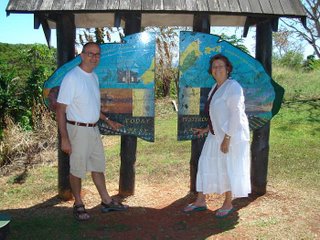
If it is 11am for the travellers in Fiji what time is it for everyone back in Dartford? You need to think about how many hours there are in a day and also how many degrees the earth turns through. It also helps greatly to know that Greenwich in England is on the 0º line of longitude and the international date line is on 180º.
In the picture one of the travellers is standing in today and one is standing in yesterday. They only have to take one step to travel back or forward in time. How does that work?
Learning is like travelling, you find out a lot of stuff along the way, but you keep on bumping into new questions that need answers.
(Written by my brother Michael Drury - Thank you!)

If it is 11am for the travellers in Fiji what time is it for everyone back in Dartford? You need to think about how many hours there are in a day and also how many degrees the earth turns through. It also helps greatly to know that Greenwich in England is on the 0º line of longitude and the international date line is on 180º.
In the picture one of the travellers is standing in today and one is standing in yesterday. They only have to take one step to travel back or forward in time. How does that work?
Learning is like travelling, you find out a lot of stuff along the way, but you keep on bumping into new questions that need answers.
(Written by my brother Michael Drury - Thank you!)
Thursday, October 12, 2006
We will be running half courses in October of this year. For some children the courses will be just a few weeks before the examination and other children will be writing their examinations early next year.
Going away on holiday before an examination is always a worry to parents. Would their child be better served by having a peaceful half term, doing a little work and generally relaxing – or should the family fly off to a remote location so that all the family can `get away from it all?
A middle route could be a visit to Marbella. In the heart of old Marbella is `Angela’s School’. The school has been running for many years. Angela has all the up to date information about how to get a child into an exclusive school.
http://www.gomarbella.com/ASC/index.htm
Your loved one could do work towards the examination for an hour or so in the morning – and then have the rest of the day to enjoy a holiday.
One of the best arguments that a child can put up about not working on holiday is that of missing out on the rest of the family’s activities. One family tried to solve the problem by `agreeing’ that the rest of the family would read for the forty minutes of 11+ work. We were told that the ensuring arguments about books, and what to read, were far worse than the actual 11+ `Just now! Just now!’
Going away on holiday before an examination is always a worry to parents. Would their child be better served by having a peaceful half term, doing a little work and generally relaxing – or should the family fly off to a remote location so that all the family can `get away from it all?
A middle route could be a visit to Marbella. In the heart of old Marbella is `Angela’s School’. The school has been running for many years. Angela has all the up to date information about how to get a child into an exclusive school.
http://www.gomarbella.com/ASC/index.htm
Your loved one could do work towards the examination for an hour or so in the morning – and then have the rest of the day to enjoy a holiday.
One of the best arguments that a child can put up about not working on holiday is that of missing out on the rest of the family’s activities. One family tried to solve the problem by `agreeing’ that the rest of the family would read for the forty minutes of 11+ work. We were told that the ensuring arguments about books, and what to read, were far worse than the actual 11+ `Just now! Just now!’
Wednesday, October 11, 2006
Get me there on time!
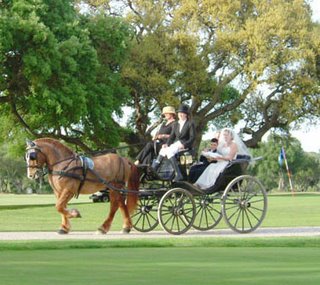
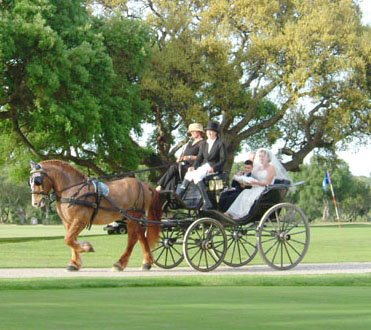
Tarryn and Chris were married in Spain. They arrived in style with a beautiful black horse. The journey was eventful because the horse decided to take a lap around the seventeenth and eighteen green before they could alight to wow their guests.
If the eleven plus examinations are at your child’s school then you will know just how long it takes from waking to breakfast to leaving and then arriving. Naturally you want to arrive on time.
Some children do the 11+ test at a local grammar school so this involves different sets of traffic lights. You timing is changed. In years to come this might become a very familiar route – but you can’t afford to gamble on the day of the actual examination.
Simply drive the route a few times, ahead of the day, to make sure you are aware of local traffic conditions.
The last thing you want is your anxiety about arriving on time to rub off on your child. Remember too, that any unforgivable signs and words may be repeated at the most inopportune moment.
Avoid any or all discussion or last minute advice about examination technique and timing. Your last words, and in fact your only words on the subject all morning, just need to be: `Good Luck. Just do your best – we will love you what ever happens.’
You will of course have followed an action plan where the countdown started a full 24 hours before:
Food
Sleep
Pencils and general stationery
Keeping yourself calm
Not harping on about the examination
Siblings
Watch
Petrol
After exam snack
The list is endless. Good luck!
Do you remember the discussions about transport to your wedding? How fast will the horse go? Can we rely on the driver? What happens if we arrive early? Does the horse need food? Where can the horse get a drink? How do we recompense the driver?
Arriving at an 11+ examination needs just the same amount of scrutiny. Tarryn (my niece) and Chris arrived relaxed and unflustered. We hope you do the same.
If the eleven plus examinations are at your child’s school then you will know just how long it takes from waking to breakfast to leaving and then arriving. Naturally you want to arrive on time.
Some children do the 11+ test at a local grammar school so this involves different sets of traffic lights. You timing is changed. In years to come this might become a very familiar route – but you can’t afford to gamble on the day of the actual examination.
Simply drive the route a few times, ahead of the day, to make sure you are aware of local traffic conditions.
The last thing you want is your anxiety about arriving on time to rub off on your child. Remember too, that any unforgivable signs and words may be repeated at the most inopportune moment.
Avoid any or all discussion or last minute advice about examination technique and timing. Your last words, and in fact your only words on the subject all morning, just need to be: `Good Luck. Just do your best – we will love you what ever happens.’
You will of course have followed an action plan where the countdown started a full 24 hours before:
Food
Sleep
Pencils and general stationery
Keeping yourself calm
Not harping on about the examination
Siblings
Watch
Petrol
After exam snack
The list is endless. Good luck!
Do you remember the discussions about transport to your wedding? How fast will the horse go? Can we rely on the driver? What happens if we arrive early? Does the horse need food? Where can the horse get a drink? How do we recompense the driver?
Arriving at an 11+ examination needs just the same amount of scrutiny. Tarryn (my niece) and Chris arrived relaxed and unflustered. We hope you do the same.
Tuesday, October 10, 2006
Cars and Mathematics
My sister married the most academically gifted man I have ever met. They studied together at university and enjoyed a wide and varied social life.
One day my brother in law arrived, with my sister beside him, in a very large motor car. The engine, I think, was urged from a very large lorry. The car was white with a pointed nose that protruded a good three feet in front of the fan belt. The rear of the car had no boot that I can recall but there was a ledge where suitcases or boxes could be strapped.
There were only two seats – and the driver and his passenger were probably about four and half feet off the ground. It was in fact the driving position of a very early Chelsea tractor. Naturally the car was topless. In those days it would have called an open tourer.
It was a remarkably noisy vehicle, as befitted its description as a `sports car’. I am not sure how long it took to reach 60 miles per hour. The engine did not purr – it chugged and gurgled majestically. There was no gentle emission, or puff of blue smoke – there was, quite simply, a continuous plume of carbon emissions.
Naturally there was a discussion of how many miles to the gallon the car did. In those days we did not have concern ourselves with litres. We could talk about gallons, quarts and pints. I think the car did eight miles to the gallon. If the car was driven fast (over 30 miles per hour) the consumption dropped to nearer to four miles to the gallon.
By now you should be able to work out the 11+ question. (Conversion of units is still a part of some 11+ examinations.)
Hint 1: We will need to change 4 miles to kilometres and then change 1 gallon to litres.
Hint 2: We know that 4 miles is about 6.4 kilometres.
Hint 3: We know too that 1 gallon is about 4.5 litres.
How many kilometres to the litre did the car do when it was driven quickly?
One day my brother in law arrived, with my sister beside him, in a very large motor car. The engine, I think, was urged from a very large lorry. The car was white with a pointed nose that protruded a good three feet in front of the fan belt. The rear of the car had no boot that I can recall but there was a ledge where suitcases or boxes could be strapped.
There were only two seats – and the driver and his passenger were probably about four and half feet off the ground. It was in fact the driving position of a very early Chelsea tractor. Naturally the car was topless. In those days it would have called an open tourer.
It was a remarkably noisy vehicle, as befitted its description as a `sports car’. I am not sure how long it took to reach 60 miles per hour. The engine did not purr – it chugged and gurgled majestically. There was no gentle emission, or puff of blue smoke – there was, quite simply, a continuous plume of carbon emissions.
Naturally there was a discussion of how many miles to the gallon the car did. In those days we did not have concern ourselves with litres. We could talk about gallons, quarts and pints. I think the car did eight miles to the gallon. If the car was driven fast (over 30 miles per hour) the consumption dropped to nearer to four miles to the gallon.
By now you should be able to work out the 11+ question. (Conversion of units is still a part of some 11+ examinations.)
Hint 1: We will need to change 4 miles to kilometres and then change 1 gallon to litres.
Hint 2: We know that 4 miles is about 6.4 kilometres.
Hint 3: We know too that 1 gallon is about 4.5 litres.
How many kilometres to the litre did the car do when it was driven quickly?
Monday, October 09, 2006
11+ Mathematics
Probably comparatively few people are able to buy a house `cash down’. Banks or building societies may advance part of the purchase price. The charge is usually made 1% over the bank rate.
During 1931 the popularity of house purchase by instalment grew – and a total £90 228 000 was loaned. This was back in the days when a house cost around £500. An advertisement in a local paper focused on a single estate agent in one of our local villages who has recently sold over £5 000 000 worth of property. The average price of a house is this village in 2006 is around £290 500.
Some straight forward 11+ mathematics follows.
Back in 1931, by dividing the total money loaned by the average house price we can see that 180456 loans were made in the whole country.
In 2006, to find out how many times 290 500 went into 5 000 000, we had to divide once again. The local estate agent had to make just 17 sales.
However, and there is always a however, £290 500 in today’s money divided by the £500 cost all those years ago suggests a rise in value 581 times greater.
The 11+ question is: Assuming the rise in house prices maintains a similar pattern in the future, how much will our ten to eleven year olds have to pay for a house in another seventy five years?
If we round it all up our £290 500 house becomes £300 000. Our 581 becomes 600 so the cost of a house in 75 years time will be £180 000 000! )
During 1931 the popularity of house purchase by instalment grew – and a total £90 228 000 was loaned. This was back in the days when a house cost around £500. An advertisement in a local paper focused on a single estate agent in one of our local villages who has recently sold over £5 000 000 worth of property. The average price of a house is this village in 2006 is around £290 500.
Some straight forward 11+ mathematics follows.
Back in 1931, by dividing the total money loaned by the average house price we can see that 180456 loans were made in the whole country.
In 2006, to find out how many times 290 500 went into 5 000 000, we had to divide once again. The local estate agent had to make just 17 sales.
However, and there is always a however, £290 500 in today’s money divided by the £500 cost all those years ago suggests a rise in value 581 times greater.
The 11+ question is: Assuming the rise in house prices maintains a similar pattern in the future, how much will our ten to eleven year olds have to pay for a house in another seventy five years?
If we round it all up our £290 500 house becomes £300 000. Our 581 becomes 600 so the cost of a house in 75 years time will be £180 000 000! )
Sunday, October 08, 2006
Just a bit of Padding
My great grandmother, on my mother’s side, was a `van Tonder’. She was quite simply an indomitable woman. She was very proud of her pumpkin pies – and she loved to sit in the calm of the afternoon working on her quilts.
Quilting is a form of needlework which dates back to the eleventh century. The word quilt means sticking things together. A quilt is a cover for a bed It is made of two layers of fabric. There is often a soft substance such as wool or down, between them. The quilt is often stitched in patterns.
We presume the quilt originally came into existence before the eiderdown was invented. There is evidence of wooden forms or templates that early English workers arranged on the material and then sewed round.
Naturally the padding between the outer coverings is important – and if the top cover was often made from the finest linen or silk the backing could be a coarse material.
We now come to the nub of the question. With many 11+ examination boards now opting for an essay or an account, how much padding can be allowed in a written answer? It is simple. If your child is answering the question then fewer words will be needed. If there is a brain storm and the answer gets longer and longer then no doubt there would be more padding.
I can not believe that over the centuries – and in England quilting goes back to the eleventh century – that there have been mothers who have not complained about the amount of padding.
`Be careful of that padding, dear.’
`Too much padding and your work becomes unwieldy.’
Just as with a properly planned quilt you will have a template to work around – so in an essay your child will need a plan.
Sit down with your child and practice planning. Planning has not changed since you were at school. Plan all sorts of topics. Here are three examples:
`Write a letter complaining about loud music.’
`How do you make a pumpkin pie?’
``Explain how you can fix two bits of material together to help you to keep warm.’
Quilting is a form of needlework which dates back to the eleventh century. The word quilt means sticking things together. A quilt is a cover for a bed It is made of two layers of fabric. There is often a soft substance such as wool or down, between them. The quilt is often stitched in patterns.
We presume the quilt originally came into existence before the eiderdown was invented. There is evidence of wooden forms or templates that early English workers arranged on the material and then sewed round.
Naturally the padding between the outer coverings is important – and if the top cover was often made from the finest linen or silk the backing could be a coarse material.
We now come to the nub of the question. With many 11+ examination boards now opting for an essay or an account, how much padding can be allowed in a written answer? It is simple. If your child is answering the question then fewer words will be needed. If there is a brain storm and the answer gets longer and longer then no doubt there would be more padding.
I can not believe that over the centuries – and in England quilting goes back to the eleventh century – that there have been mothers who have not complained about the amount of padding.
`Be careful of that padding, dear.’
`Too much padding and your work becomes unwieldy.’
Just as with a properly planned quilt you will have a template to work around – so in an essay your child will need a plan.
Sit down with your child and practice planning. Planning has not changed since you were at school. Plan all sorts of topics. Here are three examples:
`Write a letter complaining about loud music.’
`How do you make a pumpkin pie?’
``Explain how you can fix two bits of material together to help you to keep warm.’
Saturday, October 07, 2006
How can we find time in an examination?
A mother sent us a note today:
My child, Samantha, has an examination coming up in mid to late November of this year. Please give her some examination tips.
The dialogue in the lesson went as follows:
`Please thank your mother Samantha for this note. What techniques do you, and your mother, feel you need?’
`I am struggling with timing. I never finish the papers.’
`Please could I see your watch?’
`I don’t have one. I have never had one.’
`How do you time yourself on papers at home?’
`My mum tells me the time.’
Suggestion 1
Samantha needs to buy a watch. It should have a large clear face that is easy to read. She should get used to wearing the watch to school.
Suggestion 2
Samantha needs to do a wide range of timing exercises – from watching and timing of the boiling of an egg to how long it takes to drive from home to school every weekday. She needs to be able to work out just how long five minutes is. Samantha also needs to know when 35 minutes has gone past.
Suggestion 3
She should time herself on sections of verbal and non verbal reasoning papers.
Suggestion 4
She must make sure she is very confident about reading the time.
Suggestion 5
It was Benjamin Franklin who reminded us:
“Lost time is never found again.”
My child, Samantha, has an examination coming up in mid to late November of this year. Please give her some examination tips.
The dialogue in the lesson went as follows:
`Please thank your mother Samantha for this note. What techniques do you, and your mother, feel you need?’
`I am struggling with timing. I never finish the papers.’
`Please could I see your watch?’
`I don’t have one. I have never had one.’
`How do you time yourself on papers at home?’
`My mum tells me the time.’
Suggestion 1
Samantha needs to buy a watch. It should have a large clear face that is easy to read. She should get used to wearing the watch to school.
Suggestion 2
Samantha needs to do a wide range of timing exercises – from watching and timing of the boiling of an egg to how long it takes to drive from home to school every weekday. She needs to be able to work out just how long five minutes is. Samantha also needs to know when 35 minutes has gone past.
Suggestion 3
She should time herself on sections of verbal and non verbal reasoning papers.
Suggestion 4
She must make sure she is very confident about reading the time.
Suggestion 5
It was Benjamin Franklin who reminded us:
“Lost time is never found again.”
Friday, October 06, 2006
It is just not fair!
It must be a great relief to the souls of the men and women who build and develop our 11+ tests that parents are not allowed to see the actual 11+ test papers. It is conceivable that the test makers could come under considerable pressure from parents about the content of the tests.
It is all a question of what is fair. Is it fair to include a question that a loving parent or a diligent tutor has not covered in the examination preparations? Can you imagine the fuss and furore if parents were able to pick over individual questions?
`Oh no! That did not come up in the papers we did. There was nothing about that in the lessons.’
Suppose, that by design, questions of the following type were included. You see at a glance that these questions measure how well you can cope with applied ideas, such as understanding of technical drawings. How will we encourage girls into engineering if we do not look for strengths in the field when the children are ten and eleven years old?
It is all a question of what is fair. Is it fair to include a question that a loving parent or a diligent tutor has not covered in the examination preparations? Can you imagine the fuss and furore if parents were able to pick over individual questions?
`Oh no! That did not come up in the papers we did. There was nothing about that in the lessons.’
Suppose, that by design, questions of the following type were included. You see at a glance that these questions measure how well you can cope with applied ideas, such as understanding of technical drawings. How will we encourage girls into engineering if we do not look for strengths in the field when the children are ten and eleven years old?
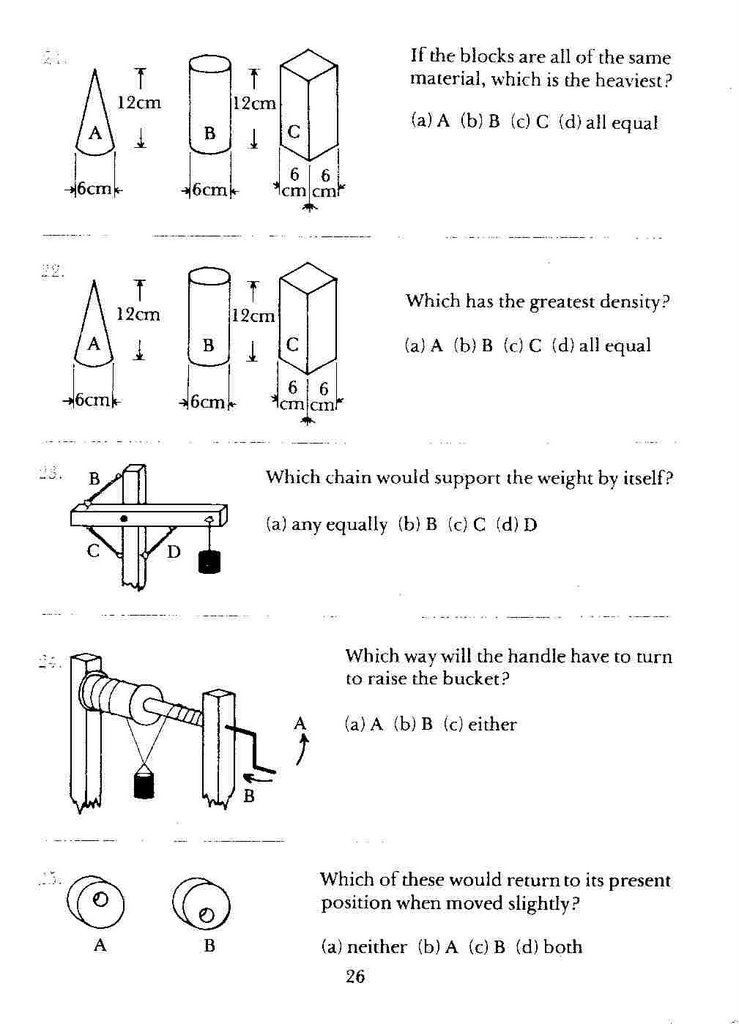
Thursday, October 05, 2006
Ten Tips to Eleven Plus Examinations
1. Talk to your eleven plus child - discuss your expectations - and understand your child’s position. Discuss the rules of engagement - the time for study, homework, games, school, family and friends. Develop the point that `both sides’ are working within the framework of a family.
2. Listen to, and try to understand, your child’s teachers and tutors. If you hear the words: `Border Line’ interpret the words as such - do not think that this means your child will pass with flying colours. Be realistic about what your school can offer. Your child’s school has far wider and very different responsibilities to high marks on a test paper.
3. Make a point of your child maintaining relationships with friends. Do not allow the week to be so cluttered that friends have to be ignored `until the examination is over’. In any event your child’s best friend’s mother may know more about what your child is up to a school than you will ever need to know. But don’t ask the questions if you don’t want to hear the answers.
4. Both sides - parents and children - must understand that the nerves of both parties may be on edge. Tolerance is essential. Encourage your child to make allowances.
5. Avoid any discussion that may end with one side being the `winner’. It is just over one hundred years since England and France signed the `Entente Cordiale’ - bringing peace to both countries. Develop your own negotiating positions - and work within those bounds. Use the term `Entente Cordiale’ to set up a mediating framework.
6. Try to develop a dialogue about school. Discuss how you would like to hear after:
`How did it go at school today?’
`Fine.’
`What did you learn that was new and interesting?’
`Nothing.’
Help to develop the three sentence answer to every question. (`Yes thank you because ….’, `And then I …’ and `I think …..’.
7. Work together to understand the concept of the generation gap. You and your child may have different values and aspirations. Look at the gap between you and your parents. Ask your parents how they, and you, resolved the gap.
8. Help all concerned in the household to understand the fears, anxieties and pressures - along with the ten year old’s desire and need for independence. Younger siblings must respect privacy and the need to be quiet. Older siblings must learn to curb the cutting remark. Grand parents must continue to be supportive and accepting.
9. Think seriously about food and exercise. If the day and the diet are not balanced then it becomes hard to study and prepare.
10. Devise policies on the rules of the house - the tidy bedroom, the help in the home, walking the dog, feeding the parrot. The ten year old must understand that he or she is part of the family and can not simply move from 11+ practice papers to lie on the couch with the remote control while asking for sustenance, use of the telephone and ignoring the pleas of the dog. He or she has to get up to let the dog out. Explain how this selfless humility may actually help in the examination.
2. Listen to, and try to understand, your child’s teachers and tutors. If you hear the words: `Border Line’ interpret the words as such - do not think that this means your child will pass with flying colours. Be realistic about what your school can offer. Your child’s school has far wider and very different responsibilities to high marks on a test paper.
3. Make a point of your child maintaining relationships with friends. Do not allow the week to be so cluttered that friends have to be ignored `until the examination is over’. In any event your child’s best friend’s mother may know more about what your child is up to a school than you will ever need to know. But don’t ask the questions if you don’t want to hear the answers.
4. Both sides - parents and children - must understand that the nerves of both parties may be on edge. Tolerance is essential. Encourage your child to make allowances.
5. Avoid any discussion that may end with one side being the `winner’. It is just over one hundred years since England and France signed the `Entente Cordiale’ - bringing peace to both countries. Develop your own negotiating positions - and work within those bounds. Use the term `Entente Cordiale’ to set up a mediating framework.
6. Try to develop a dialogue about school. Discuss how you would like to hear after:
`How did it go at school today?’
`Fine.’
`What did you learn that was new and interesting?’
`Nothing.’
Help to develop the three sentence answer to every question. (`Yes thank you because ….’, `And then I …’ and `I think …..’.
7. Work together to understand the concept of the generation gap. You and your child may have different values and aspirations. Look at the gap between you and your parents. Ask your parents how they, and you, resolved the gap.
8. Help all concerned in the household to understand the fears, anxieties and pressures - along with the ten year old’s desire and need for independence. Younger siblings must respect privacy and the need to be quiet. Older siblings must learn to curb the cutting remark. Grand parents must continue to be supportive and accepting.
9. Think seriously about food and exercise. If the day and the diet are not balanced then it becomes hard to study and prepare.
10. Devise policies on the rules of the house - the tidy bedroom, the help in the home, walking the dog, feeding the parrot. The ten year old must understand that he or she is part of the family and can not simply move from 11+ practice papers to lie on the couch with the remote control while asking for sustenance, use of the telephone and ignoring the pleas of the dog. He or she has to get up to let the dog out. Explain how this selfless humility may actually help in the examination.
Wednesday, October 04, 2006
Building Excitement
We must all often wonder what goes through the mind of people who build reasoning and ability papers. We know that the test builder must be literate, imaginative and creative. We hope that at the 11+ stage the questions stimulate and interest our children.
Some `candidates’ will be able to see their way through a test question like this in seconds. Others will remain mystified and puzzled.
Some drilchne love iwrognk through blavre reasoning papers. They enjoy the elhaclneg and the excitement of the tsonseuiq.
Think, however, of the reasoning steps involved in a question like:
Here are a group of five whole numbers; one is missing.
3 17 11 .. 18
Half of the missing number is double another. The missing number is not the largest in the group, nor is it an odd one. What is the number that is missing?
We know that our children will have around 40 seconds to solve this problem. Surely there must be some type of mind that solves a problem like this quicker than others?
Does it mean that a child with an extraordinary ability with languages and a genuine love of subjects like history, geography and the arts should be denied a place in a grammar school? The steps to solving a problem of this kind can be taught – and there will certainly be some children who will revel in the opportunity of trying to decode the answer.
Ninety nine per cent of parents will have been able to work out that the answer to the missing number is twelve within twenty seconds! Some brave parents will try to explain their working out – only to have their explanation roundly rejected. There may be one or two of us who would have to phone a friend for help.
We can not choose which types of questions will come up in a test. We can say which ones are more likely. But we must all thank the selection test builders for the excitement they bring to our lives.
Some `candidates’ will be able to see their way through a test question like this in seconds. Others will remain mystified and puzzled.
Some drilchne love iwrognk through blavre reasoning papers. They enjoy the elhaclneg and the excitement of the tsonseuiq.
Think, however, of the reasoning steps involved in a question like:
Here are a group of five whole numbers; one is missing.
3 17 11 .. 18
Half of the missing number is double another. The missing number is not the largest in the group, nor is it an odd one. What is the number that is missing?
We know that our children will have around 40 seconds to solve this problem. Surely there must be some type of mind that solves a problem like this quicker than others?
Does it mean that a child with an extraordinary ability with languages and a genuine love of subjects like history, geography and the arts should be denied a place in a grammar school? The steps to solving a problem of this kind can be taught – and there will certainly be some children who will revel in the opportunity of trying to decode the answer.
Ninety nine per cent of parents will have been able to work out that the answer to the missing number is twelve within twenty seconds! Some brave parents will try to explain their working out – only to have their explanation roundly rejected. There may be one or two of us who would have to phone a friend for help.
We can not choose which types of questions will come up in a test. We can say which ones are more likely. But we must all thank the selection test builders for the excitement they bring to our lives.
Tuesday, October 03, 2006
Two Little Words
When we run our 11+ courses we deliver a series of `pep talk’. The talks range from `The Night Before’ to `How to be pleasant to your parents.’ One message we try to put across is to remember to say thank you to your parents.
`Thank you mother, I really enjoyed that lesson. We went over some verbal reasoning exercises that I enjoyed. The maths was stimulating as we revised division of decimals and then went over proportion again. I can’t wait to go back.’ Familiar words?
We always watch the parents and the children as they meet during and after the course. Naturally some conversations go:
`Hello Dear, did you have a good time?
`Yes.’
`Did you learn anything new?’
`Mum. What is for supper?’
Now as a mother you have just forked out a fortune for your child’s education. The immortal words: `I am only doing it for you,’ spring to mind. What you would really like to hear is an in depth analysis of the day – culminating in your child’s success after adversity – and going on to win the prize of the best student of the day.
In some of the sessions we rehearse what parents really want to her – but if our efforts are not to your liking why not adopt a purposeful approach to the conversation? Before your child leaves to go to a lesson, or attend a course, hand him, or her, a small card. On the card write the three questions and the three answers you want to hear. We will do our part – we will whisper a reminder. You child should then approach you with a big smile and say:
`Mum, guess what?’
`Yes Dear?’
`It was the best …… ever.’
(Then you know you will have had your money’s worth.)
`Thank you mother, I really enjoyed that lesson. We went over some verbal reasoning exercises that I enjoyed. The maths was stimulating as we revised division of decimals and then went over proportion again. I can’t wait to go back.’ Familiar words?
We always watch the parents and the children as they meet during and after the course. Naturally some conversations go:
`Hello Dear, did you have a good time?
`Yes.’
`Did you learn anything new?’
`Mum. What is for supper?’
Now as a mother you have just forked out a fortune for your child’s education. The immortal words: `I am only doing it for you,’ spring to mind. What you would really like to hear is an in depth analysis of the day – culminating in your child’s success after adversity – and going on to win the prize of the best student of the day.
In some of the sessions we rehearse what parents really want to her – but if our efforts are not to your liking why not adopt a purposeful approach to the conversation? Before your child leaves to go to a lesson, or attend a course, hand him, or her, a small card. On the card write the three questions and the three answers you want to hear. We will do our part – we will whisper a reminder. You child should then approach you with a big smile and say:
`Mum, guess what?’
`Yes Dear?’
`It was the best …… ever.’
(Then you know you will have had your money’s worth.)
Monday, October 02, 2006
A Time To Work and A Time To Watch
I was eighteen years old when television first came to Zimbabwe. It is difficult to put a figure on how much time today’s children spend watching television. We know that fifteen to eighteen year olds seem to watch less TV than younger children.
A quick eleven plus question.
If we watch an average of 2 hours of TV a day, how much will we have watched by the time we are eighteen?
If the same question had been posed as: (365 x (18 x 2)) then it is possible that more children will not have had to hesitate.
An even easier question would have been 365 x 36.
In the great spirit of research into television, studying and children it was found that watching a simple quiz show before an examination helps to stimulate the mind.
Perhaps parents need to start watching and recording quiz shows to ensure the television viewing before an examination is appropriate.
Naturally there will be a rush on the book shops with anxious parents asking for quiz books suitable for the eleven plus. If you do decide to make up your own questions, please send some sample questions to us.
My questions is: If there was no TV until a child was eighteen - how on earth would children spend the time?
A quick eleven plus question.
If we watch an average of 2 hours of TV a day, how much will we have watched by the time we are eighteen?
If the same question had been posed as: (365 x (18 x 2)) then it is possible that more children will not have had to hesitate.
An even easier question would have been 365 x 36.
In the great spirit of research into television, studying and children it was found that watching a simple quiz show before an examination helps to stimulate the mind.
Perhaps parents need to start watching and recording quiz shows to ensure the television viewing before an examination is appropriate.
Naturally there will be a rush on the book shops with anxious parents asking for quiz books suitable for the eleven plus. If you do decide to make up your own questions, please send some sample questions to us.
My questions is: If there was no TV until a child was eighteen - how on earth would children spend the time?
Sunday, October 01, 2006
The Fruits of the Vine
Summer is drawing to an end. Autumn is growing closer. The grapes on our vine at home in Kent are growing sweeter and blacker. All this means that the Eleven Plus examinations are growing closer for another year. In Bexley the children will be writing in early November.
This is the time of year that parents are most likely to show concern about what their most loved one knows and does not know. Every single question is analysed and worried over. Children bring little lists of three or four questions to their tutors to go over. Most parents, however, are hot stuff on questions like:
How many grapes make a bottle of wine?
As adults we all know that while it varies, it usually takes between 600 to 800 grapes per bottle. This could be around ten bunches of grapes.
Please make sure that you do not try to fill your child with too much trivia with a month to go. Think of your poor child. Why not concentrate on trying to help him or her to do as well as possible on the topics already covered at school and in any extra lessons or work at home. The very hard questions on practice papers are there to stretch and stimulate the very bright.
It is much more important to know how to find ten per cent of a number or how many degrees there are in a triangle than spend precious time on some rather obscure question that may or may not come up.
This is the time of year that parents are most likely to show concern about what their most loved one knows and does not know. Every single question is analysed and worried over. Children bring little lists of three or four questions to their tutors to go over. Most parents, however, are hot stuff on questions like:
How many grapes make a bottle of wine?
As adults we all know that while it varies, it usually takes between 600 to 800 grapes per bottle. This could be around ten bunches of grapes.

Please make sure that you do not try to fill your child with too much trivia with a month to go. Think of your poor child. Why not concentrate on trying to help him or her to do as well as possible on the topics already covered at school and in any extra lessons or work at home. The very hard questions on practice papers are there to stretch and stimulate the very bright.
It is much more important to know how to find ten per cent of a number or how many degrees there are in a triangle than spend precious time on some rather obscure question that may or may not come up.
Friday, September 29, 2006
The Special One
At some time or another your much loved eleven year old may start thinking about the four key throwing events: shot put, discus, javelin and hammer. In early days the throwing events were used a practice activities for war. In competition and training we need to observe simple but vital training rules:
Never thrown a implement if someone is in the landing area.
Never stand in the throwing area.
Treat javelins with care. Carry them vertically - point down.
When working in groups take especial care.
Start with light implements and progress on the heaviest you can manage comfortably. Trying to throw heavy instruments too early on can cause problems ad harm progress.
Like with so much in life there are parallels with preparing for eleven plus examinations. Eleven plus preparation, and taking the examination, is certainly not practice for war. There is, however, naturally an element of competition because there are so few places and so many aspiring candidates. What then are the eleven plus simple but vital training rules?
Start with easy work to build confidence.
Add lots or repetition and practice into your program.
Learn to listen carefully on a one to one basis.
Be prepared to experience failure - but continue to strive for the very best.
Discuss your progress with interested parties - they may throw in good coaching hints.
Some of our children may land up competing in the Olympics. There may be considerably more who will have won the prize of a grammar school place.
Preparing for every examination will expose sprinters and marathon runners. Some will be able to maintain a sustained approach to the examination - while others will need frequent rests along with bursts of high activity.
Listen to your child’s body. When he or she is tired simply let it be. Try to foster a state of dialogue where you, as a parent, can actually listen to your child without foisting your own anxieties.
Treat your child like a prize athlete - a special one - and enjoy the new relationship.
Never thrown a implement if someone is in the landing area.
Never stand in the throwing area.
Treat javelins with care. Carry them vertically - point down.
When working in groups take especial care.
Start with light implements and progress on the heaviest you can manage comfortably. Trying to throw heavy instruments too early on can cause problems ad harm progress.
Like with so much in life there are parallels with preparing for eleven plus examinations. Eleven plus preparation, and taking the examination, is certainly not practice for war. There is, however, naturally an element of competition because there are so few places and so many aspiring candidates. What then are the eleven plus simple but vital training rules?
Start with easy work to build confidence.
Add lots or repetition and practice into your program.
Learn to listen carefully on a one to one basis.
Be prepared to experience failure - but continue to strive for the very best.
Discuss your progress with interested parties - they may throw in good coaching hints.
Some of our children may land up competing in the Olympics. There may be considerably more who will have won the prize of a grammar school place.
Preparing for every examination will expose sprinters and marathon runners. Some will be able to maintain a sustained approach to the examination - while others will need frequent rests along with bursts of high activity.
Listen to your child’s body. When he or she is tired simply let it be. Try to foster a state of dialogue where you, as a parent, can actually listen to your child without foisting your own anxieties.
Treat your child like a prize athlete - a special one - and enjoy the new relationship.
Thursday, September 28, 2006
Can Any One be so Lucky?
Our super administrator is called `Gerry’. Many of you will have spoken to her at one time or another.
In a few weeks time Gerry is off to Las Vegas. It is possible that she will have a little flutter while she is there. We thought she needed some protection. We know that she will spend around $500.00 – and enjoy about three and a half hours a day on the tables.
We hope too that she will be able to take in at least one of the top shows. She has mentioned Tom Jones – but we don’t know if this is simply wish fulfilment.
On the slot machines she will be trying to build up a row of four bells or cherries or what ever she goes for. She will be calculating the odds every time she feeds the machine. Every time that lever goes down she will feel a little thrill of anticipation. We have all heard stories about the jackpot. I think it is called a `truck load’. Imagine how the young man who won $39 million a few years ago felt. If Gerry won that, would we ever see her again?
The laws about gambling in Las Vegas are strict. The advice parents give to their 11+ children must also be strict.
`If you have 15 questions left on your paper – and there are three minutes left to go you must simply guess.’
This now is the problem. Do you fill in the first multiple choice boxe in all fifteen questions – hoping that there will be a chance of at least a few of them being correct? Do you tell your child to select the answers at random? Should they choose the numbers of their birthday? The odds are great. You just have to remind your child to be wise and do their best under pressure.
If you do telephone us in early November and ask for Gerry – and a voice says: `I am sorry, but she does not work here any more.’ You will know that she either met Tom Jones or she won the jackpot.
In a few weeks time Gerry is off to Las Vegas. It is possible that she will have a little flutter while she is there. We thought she needed some protection. We know that she will spend around $500.00 – and enjoy about three and a half hours a day on the tables.
We hope too that she will be able to take in at least one of the top shows. She has mentioned Tom Jones – but we don’t know if this is simply wish fulfilment.
On the slot machines she will be trying to build up a row of four bells or cherries or what ever she goes for. She will be calculating the odds every time she feeds the machine. Every time that lever goes down she will feel a little thrill of anticipation. We have all heard stories about the jackpot. I think it is called a `truck load’. Imagine how the young man who won $39 million a few years ago felt. If Gerry won that, would we ever see her again?
The laws about gambling in Las Vegas are strict. The advice parents give to their 11+ children must also be strict.
`If you have 15 questions left on your paper – and there are three minutes left to go you must simply guess.’
This now is the problem. Do you fill in the first multiple choice boxe in all fifteen questions – hoping that there will be a chance of at least a few of them being correct? Do you tell your child to select the answers at random? Should they choose the numbers of their birthday? The odds are great. You just have to remind your child to be wise and do their best under pressure.
If you do telephone us in early November and ask for Gerry – and a voice says: `I am sorry, but she does not work here any more.’ You will know that she either met Tom Jones or she won the jackpot.
Wednesday, September 27, 2006
Just say no...
`Mum, please can I have some chocolate? My exam is today and I really, really do feel nervous!’
`Please Mum, I am not feeling at all well. Just a little chocolate will help.’
Why is it that so many people have similar chocolate eating habits? We all know of people who have eaten three or four thick bars of chocolate – or a whole box at one sitting. Some of us have actually done that our selves! It seems that a taste of chocolate triggers off a desire for more.
We know that chocolate contains fat, sugar and cocoa. But there is also the stimulant caffeine. We are lucky that there isn’t enough caffeine in chocolate to severely affect an adult’s nervous system. Scientists have told us that dark chocolate is better for us than milk chocolate. We have also been told that it is not bad to eat some chocolate – in moderation. But chocolate before an examination?
Just before the eleven plus examinations try to make sure that there is simply no chocolate in the house. Make sure too that you do not allow your child to walk into any shop that has chocolate of any kind what so ever. The emotional pressure that children can bring to bear on parents at certain times has to be experienced to be believed. On the way to the examination don’t stop the car for anything at all.
We have a copy of Jamie Oliver’s 1999 `Naked Chef’. He lists four recipes with chocolate. In the recipe for a simple chocolate tart he mentions `chocofreaks’ – but he does say that the better the chocolate you buy the better the taste. Jamie was not writing about children and examinations – but he still makes a lot of sense!
We naturally also have a copy of Amanda Grant’s `Kids Kitchen’. She writes on baby and toddler nutrition. She suggests a wide range of menus for children learn to cook. Her ideas for melted chocolate include:
Dipping balls of ice cream into melted chocolate.
Half dipping flapjacks into melted chocolate.
Half dipping a mango into melted chocolate.
Chocolate makes us feel good. If your child has some chocolate just before the examination then your child may become distracted during the examination and have to try to deal with cravings as well as tricky questions.
Naturally you, as a parent, can buy and eat chocolate while your child is being tested. You need to be distracted. You need to eliminate your cravings. Jamie and Amanda won’t know. It is simply between you and your conscience. Just don’t leave any wrappings on the car seat for the kids to find.
`Please Mum, I am not feeling at all well. Just a little chocolate will help.’
Why is it that so many people have similar chocolate eating habits? We all know of people who have eaten three or four thick bars of chocolate – or a whole box at one sitting. Some of us have actually done that our selves! It seems that a taste of chocolate triggers off a desire for more.
We know that chocolate contains fat, sugar and cocoa. But there is also the stimulant caffeine. We are lucky that there isn’t enough caffeine in chocolate to severely affect an adult’s nervous system. Scientists have told us that dark chocolate is better for us than milk chocolate. We have also been told that it is not bad to eat some chocolate – in moderation. But chocolate before an examination?
Just before the eleven plus examinations try to make sure that there is simply no chocolate in the house. Make sure too that you do not allow your child to walk into any shop that has chocolate of any kind what so ever. The emotional pressure that children can bring to bear on parents at certain times has to be experienced to be believed. On the way to the examination don’t stop the car for anything at all.
We have a copy of Jamie Oliver’s 1999 `Naked Chef’. He lists four recipes with chocolate. In the recipe for a simple chocolate tart he mentions `chocofreaks’ – but he does say that the better the chocolate you buy the better the taste. Jamie was not writing about children and examinations – but he still makes a lot of sense!
We naturally also have a copy of Amanda Grant’s `Kids Kitchen’. She writes on baby and toddler nutrition. She suggests a wide range of menus for children learn to cook. Her ideas for melted chocolate include:
Dipping balls of ice cream into melted chocolate.
Half dipping flapjacks into melted chocolate.
Half dipping a mango into melted chocolate.
Chocolate makes us feel good. If your child has some chocolate just before the examination then your child may become distracted during the examination and have to try to deal with cravings as well as tricky questions.
Naturally you, as a parent, can buy and eat chocolate while your child is being tested. You need to be distracted. You need to eliminate your cravings. Jamie and Amanda won’t know. It is simply between you and your conscience. Just don’t leave any wrappings on the car seat for the kids to find.
Tuesday, September 26, 2006
What Career will you Follow?
It sometimes helps to clarify the reason why attending a grammar school is a good idea for some children. Parents can talk about the difference between jobs and careers.
A job exists when there is a definite arrangement for regular work every week, or every month, for pay or other compensation (eg, profits, anticipated profits, or pay in kind, such as room and board).
A career, however, is something a little different. A career is more of a lifelong process; it is unique to each person and involves a sequence of work and leisure activities. A career includes career development and participation in occupations. Ideally a career choice should be an informed decision.
Jackie, who is married to my son, chose to be a photo journalist. She likes deep sea diving and adventures. She reads a lot and enjoys travel. (This is a great help when one is a photo journalist.) The following is an extract from a recent trip to the jungle.
We hiked up and up, first to Cerro Zapote where there was a break in the canopy and we could see for miles across the rain forest. It is so lush with plants that you recognize from the vivero – but these are on steroids! Huge trees tower over head with vines as thick as tree trunks hanging down.
I have probably got this wrong. It seems to me that a photo journalist says: `I feel like some deep jungle activity.’ She then finds a magazine that wants an article about visiting the jungle. The magazine then pays the fare and expenses – and for the ensuing article.
Point out that many bright adults prefer a career to a job.
Suggest: `If things don’t work out you may land up with a job. If you choose a career then you will be able to make many more of your own decisions.’
Make the point that Jackie does many jobs – but she has just one career.
A job exists when there is a definite arrangement for regular work every week, or every month, for pay or other compensation (eg, profits, anticipated profits, or pay in kind, such as room and board).
A career, however, is something a little different. A career is more of a lifelong process; it is unique to each person and involves a sequence of work and leisure activities. A career includes career development and participation in occupations. Ideally a career choice should be an informed decision.
Jackie, who is married to my son, chose to be a photo journalist. She likes deep sea diving and adventures. She reads a lot and enjoys travel. (This is a great help when one is a photo journalist.) The following is an extract from a recent trip to the jungle.
We hiked up and up, first to Cerro Zapote where there was a break in the canopy and we could see for miles across the rain forest. It is so lush with plants that you recognize from the vivero – but these are on steroids! Huge trees tower over head with vines as thick as tree trunks hanging down.
I have probably got this wrong. It seems to me that a photo journalist says: `I feel like some deep jungle activity.’ She then finds a magazine that wants an article about visiting the jungle. The magazine then pays the fare and expenses – and for the ensuing article.
Point out that many bright adults prefer a career to a job.
Suggest: `If things don’t work out you may land up with a job. If you choose a career then you will be able to make many more of your own decisions.’
Make the point that Jackie does many jobs – but she has just one career.
Monday, September 25, 2006
Spilt Milk
My grandfather was a farmer. The farm had tobacco, maize, fruit, cattle and a large dairy operation. Every day the milk had to be delivered to a town about twelve miles away. The roads were sandy with no tarmac. There were seven gates that had to be opened and closed between the farm and the nearest town.
One day my grandfather broke his leg.
My brother was sent by train to help out. He walked from the rail station to the police station. He was met by the policeman in charge. My brother, Michael, was invited to climb into the driving seat of the policeman’s car. The driving test followed. They went round the very short block – and Michael passed. There was no theory test and certainly no stop lights in the rather remote town. He did not have to navigate a crossing during the course of the test.
You see the policeman’s wife, and the rest of the town, had run out of milk. There was no one else on the farm who could drive. Late that night 16 year old Michael was dropped on the farm. Early next morning he drove the milk to town.
How we must wish that a head teacher would wake up one morning and say: `We need more children in our school.’
Certain children could be accepted into grammar school without having to go through the pressure of eleven plus examinations.
This could save a lot of spilt milk.
One day my grandfather broke his leg.
My brother was sent by train to help out. He walked from the rail station to the police station. He was met by the policeman in charge. My brother, Michael, was invited to climb into the driving seat of the policeman’s car. The driving test followed. They went round the very short block – and Michael passed. There was no theory test and certainly no stop lights in the rather remote town. He did not have to navigate a crossing during the course of the test.
You see the policeman’s wife, and the rest of the town, had run out of milk. There was no one else on the farm who could drive. Late that night 16 year old Michael was dropped on the farm. Early next morning he drove the milk to town.
How we must wish that a head teacher would wake up one morning and say: `We need more children in our school.’
Certain children could be accepted into grammar school without having to go through the pressure of eleven plus examinations.
This could save a lot of spilt milk.
Saturday, September 23, 2006
Vote for the 11 Plus
Everyone entitled to vote in an election is sent a poll card to indicate the time and date of the election and the location of their polling station.
People who have indicated their wish to vote by post are sent a voting pack.
The facility is known as absent voting and is available for registered voters who are unable to attend polling stations.
The reasons could be:
-Health
-living abroad
-a student at university
We would like to add the 11+ child who is worried about examinations. Think how easy it would be to fill in a card and ask for a postal 11+ paper.
I was in one of our centres this week and one cheerful ten year was chatting about how she would get flu on the day and then have the paper sent to her at home. She explained that she would be able to look up all the answers on the internet.
Some states in Americans, of course, have a few more categories when they are dealing with absent voters:
-age 60 years old or older
-unable to vote without assistance at the polls
-expecting to be out of town on election day
-in jail awaiting arraignment or trial
-unable to attend the polls due to religious reasons
We sincerely hope that our ten year olds writing 11+ examinations do not fit into too many of the above American categories. On the other hand we can all remember a President elected on a postal vote.
People who have indicated their wish to vote by post are sent a voting pack.
The facility is known as absent voting and is available for registered voters who are unable to attend polling stations.
The reasons could be:
-Health
-living abroad
-a student at university
We would like to add the 11+ child who is worried about examinations. Think how easy it would be to fill in a card and ask for a postal 11+ paper.
I was in one of our centres this week and one cheerful ten year was chatting about how she would get flu on the day and then have the paper sent to her at home. She explained that she would be able to look up all the answers on the internet.
Some states in Americans, of course, have a few more categories when they are dealing with absent voters:
-age 60 years old or older
-unable to vote without assistance at the polls
-expecting to be out of town on election day
-in jail awaiting arraignment or trial
-unable to attend the polls due to religious reasons
We sincerely hope that our ten year olds writing 11+ examinations do not fit into too many of the above American categories. On the other hand we can all remember a President elected on a postal vote.
Friday, September 22, 2006
The Golden Key
Children writing the Eleven Plus examinations can be expected to have knowledge and interests beyond the possible content of `11+ Syllabus’. Some chldren will be helped with a careful analysis of language - and and this will include help with how to approach questions. Other children will need to rely on good luck.
It is easy to explain: `Punch hit Judy‘ and `Judy was hit by Punch‘. This fits together very easily.
`The daughter broke the glass.’ and `The glass was broken by the daughter’ also both work.
What is the problem with: `Uncle weighs 85 kilos’ and `85 kilos is weighed by Uncle’?
The story of Punch and Judy goes back a long way. Punch was a jealous man and he murdered his baby daughter. Judy collected a bludgeon and tried to hit Punch.
Punch beat her to death with another bludgeon and then threw the two bodies into the street.
A policeman saw the bodies and came to arrest Punch. Punch ran away - but was arrested. He was thrown into prison but escaped because of a golden key.
How useful it would be for all of us to be able to overcome disaster and escape with the help of a golden key.
Why not make sure your child wears a golden key on the day of the 11+ examination?
When the brain slows down on a question instead of getting upset and trying to bludgeon his or her way through the answer, your child could simply touch the key and all would be right in the world.
It is easy to explain: `Punch hit Judy‘ and `Judy was hit by Punch‘. This fits together very easily.
`The daughter broke the glass.’ and `The glass was broken by the daughter’ also both work.
What is the problem with: `Uncle weighs 85 kilos’ and `85 kilos is weighed by Uncle’?
The story of Punch and Judy goes back a long way. Punch was a jealous man and he murdered his baby daughter. Judy collected a bludgeon and tried to hit Punch.
Punch beat her to death with another bludgeon and then threw the two bodies into the street.
A policeman saw the bodies and came to arrest Punch. Punch ran away - but was arrested. He was thrown into prison but escaped because of a golden key.
How useful it would be for all of us to be able to overcome disaster and escape with the help of a golden key.
Why not make sure your child wears a golden key on the day of the 11+ examination?
When the brain slows down on a question instead of getting upset and trying to bludgeon his or her way through the answer, your child could simply touch the key and all would be right in the world.
Thursday, September 21, 2006
Go Bananas!
Many years ago my son worked, for short time, in a banana factory in Kent. The company were major importers of bananas from all over the word. He was involved with a labelling program and with bar codes. It was a wonderful place to work - the people were so pleasant and so helpful.
As the bananas came onto the conveyor belt one person had the unenviable task of looking out for `things’. Occasionally a tarantula would be hiding in a bunch of bananas. Identification was necessary - as was disposing of the creature.
This brings to mind the strange sickness that stuck the southern Italian port of Taranto. It was said to be caused by the bite of the tarantula spider, and the only cure was to dance wildly and sweat out the spider’s poison. (It has to be held in mind that this was before the days of `step’ and `running machines’ in gyms. Otherwise the spider may have been called a Reebok or a Puma. Who knows?)
The special dance was called the tarantella - and composers developed special music to celebrate the death defying nature of the dance.
It is sad to think that in the pre Christian era that Taranto was a cult centre for the rites of the Greek God Dionysus and the Roman Bacchus. It is possible, therefore, that the rites included drunken and frenzied dancing.
On receiving the results please do not let your 11+ child know these last facts about the dance. We would much prefer the modest eleven year old to think that the celebratory dance around the kitchen table was due more to defying death by a spider than to mum’s extra glass of wine.
As the bananas came onto the conveyor belt one person had the unenviable task of looking out for `things’. Occasionally a tarantula would be hiding in a bunch of bananas. Identification was necessary - as was disposing of the creature.
This brings to mind the strange sickness that stuck the southern Italian port of Taranto. It was said to be caused by the bite of the tarantula spider, and the only cure was to dance wildly and sweat out the spider’s poison. (It has to be held in mind that this was before the days of `step’ and `running machines’ in gyms. Otherwise the spider may have been called a Reebok or a Puma. Who knows?)
The special dance was called the tarantella - and composers developed special music to celebrate the death defying nature of the dance.
It is sad to think that in the pre Christian era that Taranto was a cult centre for the rites of the Greek God Dionysus and the Roman Bacchus. It is possible, therefore, that the rites included drunken and frenzied dancing.
On receiving the results please do not let your 11+ child know these last facts about the dance. We would much prefer the modest eleven year old to think that the celebratory dance around the kitchen table was due more to defying death by a spider than to mum’s extra glass of wine.
Wednesday, September 20, 2006
How not to be a Soppy Mum.
As your child disappears into the class room on the morning of the first eleven plus examination you may feel you just have to shout a last minute piece of advice.
There will have been lots of other mothers and fathers, all willing their children on to greater things.
You don’t want to appear too soppy in front of all the other parents - but you do want to do something special. Why not shout:
`Sturdy Oboe!’
No one but you and your child will know that the words are an anagram of `Do your best!’.
You could follow with a loud: `Bona fortuna!’ - which we all know is good luck in Latin. This will impress all the other parents and make them envious of your child. They will be saying: `What a lucky child to have parents as educated as that.’ They will drive away in their lovely big cars muttering:
`Sturdy Oboe, Bona fortuna.’
`That was not in any of the 11+ papers. I told you we should have bought that extra set.’
When they pick their child up after the examination they will not be saying:
`Hello dear, was it all right?’
They will ask anxiously:
`Did sturdy oboe, bona fortuna come up?'
There will have been lots of other mothers and fathers, all willing their children on to greater things.
You don’t want to appear too soppy in front of all the other parents - but you do want to do something special. Why not shout:
`Sturdy Oboe!’
No one but you and your child will know that the words are an anagram of `Do your best!’.
You could follow with a loud: `Bona fortuna!’ - which we all know is good luck in Latin. This will impress all the other parents and make them envious of your child. They will be saying: `What a lucky child to have parents as educated as that.’ They will drive away in their lovely big cars muttering:
`Sturdy Oboe, Bona fortuna.’
`That was not in any of the 11+ papers. I told you we should have bought that extra set.’
When they pick their child up after the examination they will not be saying:
`Hello dear, was it all right?’
They will ask anxiously:
`Did sturdy oboe, bona fortuna come up?'
Tuesday, September 19, 2006
Shades of Light
One of the earliest scanners was made of a machine which allowed three dimensional pictures of the human brain. The scanner allowed doctors to see the living brain in action for the first time.
The machine scanned the brain with X-rays and linked to a computer and a Polaroid camera. The photographs could look at the effects of a stroke, a tumour or a skull injury in just a few minutes.
The scanner took only four minutes to rotate around a person’s head in 180 steps of one degree.
We know that here are much more up to date scanners around today.
It would a wonderful sight, however, to see the results of a room full of 11+ children, all wearing light weight scanners, working on the same paper under the stress of a competitive selection test. Just think of the nervous energy that could be captured. Think of what value it would be to examiners to see a grey mist coming over children’s eyes on question 14.
Remember that Question 14 was the question that asked: `The number of bacteria in a large sealed jar doubles every minute. An hour after the first bacterium was put into the jar and sealed in, the jar is full. When was the jar half full?’
Thank too of the colours on the screen on Question 23.
A horse was tied to a 30 foot rope. How did the horse manage to eat a pile of hay 50 feet away without biting through the rope?
(Answers at the bottom of the blog of the 18th.)
The machine scanned the brain with X-rays and linked to a computer and a Polaroid camera. The photographs could look at the effects of a stroke, a tumour or a skull injury in just a few minutes.
The scanner took only four minutes to rotate around a person’s head in 180 steps of one degree.
We know that here are much more up to date scanners around today.
It would a wonderful sight, however, to see the results of a room full of 11+ children, all wearing light weight scanners, working on the same paper under the stress of a competitive selection test. Just think of the nervous energy that could be captured. Think of what value it would be to examiners to see a grey mist coming over children’s eyes on question 14.
Remember that Question 14 was the question that asked: `The number of bacteria in a large sealed jar doubles every minute. An hour after the first bacterium was put into the jar and sealed in, the jar is full. When was the jar half full?’
Thank too of the colours on the screen on Question 23.
A horse was tied to a 30 foot rope. How did the horse manage to eat a pile of hay 50 feet away without biting through the rope?
(Answers at the bottom of the blog of the 18th.)
Monday, September 18, 2006
Ratios
An 11+ child will meet ratios during lessons and doing papers. Ratios are usually expressed in Lowest Terms. A Ratio of 16:8 is usually written as 2:1.
Ratios express a relationship between one set of figures and another. It is also rather important that the relationship between the ratios is real - otherwise the result would be meaningless.
In real life we look at one crucial ratio very often. This is our `Quick’ or `Acid’ test. We look at our current assets and our current liabilities. For ten year old children current assets might include: savings, money dad owes and the money big sister owes. Current liabilities could possibly include the loan from mum because dad had not paid back the money he had borrowed.
The assets of your ten year old could be £75. The liabilities could be £25. The current ratio is 75:25 or 3:1. This means that your ten year old is liquid! Long may that last!
A simple 11+ question could be: `You have a ratio in a classroom of two adults to 18 children. How many children does each adult have to look after?’
A more complex question could be: The ratio of computers to children in one class is 15:20. Is this a better ratio than 40:20?
Anyway, forget the ratio, how do I write a fraction in lowest terms?
Answers to the blog of the 19th: One minute to the hour and it was not tethered.)
Ratios express a relationship between one set of figures and another. It is also rather important that the relationship between the ratios is real - otherwise the result would be meaningless.
In real life we look at one crucial ratio very often. This is our `Quick’ or `Acid’ test. We look at our current assets and our current liabilities. For ten year old children current assets might include: savings, money dad owes and the money big sister owes. Current liabilities could possibly include the loan from mum because dad had not paid back the money he had borrowed.
The assets of your ten year old could be £75. The liabilities could be £25. The current ratio is 75:25 or 3:1. This means that your ten year old is liquid! Long may that last!
A simple 11+ question could be: `You have a ratio in a classroom of two adults to 18 children. How many children does each adult have to look after?’
A more complex question could be: The ratio of computers to children in one class is 15:20. Is this a better ratio than 40:20?
Anyway, forget the ratio, how do I write a fraction in lowest terms?
Answers to the blog of the 19th: One minute to the hour and it was not tethered.)
Sunday, September 17, 2006
England played rugby in Chicago in the 1982 tour of America. The team were astonished when the referee blew for supposed infringement during an open passage of play.
The England team queried the decision. The referee explained that the match was sponsored by the local television company - so a suitable intervals they had to stop for commercial breaks. He showed the team his bleeper. When he heard three bleeps he had to stop the game for one minute.
Some mums and dads could influence key segments of the 11+ examination through the use of technology.
Take the verbal reasoning test. We know that in some areas there will be 75 questions and there are 50 minutes. We know that you will suggest to your child that he or she should be around Question 35 after 25 minutes. (Should half way be one beep or two?)
We know too that you warned your child not to take too long over the first ten questions. (I can’t remember … was that two beeps or one beep?)
We know too that you will have reminded your child to go back over key questions - if there was time at the end. Now this is where it gets tricky. `Remember’ in Morse Code is:
.-. . -- . -- -... . .-.
But half way is:
.... .- .-.. ..-. / .-- .- -.--
Why not simply make sure that your child knows how to use a watch?
The England team queried the decision. The referee explained that the match was sponsored by the local television company - so a suitable intervals they had to stop for commercial breaks. He showed the team his bleeper. When he heard three bleeps he had to stop the game for one minute.
Some mums and dads could influence key segments of the 11+ examination through the use of technology.
Take the verbal reasoning test. We know that in some areas there will be 75 questions and there are 50 minutes. We know that you will suggest to your child that he or she should be around Question 35 after 25 minutes. (Should half way be one beep or two?)
We know too that you warned your child not to take too long over the first ten questions. (I can’t remember … was that two beeps or one beep?)
We know too that you will have reminded your child to go back over key questions - if there was time at the end. Now this is where it gets tricky. `Remember’ in Morse Code is:
.-. . -- . -- -... . .-.
But half way is:
.... .- .-.. ..-. / .-- .- -.--
Why not simply make sure that your child knows how to use a watch?
Saturday, September 16, 2006
A Day Dream
Some books on `How To Study’ suggest methods of trying to cut out day dreaming. In a test situation a child may become stuck on a problem and lose focus while he or she is trying to develop an answer. This is when the day dream can strike.
You may have suggested that your child reads over and over some notes the two of you have developed on percentages. Perhaps a day dream might creep in because the work may have been too easy or too repetitious.
The problem is that we need day dreamers. In every profession we need some one who can create. In some people the act of creation must be very close to a day dream.
Rupert Brook, when talking about `The Soldier’ gave us:
If I should die think only this of me:
That there’s some corner of a foreign field
That is for ever England.
The poem goes on to remind us that `her sights and sounds; dreams happy as her day;’.Would Rupert Brook have had to have been a day dreamer to be able to create this poem? Did he write wonderful poetry because he did not have access to a book called: `The Poets’ Guide to Stopping Day Dreaming’.
You may have suggested that your child reads over and over some notes the two of you have developed on percentages. Perhaps a day dream might creep in because the work may have been too easy or too repetitious.
The problem is that we need day dreamers. In every profession we need some one who can create. In some people the act of creation must be very close to a day dream.
Rupert Brook, when talking about `The Soldier’ gave us:
If I should die think only this of me:
That there’s some corner of a foreign field
That is for ever England.
The poem goes on to remind us that `her sights and sounds; dreams happy as her day;’.Would Rupert Brook have had to have been a day dreamer to be able to create this poem? Did he write wonderful poetry because he did not have access to a book called: `The Poets’ Guide to Stopping Day Dreaming’.
Friday, September 15, 2006
Making Time for Everything
Able children studying for examinations often have full and varied lives. Their activities can range from music lessons to sport.
How on earth do you and your child budget time to do a little extra study and work?
Some parents find a formal weekly meeting is very useful. Write down the times of the activities, the possible amount of homework and how much studying is going to be done. Work out too time for reading, relaxing, TV. and family time. Think too about time for your child and one or two of his or her friends to get together to `chat and chill’.
Discuss the need to keep work in one place.
Set mini goals – that are achievable.
Be very specific about when additional work is to done – and exactly what is to be done.
On Wednesday evening at, 6.30, do Non Verbal Reasoning Test 5, from questions 16 – 32.
This means that time is allocated in everyone’s mind.
You know that you too have a commitment on a Wednesday evening at 6.30 to help, advise, answer, cajole and simply be there.
How on earth do you and your child budget time to do a little extra study and work?
Some parents find a formal weekly meeting is very useful. Write down the times of the activities, the possible amount of homework and how much studying is going to be done. Work out too time for reading, relaxing, TV. and family time. Think too about time for your child and one or two of his or her friends to get together to `chat and chill’.
Discuss the need to keep work in one place.
Set mini goals – that are achievable.
Be very specific about when additional work is to done – and exactly what is to be done.
On Wednesday evening at, 6.30, do Non Verbal Reasoning Test 5, from questions 16 – 32.
This means that time is allocated in everyone’s mind.
You know that you too have a commitment on a Wednesday evening at 6.30 to help, advise, answer, cajole and simply be there.
Thursday, September 14, 2006
We had a teacher at primary school who urged us to learn parts of: `The Rime of the Ancient Mariner’. His name was Mr. Green. He once threw a blackboard ruler at me. I did not like Mr. Green.
I can still remember his scathing tongue when I put the word `Not’ instead of: `Nor’ in the line `Nor any drop to drink’.
Day after day, day after day,
We stuck, nor breath nor motion;
As idle as a painted ship
Upon a painted ocean.
Water, water, every where,
And all the boards did shrink;
Water, water, every where,
Nor any drop to drink.
At the time I could not understand why he wanted us to learn chunks from a wide variety of poems. I did not connect learning poetry with studying mathematics.
Take the learning involved in learning how to divide fractions:
When dividing fractions, turn the second fraction upside down, and multiply.
Do you think there is any carry over between learning verses of poetry and learning mathematics rules?
Can you think of elements of key poems for your child to learn before the 11+ examinations?
We don't want rulers thrown around. We want words and ideas to stretch and develop. We want uplifting words. We want words that could pass through their minds when they hit a problem in the examination.
Any ideas?
I can still remember his scathing tongue when I put the word `Not’ instead of: `Nor’ in the line `Nor any drop to drink’.
Day after day, day after day,
We stuck, nor breath nor motion;
As idle as a painted ship
Upon a painted ocean.
Water, water, every where,
And all the boards did shrink;
Water, water, every where,
Nor any drop to drink.
At the time I could not understand why he wanted us to learn chunks from a wide variety of poems. I did not connect learning poetry with studying mathematics.
Take the learning involved in learning how to divide fractions:
When dividing fractions, turn the second fraction upside down, and multiply.
Do you think there is any carry over between learning verses of poetry and learning mathematics rules?
Can you think of elements of key poems for your child to learn before the 11+ examinations?
We don't want rulers thrown around. We want words and ideas to stretch and develop. We want uplifting words. We want words that could pass through their minds when they hit a problem in the examination.
Any ideas?
Wednesday, September 13, 2006
We Just Want The Best
Our headquarters building looks over the River Thames. We landed up in an Industrial Park because we needed room for our children, the testing department and our administration. Above all we needed parking.
In front of us lies some open ground – and we were visited by a group of travellers. The large family was from Ireland. There was some degree of suspicion on both sides as the travellers became more settled. Cars arriving to drop children off for lessons sometimes had to weave between toys and vehicles. The traveller children sometimes had to move their games and activities to accommodate the cars arriving and driving away.
The council and the police were tireless and endlessly correct. The travellers were polite and determined. Both sides knew their rights.
The Human Rights Act
Travellers’ rights in the Human Rights Act also have to be considered when councils take action. These include rights to:
• Respect for private and family life
• Protection of property
• Education
• Freedom from discrimination
The travellers had landed up in Gravesend because it was the school holidays – and the family had had holidays in Gravesend for many years. The vans had to move on within 28 days.
Towards the end of the stay the traveller children began walking up to the cars and talking to our families and children. Some of our mothers were simply magnificent in the manner in which they communicated with children from very different backgrounds and aspirations.
The traveller children asked me on a number of occasions about what our children were doing, what they were learning and why they were working in the holidays. One articulate little girl took the time to explain why she simply did not like mathematics.
Some of our children will go on to grammar school. They, like the travelers, will have protection under the Human Right Act. All we can hope is that the education offered to both sets of children is the best education possible.
In front of us lies some open ground – and we were visited by a group of travellers. The large family was from Ireland. There was some degree of suspicion on both sides as the travellers became more settled. Cars arriving to drop children off for lessons sometimes had to weave between toys and vehicles. The traveller children sometimes had to move their games and activities to accommodate the cars arriving and driving away.
The council and the police were tireless and endlessly correct. The travellers were polite and determined. Both sides knew their rights.
The Human Rights Act
Travellers’ rights in the Human Rights Act also have to be considered when councils take action. These include rights to:
• Respect for private and family life
• Protection of property
• Education
• Freedom from discrimination
The travellers had landed up in Gravesend because it was the school holidays – and the family had had holidays in Gravesend for many years. The vans had to move on within 28 days.
Towards the end of the stay the traveller children began walking up to the cars and talking to our families and children. Some of our mothers were simply magnificent in the manner in which they communicated with children from very different backgrounds and aspirations.
The traveller children asked me on a number of occasions about what our children were doing, what they were learning and why they were working in the holidays. One articulate little girl took the time to explain why she simply did not like mathematics.
Some of our children will go on to grammar school. They, like the travelers, will have protection under the Human Right Act. All we can hope is that the education offered to both sets of children is the best education possible.
Tuesday, September 12, 2006
A Hairy Problem
One of the great advantages of the11+ examination is that parents can say – with a correct and solemn face: `You know you really do have to read to develop your vocabulary.’ What sort of book would your child need to read if the word `Trichology’ appeared as part of the plot? As adults we know that the word is to do with the study of hair.
My Microsoft Word immediately underlined `Trichology’ with a serrated red line – indicating that the word is not in this version of Microsoft’s dictionary. Naturally a number of the old fashioned book dictionaries were able to define and explain the meaning of the word. The word did not, however, appear in a well known children’s dictionary.
This then is the problem. Sometimes when our children are learning they are children and they are expected to use children’s words. At other times they have to cross the thin red line and use words and concepts like much older people. It is perfectly correct for child to be able describe a person as being `bald’. It may not be very good taste to describe someone as being `follically challenged’.
If, however, we had used the word `tresses’ we may have thought of a woman’s hair – but `pelt’ could have brought a man’s head to mind.
To be perfectly honest it is extremely unlikely that a word like `Trichology’ will appear in an 11+ paper. If the word did sneak onto the paper it would only be in a question like: `Which letter appears in the first word but not in the second?’
What a waste of a perfectly valuable word.
My Microsoft Word immediately underlined `Trichology’ with a serrated red line – indicating that the word is not in this version of Microsoft’s dictionary. Naturally a number of the old fashioned book dictionaries were able to define and explain the meaning of the word. The word did not, however, appear in a well known children’s dictionary.
This then is the problem. Sometimes when our children are learning they are children and they are expected to use children’s words. At other times they have to cross the thin red line and use words and concepts like much older people. It is perfectly correct for child to be able describe a person as being `bald’. It may not be very good taste to describe someone as being `follically challenged’.
If, however, we had used the word `tresses’ we may have thought of a woman’s hair – but `pelt’ could have brought a man’s head to mind.
To be perfectly honest it is extremely unlikely that a word like `Trichology’ will appear in an 11+ paper. If the word did sneak onto the paper it would only be in a question like: `Which letter appears in the first word but not in the second?’
What a waste of a perfectly valuable word.
Monday, September 11, 2006
Mum, I think I ate it!
The newsreader today was obviously using an autocue. Television has a lot to answer for – but the introduction of a device where words flow over a screen must have saved many embarrassing moments. The news reader can read without looking down or fidgeting with papers.
We know of some actors who have prompts pinned to various bits of furniture. It must take great skill to remember to be in the correct position to be able to remember to read the next cue.
Generations of children have used words, or reminders, written in indelible ink onto wooden rulers. It must have been a very sad day for some children when wooden rulers were replaced by plastic rulers – because then the evidence could not be eaten so easily.
Just imagine the riches some inventor could accrue if he or she could invent an edible 11+ autocue.
Think of the frustration if your child ate the wrong cue! Who would be to blame?
We know of some actors who have prompts pinned to various bits of furniture. It must take great skill to remember to be in the correct position to be able to remember to read the next cue.
Generations of children have used words, or reminders, written in indelible ink onto wooden rulers. It must have been a very sad day for some children when wooden rulers were replaced by plastic rulers – because then the evidence could not be eaten so easily.
Just imagine the riches some inventor could accrue if he or she could invent an edible 11+ autocue.
Think of the frustration if your child ate the wrong cue! Who would be to blame?
Sunday, September 10, 2006
Just A Big Drip
A bathroom tap went today. A drip appeared and became a little flood. Action was needed.
It started with a trip to the loft. There were six taps to control the outer workings of the cold water tanks. The Reader’s Digest 1001 DIY Hints suggested a carrot could be stuck in the relevant outlet pipe and then the pipe could be drained. I ate the carrot while I was looking for the correct tank tap.
Here follows a little mathematics exercise. The drip took just on a minute to fill a half litre jug. If the basin was able to accommodate four litres of dripped water – how long would it take to fill the basin? But – it took just on thirty minutes to drive to the nearest DIY store to buy a new tap. The old tap was not in good condition. How much water flowed away while I was on the round trip? Answers by email please.
(Actually none flowed while I was away because the water had been turned off.)
A more useful 11+ examination tip to recall would be contained in the following question:
If one litre of water has a mass of one kilogram, what would be the mass of 500 litres?
Please remind your child that one litre of water has a mass of one kilogram.
P.S. Did you know that?
It started with a trip to the loft. There were six taps to control the outer workings of the cold water tanks. The Reader’s Digest 1001 DIY Hints suggested a carrot could be stuck in the relevant outlet pipe and then the pipe could be drained. I ate the carrot while I was looking for the correct tank tap.
Here follows a little mathematics exercise. The drip took just on a minute to fill a half litre jug. If the basin was able to accommodate four litres of dripped water – how long would it take to fill the basin? But – it took just on thirty minutes to drive to the nearest DIY store to buy a new tap. The old tap was not in good condition. How much water flowed away while I was on the round trip? Answers by email please.
(Actually none flowed while I was away because the water had been turned off.)
A more useful 11+ examination tip to recall would be contained in the following question:
If one litre of water has a mass of one kilogram, what would be the mass of 500 litres?
Please remind your child that one litre of water has a mass of one kilogram.
P.S. Did you know that?
Saturday, September 09, 2006
Simply The Best
The decision to transfer a child to a particular type of secondary school will, to a certain extent, determine the kind of curriculum he or she will follow.
Attending grammar school may also affect chances of proceeding to higher education.
All parents will hope that the words `Grammar School’ on an application form will also help to open up a wider range of vocational opportunities.
It would be so much easier for some children if the transfer to secondary school was simply one phase in a continuous process of education. Would it work if all marks from school were rolled into one big ball? Could the results from Standard Assessment Tests, produced by the Qualifications and Curriculum Authority in May of each year, play a part?
Should the fact that a boy plays cricket for his country be considered as recognition of prowess and ability?
Is there any way that a wonderfully proficient girl, on Grade 5 on the piano, could be considered to be a suitable candidate?
We all simply want the best for our children. The best teachers. The best schools. The best education. The best university. The best possible future. A good grammar school may give some of our children the best possible opportunity.
Attending grammar school may also affect chances of proceeding to higher education.
All parents will hope that the words `Grammar School’ on an application form will also help to open up a wider range of vocational opportunities.
It would be so much easier for some children if the transfer to secondary school was simply one phase in a continuous process of education. Would it work if all marks from school were rolled into one big ball? Could the results from Standard Assessment Tests, produced by the Qualifications and Curriculum Authority in May of each year, play a part?
Should the fact that a boy plays cricket for his country be considered as recognition of prowess and ability?
Is there any way that a wonderfully proficient girl, on Grade 5 on the piano, could be considered to be a suitable candidate?
We all simply want the best for our children. The best teachers. The best schools. The best education. The best university. The best possible future. A good grammar school may give some of our children the best possible opportunity.
Friday, September 08, 2006
Essays and Assessment
Some authorities use English essays as a method of assessment. We suppose one of the reasons for this is to encourage children who may be faced with objective tests to think creatively.
Learning to plan stories and essays, and preparing to write, plays a large part in today’s schools.
We all know of teachers who are able to make a sound appraisal of levels of ability and attainment. Some teachers are remarkably accurate in predicting chances of success at grammar school. The problem comes when the proportion of candidates in one school is not necessarily the same in another.
What happens to the 11+ children when the teacher at one school is a gifted teacher of English and at another school the teacher is simply wonderful at teaching mathematics? If we rely completely on teachers’ assessment it remains a difficult task to try to ensure the `fairness’ of the system.
It would be interesting to hear about up to date evidence of the fairness a system that uses a combination of the assessment by the teacher and the examination results of a battery of tests. If you do hear of an essay on the subject please let us know.
Learning to plan stories and essays, and preparing to write, plays a large part in today’s schools.
We all know of teachers who are able to make a sound appraisal of levels of ability and attainment. Some teachers are remarkably accurate in predicting chances of success at grammar school. The problem comes when the proportion of candidates in one school is not necessarily the same in another.
What happens to the 11+ children when the teacher at one school is a gifted teacher of English and at another school the teacher is simply wonderful at teaching mathematics? If we rely completely on teachers’ assessment it remains a difficult task to try to ensure the `fairness’ of the system.
It would be interesting to hear about up to date evidence of the fairness a system that uses a combination of the assessment by the teacher and the examination results of a battery of tests. If you do hear of an essay on the subject please let us know.
Thursday, September 07, 2006
It Has Only Taken 50 Years!
On the news today the government announced that phonics would be the primary approach to teaching reading. This will be great news for some children with reading problems when they are approaching the 11+ examinations.
So many verbal reasoning exercises depend on the ability to look at words closely and see differences between words and parts of words.
A few weeks ago, in a second hand bookshop, I found a first edition copy by `Gagg’ on the teaching of reading. The book dates back over 50 years. Gagg explained the difference between learning to read by whole word methods and learning by phonics. This is how Mr Gagg, fifty years ago, explained the two approaches:
`We have in these two pictures, described the two common extremes in the early teaching of reading nowadays. There is the school of thought which thinks that `modern methods' mean `no phonics'; and there is the school of thought which still sticks painfully to the ridiculous building of three letter words'.
In Etc we have just had our twenty nine thousandth pupil. We have seen some children who have been taught `look and say’ and others phonics. Some children have even been taught by a combination of methods!
It would be make an interesting study to see which group of readers could cope with finding hidden words. (Find a four letter word that is hidden between two words that are next to each other.)
I wish I could introduce the person or persons in the government who made the decision about phonics to Mr Gagg so they could benefit from his insight and early research.
So many verbal reasoning exercises depend on the ability to look at words closely and see differences between words and parts of words.
A few weeks ago, in a second hand bookshop, I found a first edition copy by `Gagg’ on the teaching of reading. The book dates back over 50 years. Gagg explained the difference between learning to read by whole word methods and learning by phonics. This is how Mr Gagg, fifty years ago, explained the two approaches:
`We have in these two pictures, described the two common extremes in the early teaching of reading nowadays. There is the school of thought which thinks that `modern methods' mean `no phonics'; and there is the school of thought which still sticks painfully to the ridiculous building of three letter words'.
In Etc we have just had our twenty nine thousandth pupil. We have seen some children who have been taught `look and say’ and others phonics. Some children have even been taught by a combination of methods!
It would be make an interesting study to see which group of readers could cope with finding hidden words. (Find a four letter word that is hidden between two words that are next to each other.)
I wish I could introduce the person or persons in the government who made the decision about phonics to Mr Gagg so they could benefit from his insight and early research.
Wednesday, September 06, 2006
A Mathematics Problem to Solve
We had a girl in a few weeks ago and her results have been preying on my mind. We tested her using Standardised Tests. On the reasoning test she achieved a Standardised Score of 138 – which is 99%. She struggled on the mathematics test and achieved a Standardised Score of 83 or 13%.
Children have difficulty leaning mathematics for a variety of reasons. Her mother explained that the girl had difficulty with telling the time and working out change in shops. We noticed that she used her fingers when she was doing a subtraction exercise.
She attends a very good school where the majority of children constantly achieve well above average SATs results. Her parents are professionals and she is an only child.
What can be done? The 11+ examinations are only a few months away. The first objective must be to try to build her confidence and improve her self esteem. It would help her to revise and possibly learn some arithmetic facts – her tables and number bonds.
Perhaps too we simply need to think about a little touch of mathematics anxiety. Perhaps even test worry?
How many 11+ papers has she done? What are her scores at school?
What a worry for her parents!
Children have difficulty leaning mathematics for a variety of reasons. Her mother explained that the girl had difficulty with telling the time and working out change in shops. We noticed that she used her fingers when she was doing a subtraction exercise.
She attends a very good school where the majority of children constantly achieve well above average SATs results. Her parents are professionals and she is an only child.
What can be done? The 11+ examinations are only a few months away. The first objective must be to try to build her confidence and improve her self esteem. It would help her to revise and possibly learn some arithmetic facts – her tables and number bonds.
Perhaps too we simply need to think about a little touch of mathematics anxiety. Perhaps even test worry?
How many 11+ papers has she done? What are her scores at school?
What a worry for her parents!
Tuesday, September 05, 2006
We Need a Good Walk
In 1979 the `Women’s Squash Rackets Association’ published a Revised Edition of `A Guide to Group Coaching’.
`Children need constant activity, variety and encouragement from the coach, but at the same time can not absorb a mass of new material.’
`Young players become bored with practising shots, yet respond very well to competitive practices and game-like situations.’
`Spend as little time talking as possible – use a good demonstration with verbal explanation drawing attention to the main points to be observed. Too much talking is not only an inefficient waste of time but very boring for the players.’
These comments, observation and precepts from the world of Squash would work very well for parents helping their children with 11+ tuition. Try to develop a balance between work and physical activity.
We all know the value of a good walk the night before an examination. The walk takes the mind off the exam and gives the basis of a good sleep. It also allows the family to talk about other things than the examination. Perhaps most importantly of all the ritual of a pre examination walk stops any last minute cramming.
Remember that the study habits your child is gaining will be used for tests and examinations at school – even during GCSE and `A’ level years.
`Children need constant activity, variety and encouragement from the coach, but at the same time can not absorb a mass of new material.’
`Young players become bored with practising shots, yet respond very well to competitive practices and game-like situations.’
`Spend as little time talking as possible – use a good demonstration with verbal explanation drawing attention to the main points to be observed. Too much talking is not only an inefficient waste of time but very boring for the players.’
These comments, observation and precepts from the world of Squash would work very well for parents helping their children with 11+ tuition. Try to develop a balance between work and physical activity.
We all know the value of a good walk the night before an examination. The walk takes the mind off the exam and gives the basis of a good sleep. It also allows the family to talk about other things than the examination. Perhaps most importantly of all the ritual of a pre examination walk stops any last minute cramming.
Remember that the study habits your child is gaining will be used for tests and examinations at school – even during GCSE and `A’ level years.
Monday, September 04, 2006
Card Games
The eleven plus examination cover a wide range of topics. As the dates of the examinations grow closer it becomes more important to think about what needs to be done.
One way is to develop a bank of cards with detailed explanations designed to improve understanding of key topics.
Purchase a set of 5 by 3 cards.
Take the Verbal Reasoning topic of Compound Words. On the front of one card write the topic: `Compound Words’. On the reverse write examples and key facts to remember:
The word on the left usually come first.
Look for a connection between words.
Look for common beginnings and endings.
A Non Verbal Reasoning Topic could be `Shaded Fractions’. The reverse of the card could have:
Check the size and shape of the parts.
Use diagonals when necessary.
Above all – remember lowest terms.
The cards will allow you to focus on the topics that need most attention. You may find that you need to colour code the topics as the number of cards builds up.
You are aiming at trying to reinforce good study habits.
Sunday, September 03, 2006
A Hug in Time
Babies just love to be touched and rubbed. Many parents will remember with pleasure the little rubs and pats to the back after food. There was that great feeling of triumph when, a last, a musical sound was willed from the little body.
It seems to become more difficult for some parents to offer a little hug as their child becomes older.
When your ten year leaves you on the day of the Eleven Plus examination, why not deliver the following lines with great love and meaning:
“Remember to check your work over.”
“No, you can not take chocolates into the examination.”
“Read the questions carefully – and don't be afraid to read some questions again.”
“Good luck.”
“Of course we will go to …… to night.”
“Come here – I just want to give you a hug.”
It seems to become more difficult for some parents to offer a little hug as their child becomes older.
When your ten year leaves you on the day of the Eleven Plus examination, why not deliver the following lines with great love and meaning:
“Remember to check your work over.”
“No, you can not take chocolates into the examination.”
“Read the questions carefully – and don't be afraid to read some questions again.”
“Good luck.”
“Of course we will go to …… to night.”
“Come here – I just want to give you a hug.”
Saturday, September 02, 2006
Mum - I think I have strained myself
I have a 1967 copy of a book on `Accidents to Children’. There is a section on injuries caused by the washing machine. There are graphic descriptions of children whose fingers, forearms and arms have been caught between the rollers of the automatic wringers supplied by many washing machines.
We are very grateful that our children are spared these horrors. We must all be grateful for the invention of the spin dryer.
We presume that common sense and common observation led us to expect that a child’s school achievement will be determined, to some extent, by the attitudes of the parents. It does seem likely that the attitudes will depend on material circumstances.
We no longer need to worry too much about a child suffering injury from a washing machine. The `material circumstances’ of parents may, however, supply more modern tools for little fingers to dabble in.
Repetitive Strain Injury from a keyboard is also to be feared – especially as the Eleven Plus examinations grow closer.
We are very grateful that our children are spared these horrors. We must all be grateful for the invention of the spin dryer.
We presume that common sense and common observation led us to expect that a child’s school achievement will be determined, to some extent, by the attitudes of the parents. It does seem likely that the attitudes will depend on material circumstances.
We no longer need to worry too much about a child suffering injury from a washing machine. The `material circumstances’ of parents may, however, supply more modern tools for little fingers to dabble in.
Repetitive Strain Injury from a keyboard is also to be feared – especially as the Eleven Plus examinations grow closer.
Friday, September 01, 2006
The Good Old Days
`I am going to read you some sentences. Listen carefully and you will notice that some of them say things that are always new and sensible, while others say things which are always false and foolish. I shall read a third kind of sentence also, a kind which says a thing sometimes true and sometimes false.
If the sentence is always true and sensible, put a tick. When I read one that is always false and foolish, put a cross. If you do not know, put a tick and a cross. I will read each item twice and give you ten seconds to write your answer.’
If a caller comes to your house, whom you do not want to see, it is best to go out and tell him you are out.
As a boy gets taller his height becomes greater.
Every man is his father’s son.
It is wrong for a dog to keep barking.
My cousin’s mother is my mother’s sister.
Some 11+ children would love to have test of this nature. They would enjoy the rhythmic and orderly presentation of the test. Oral presentation would certainly relieve the time constraints some children feel pressured over.
Dr J Cornwell, back in 1952, devised such a system for testing children. That was over fifty years ago. I wonder if it is time for the `good old days’ to return.
If the sentence is always true and sensible, put a tick. When I read one that is always false and foolish, put a cross. If you do not know, put a tick and a cross. I will read each item twice and give you ten seconds to write your answer.’
If a caller comes to your house, whom you do not want to see, it is best to go out and tell him you are out.
As a boy gets taller his height becomes greater.
Every man is his father’s son.
It is wrong for a dog to keep barking.
My cousin’s mother is my mother’s sister.
Some 11+ children would love to have test of this nature. They would enjoy the rhythmic and orderly presentation of the test. Oral presentation would certainly relieve the time constraints some children feel pressured over.
Dr J Cornwell, back in 1952, devised such a system for testing children. That was over fifty years ago. I wonder if it is time for the `good old days’ to return.
Thursday, August 31, 2006
We can only live in hope.
Degree courses cost money. Many of our ten and eleven year old children writing their Eleven Plus examinations will be soon be attending university. If the 2006 estimated cost of three years of university education is thousands of pounds, how much will the cost of attending university be in seven years time?
Careers Guidance becomes important. Many students will need to repay a lot of money at the end of their degree course. Traditionally a young person thinks of a career area they think will suit them. They then find out about the qualifications required – and then they need to find a job.
Our eleven plus children may need to find jobs that will enable the investment to be repaid.
Parents contemplating the 11+ and future university fees may care to consider:
Careers Guidance becomes important. Many students will need to repay a lot of money at the end of their degree course. Traditionally a young person thinks of a career area they think will suit them. They then find out about the qualifications required – and then they need to find a job.
Our eleven plus children may need to find jobs that will enable the investment to be repaid.
Parents contemplating the 11+ and future university fees may care to consider:
Insurance Policy
Rich grandparents
Second job
Hope things will change ………
Wednesday, August 30, 2006
Your Child's CV
I wonder when the results of 11+ examinations will only be part of the selection process. Schools will then need to add some form of pre selection. The schools will then need to consider the curriculum vitae (CV) as well as an application form. Perhaps the chosen few could even be interviewed.
Parents and teachers providing 11+ tuition could remind the ten year olds to bear the following points in mind:
Before completing the application form you are expected to read the school’s web site and literature.
Answer all the questions and you must use the space provided.
Express yourself in good English – and do not just write lists.
Give as much relevant information about yourself as possible.
Help with interview techniques could also be offered:
Why do you wish to attend this school?
What is your favourite music?
What are your opinions on our school uniform?
What clubs would you like to join?
Questions and answers, and thought about the actual school, may help to focus the child’s mind!
Parents and teachers providing 11+ tuition could remind the ten year olds to bear the following points in mind:
Before completing the application form you are expected to read the school’s web site and literature.
Answer all the questions and you must use the space provided.
Express yourself in good English – and do not just write lists.
Give as much relevant information about yourself as possible.
Help with interview techniques could also be offered:
Why do you wish to attend this school?
What is your favourite music?
What are your opinions on our school uniform?
What clubs would you like to join?
Questions and answers, and thought about the actual school, may help to focus the child’s mind!
Subscribe to:
Posts (Atom)